
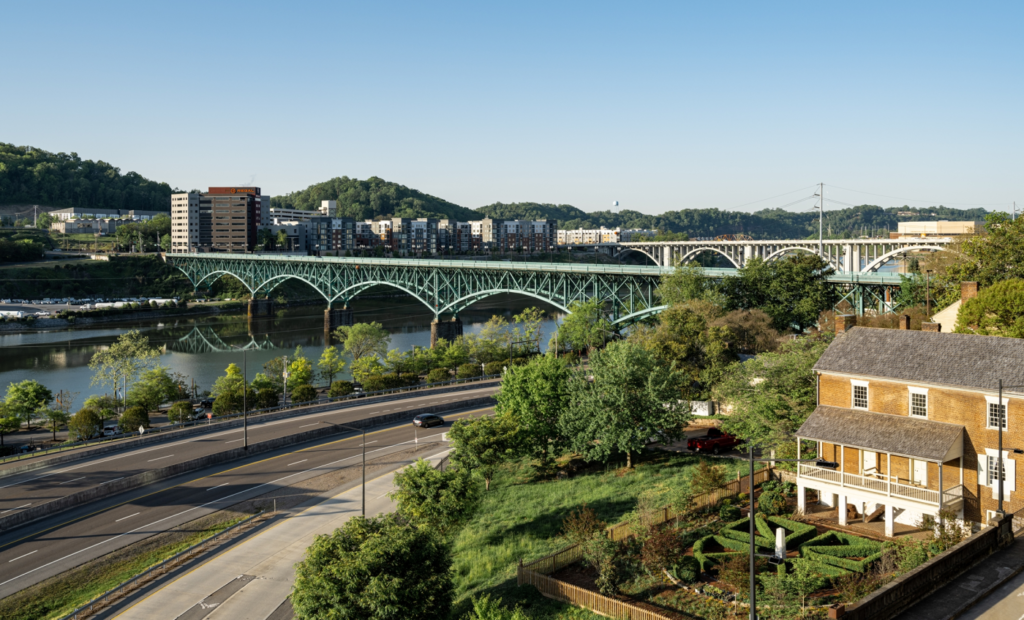
The Gay Street Bridge photographed in 2023 from the E. Hill Street viaduct, overlooking the Craighead Jackson House and Garden, by Shawn Poynter for the Knoxville History Project.
With the re-opening of the Gay Street Bridge in late 2025, to pedestrians and cyclists at least, it’s a good time to take a ghost walk back and forth across the bridges of old. And while it may be frustrating, and seem darn inconvenient, that we can’t drive across it any longer, the current structure has endured far longer than any of its predecessors—at least a century longer than any of the bridges that stood on this same spot.
In olden times, folks across the river from downtown sometimes referred to themselves as “South Americans.” A sense of remoteness, if not “otherness” may have suited them just fine. Maybe that still holds true for some South Knoxvillians today.
And while you don’t have to go far at all today to cross the river via another bridge, during the 19th century the only options included swimming across or, if you could afford to, paying the ferryman.
The first official ferry service commenced in 1792, when Knoxville, the fledgling settlement and new capital of the Southwest Territory, was only a few months old. Alexander Cunningham (son of one of the city’s first commissioners, Paul Cunningham) gained permission from city court to operate a ferry from the south side of the river to the mouth of First Creek. Soon after, the city’s founding father James White operated a ferry from his landing on the north bank over to the south bank. It’s not clear how these ferrymen coordinated their services, if at all, but references to various legal disputes suggest that relations could be occasionally testy.
Seven decades would pass before a bridge of any description connected both sides of the Tennessee River (then known as the Holston). The first one was a military pontoon bridge, generally comprised of a series of wooden “box boats,” some made from canvas, strung together. Built by the Confederate Army, Union Army soldiers confiscated it during a raid around Lenoir City in 1863 and brought it to Knoxville by rail, positioning it across the river east of First Creek. It didn’t last long before it deteriorated.
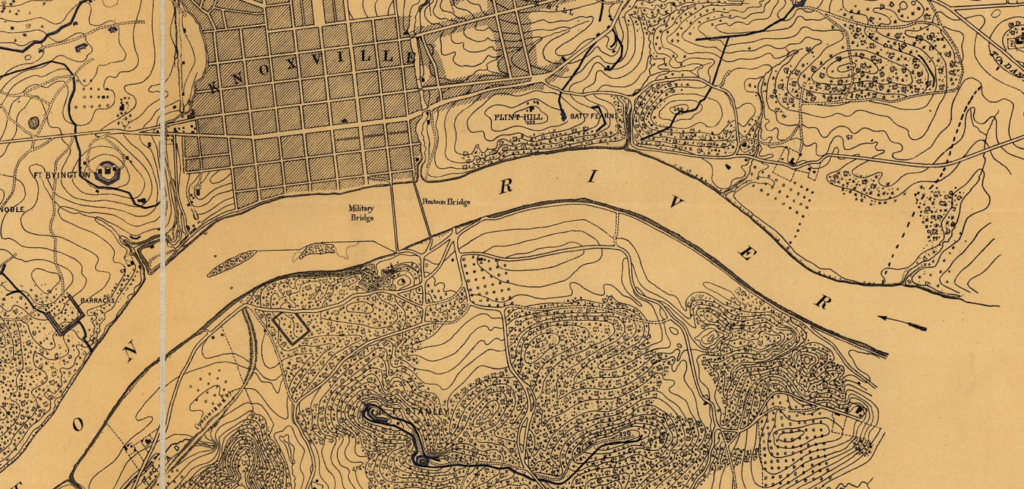
The two Union Army bridges as shown on “Topographical map of the Approaches and Defenses of Knoxville, E. Tennessee, surveyed by Capt. O.M. Poe, Chief Engineer Dept. of the Ohio, during Dec., Jan., and Feb., 1863-1864.” (Library of Congress.)
The following year, the Union Army replaced the pontoon bridge with a more permanent bridge, closer to the mouth of First Creek, that lasted beyond the end of the Civil War—but not much longer. What was dubbed the “Great Freshet of 1867” tore it to pieces.
In early March that year a wild weather event occurred, pounding the surrounding area with torrential rain that didn’t abate for the best part of a week. Enough rain fell, combined with much melting snow from higher elevations, to swell the river over its banks as well as First and Second Creeks. City founders had been shrewd with their site selection in the early 1790s when they deemed the elevated plateau between the two creeks to be high enough to escape flooding (they thought it might also thwart surprise attacks by warring Indians as well). At least this has proved to be true on the high ground where the Knox County Courthouse is—it’s never known to have flooded around there—but the same could not be said for the northern part of town, which before the Civil War was where the railroad station was sited, amid a low, marshy area that frequently flooded and caused problems.
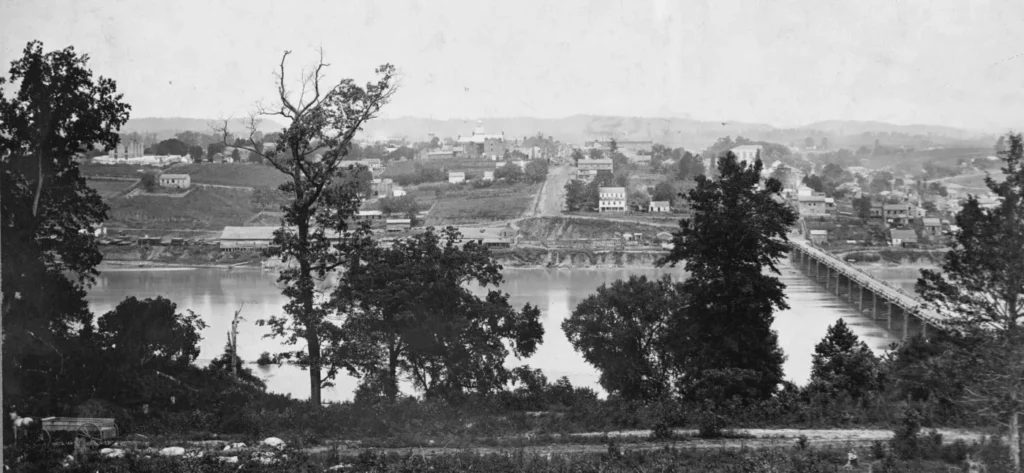
This view of downtown is taken from the south shore of the Tennessee River during the Civil War. To the right is the first proper bridge, built by Union engineers and soldiers, replacing an earlier pontoon bridge. Note that it is not aligned with Gay Street, like the Gay Street bridge is today, but rather a little to the east around the mouth of First Creek. (Library of Congress.)
During the 1867 flood, few structures along the riverfront, below the bluff, proved to be strong enough to withstand the relentless deluge. Along with numerous houses, warehouses, and several mills, the Union Army bridge was completely washed away early one morning. After the rain finally stopped and the water receded, whatever was left standing was caked in mud.
Those relying on cross-river travel for sustenance, business, or pleasure (whatever that might have been back then) would have to wait six more years for a replacement bridge.
Just like today, funding rarely appears overnight. As Knox County government had taken over ownership of the military bridge, it needed to raise sufficient capital to build a new one. But local leaders persisted, and with some fanfare, they celebrated the completion of a new bridge on October 13, 1873. You can bet it was a joyful day when regular folk could tramp across the bridge and maybe even bring along their cattle or a wagon full of crops to market rather than navigate the river via the ferry. The ferrymen, themselves, might have been peeved at losing business unless they had their fingers in other pies. But they didn’t have to wait too long before demand for ferrying returned.
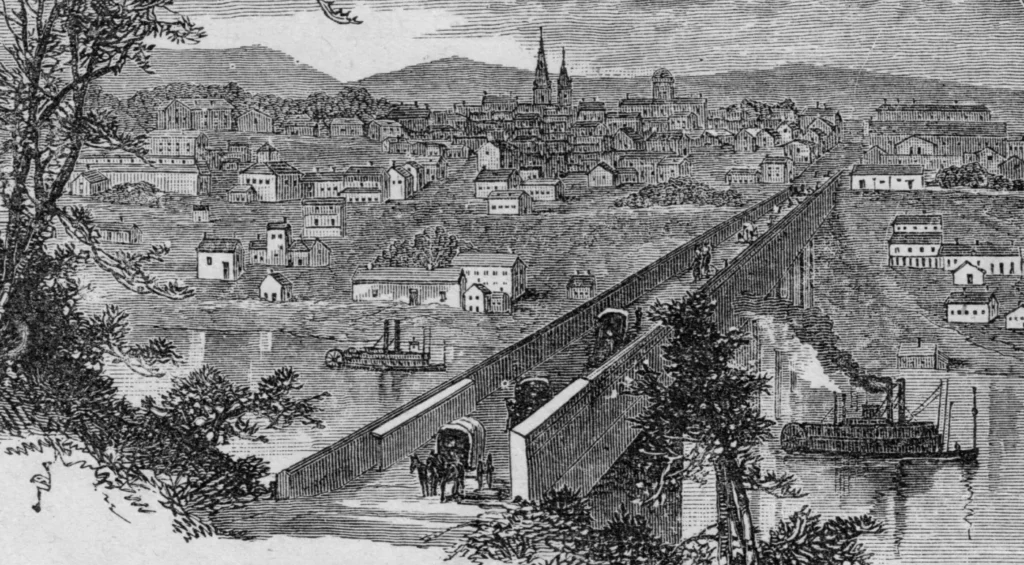
A speculative 19th century drawing of what the first, non-Union Army bridge might have looked like. Taken from Mitchell’s New Immediate Geography, 1881. (Alec Riedl Collection/Knoxville History Project.)
Less than 18 months passed before another great flood tore through the Tennessee Valley and inundated Knoxville. In February 1875, practically every small bridge on First Creek was washed away in short succession like dominoes. As the deluge rushed toward the mouth of First Creek, it crashed into the Atkins sawmill, then only six years old, after being lost in the 1867 flood.
As reported by the Daily Press & Herald, “[it] was a day long to be remembered by the citizens of Knoxville. The entire population old and young gave up the day to curious gazing on the mad waters of the turbulent Tennessee as they rushed swiftly by the city carrying on their crests articles of all descriptions; houses, barn, hay-stacks, hen coops, logs, fencing, etc.; with now and then a barn floor with frightened cattle on it turning their piteous eyes toward the banks in mute appeal for friendly aid, all passed by in rapid, continuous succession.”
In addition to those frightened cattle, one person witnessed a large haystack with a cow munching calmly on it and a raft with chickens on it floating down the river. It must have been a curious time.
The river bridge survived this winter flood—but it’s possible it may have been weakened because less than three months later, a whirling storm, with very strong winds, quickly tore the bridge away in sections rapidly from pier to pier.
Everyone vacated the bridge except for three men, including G.P. Ford, the “bridge tender” (who collected crossing fees as Knox County aimed to recoup some of its costs by operating it as a toll bridge) along with one white and one Black man. Again, the writers of the Daily Press & Herald painted a dramatic description of the manic event that followed. “The three men were by no means easy in their minds as the storm raged, and when the tremulous motion and ominous swaying of the bridge conveyed to their affrighted souls the presence of immediate danger, they stood not upon the order of their going but went at once, incontinently flying towards Gay Street. As they ran the crashing timbers behind them impelled them to still swifter flight. Arrived on the approach of the bridge, and in comparative safety, they fearfully looked back, and saw the great superstructure lifted upward, and then dashed altogether into the river below.”
The new county bridge across the river was no more. This time it would be veteran ferryman Jack Jones who would swing back into action to meet the sudden demand for ferry services at this spot on the river. Further east, Jesse Simpson ran another ferry from a launch in the general vicinity of where the South Knoxville bridge (completed in 1983) crossed above Island Home Avenue today.
As Knoxvillians came to expect, another six years went by before a new bridge arrived. Completed in early 1881, the “County Bridge” or the “Saulpaw” bridge (named after contractor George Saulpaw) soon gained a solid reputation, being championed early as “the most popular promenade about the city.”
And while the new bridge wasn’t to endure a ghastly fate at the hands of a flood or a storm, it certainly had its problems. For one thing, it proved to be rather narrow. In Over the River: One Hundred Years in the Life of South Knoxville Baptist Church, 1889-1989, the bridge was described as a “dreadful wooden toll bridge…which was only 15 feet wide with no walkways.” It was also considered unsafe for trotting horses.
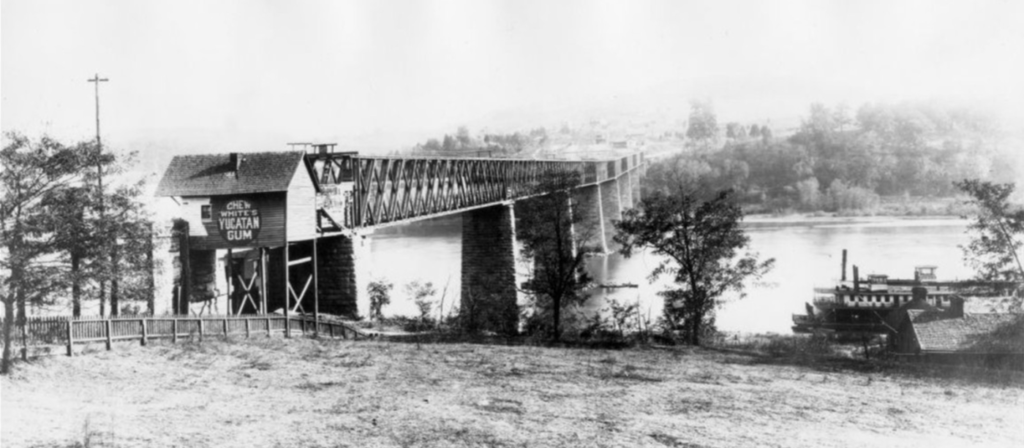
The old Knox County Bridge built by George Saulpaw in 1881. (McClung Historical Collection.)
Members of the parish began to voice their concerns about the bridge’s safety to Knox County officials, who put together a safety committee to inspect it. They did subsequently deem it to be safe, advising that several more years of life should still be left in it, but local residents persisted in advocating for a replacement.
However, according to notes from Knox County Court in 1895, the bridge was cited to be “dangerous for those who travel over said bridge on foot, meeting as they do every day wagons, drays, carriages, buggies, horsemen.” An official report also recounted “the perils of navigating the flow of cattle, hogs, and sheep, on a narrow bridge without a formal walking lane.” And on top of that, each end of the bridge had a steep grade leading up to it, especially on the north shore, which meant it was difficult to haul heavy loads across.
But these hazards didn’t discourage people from using it. From the bridge, many folks loved to watch boat races and the large steamers on the river, as well as look down and see trains passing on the tracks along the shoreline just like the Three Rivers Rambler does occasionally today.
As we saw recently in “Ghost Walking the Streets of Knoxville: Prize Steers, Peddlers, and Pool Halls,” wealthy businessman Col. Perez Dickinson loved to show off his prize cattle downtown. In 1885, he brought his prize, 1,200-pound hog, named Jumbo, and a host of other pigs, from his Island Home farm, on a wagon along Island Home Pike to the county bridge. Bridge tenders had to take down the low-hanging bridge sign to allow the porker and the procession, all led by Col. Dickinson himself in his carriage and accompanied by a “colored brass band, to enter the bridge on the south side.”
In 1896, Knox County finally announced that the bridge needed to be replaced and accepted a bid by the Youngstown Bridge Company of Ohio to build a new steel bridge. The construction of this bridge, what we call the Gay Street Bridge today (and back then it also went by Tennessee River Bridge), took a slightly skewed direction across the river, its southern terminus was slightly west of the where the Saulpaw bridge connected to the south bank. This creative approach allowed the existing bridge to remain in use while the new steel one was completed—it opened for traffic in July 1898, with generous six-feet wide walkways for pedestrians, and streetcar tracks that would extend trolley services across the river.
The current Gay Street Bridge has a history all of its own, which is another story. But take a walk over it one day. At least you won’t have to watch for car traffic. Or wait for the ferryman.
By Paul James, February 2026
“Ghost Walking” is my own take on life on the city’s streets in bygone times; how these streets and their buildings have changed through the years, and how through old pictures and stories we can glimpse the echoes of people’s past lives and particular events. Some of the photos featured in this series are included in Downtown Knoxville that I co-authored with Jack Neely, and part of the popular “Images of America” range. If you’re looking for spooky ghost stories, please allow me to direct you to historian Laura Still’s book, A Haunted History of Knoxville, and her “Shadow Side” walking tours. Laura has been leading historic walking tours for years and she also generously donates a portion from most of her tours to the Knoxville History Project. Learn more at Knoxville Walking Tours.






Leave a reply