
For the curious out there, there is one paved section of town that sounds a little more interesting than most: Crooked Street. This is the old name for Walnut Street that has fascinated a few Knoxvillians for years. Just like it did during much of the 18th and all of the 19th centuries, the street runs all the way from the river up to the Catholic church on Gallows Hill.
As you may guess from the name, it’s not quite a straight shot like all the other grid-like south-north streets running through downtown. There’s a distinct dogleg at Walnut and Cumberland by the Jame Park House and St. John’s Episcopal Church, hence how it came to be called Crooked Street. How official this name ever was isn’t easy to discern. It’s a common phrase in old newspapers, yet there’s little mention of Crooked Street in the city directories, only in 1869. And that’s not the end of the puzzle, which we’ll come to shortly.
Before Knoxville was founded in October 1791, Gen. James White, the first white settler to make a home here, arriving in the mid-1780s, owned 1,000 acres on the plateau above the river between what we know today as First and Second Creeks. Immediately after the new town was named (by the governor of the Southwest Territory, William Blount, after his superior, Gen. Henry Knox, Secretary of War) James White’s son-in-law, Charles McClung, surveyed a quadrant of his land close to the river and divided it into 64 half-acre lots. The names of Knoxville’s first streets changed a bit during those early years, but in time, the addresses of those living on the western edge of the quadrant (mostly names of men we know very little about) became known as Crooked Street because the road, for some reason that’s a little unclear, needed to go around the James Park house. It’s been suggested that McClung named the original streets after those in Philadelphia, of which there is a Walnut Street. (Incidentally, Gay Street is named after a Baltimore street.)
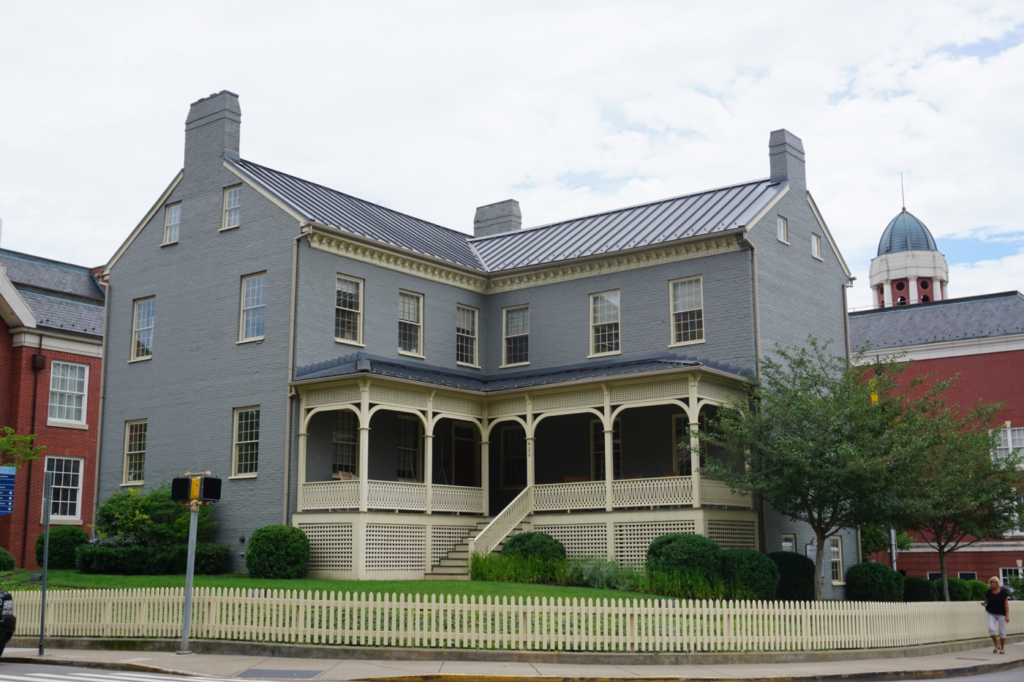
The James Park House dates to 1812 and houses the headquarters of the Gulf & Ohio Railroad. (KHP.)
The James Park house is one of the oldest buildings downtown, second only to Blount Mansion (or third if you count James White’s original cabin). Gen. John Sevier, that inspirational though complicated frontier hero, once owned this lot and attempted to build here in the late 1790s. It’s said that he didn’t progress much beyond the foundation. Like many of the early settlers, he was land rich but cash poor, so he sold the property and later spent time at his South Knoxville “plantation,” what we call Marble Springs today.
After a quick succession of owners, Irish immigrant and merchant James Park purchased the lot and in 1812 completed the building we see today. It would have been a convenient location for one who served as mayor as he did twice (1818-1821 and 1824-1826). In his second term he helped oversee forward-looking road improvements around town and may well have known his street as Crooked Street. Park’s son, the well-regarded Presbyterian minister, also named James Park, lived here all his long life until the early 20th century. After the house passed out of the Park family, it became the location for a Red Cross “War Workshop,” part curiosity shop/tearoom where women volunteers raised funds for soldiers and their families. First aid and nursing classes were held here too.
Restored about 20 years ago by the Claussen family, the house serves as the headquarters for the Gulf and Ohio Railroad that owns many of the short-line railroads around town.
It’s been suggested that the reason Crooked Street was so named is because the street had to go around the Park House. That would mean that Sevier’s original foundations or Park’s construction exceeded the size of all the other lots that sat north of it on that early street. Or did the streets that we know today actually solidify only after the Park House was completed. Either way, the lot is wider than all the lots to the north.
St. John’s Episcopal Church has stood on the just to the north since about 1862. The current building, now called a cathedral, dates to 1892 when efforts rebuilt much of the original church in a Romanesque style designed by Ohio architect Joseph Yost. It was here that the family of English-born Frances Hodgson Burnett worshipped briefly in the late 1860s and early 1870s.
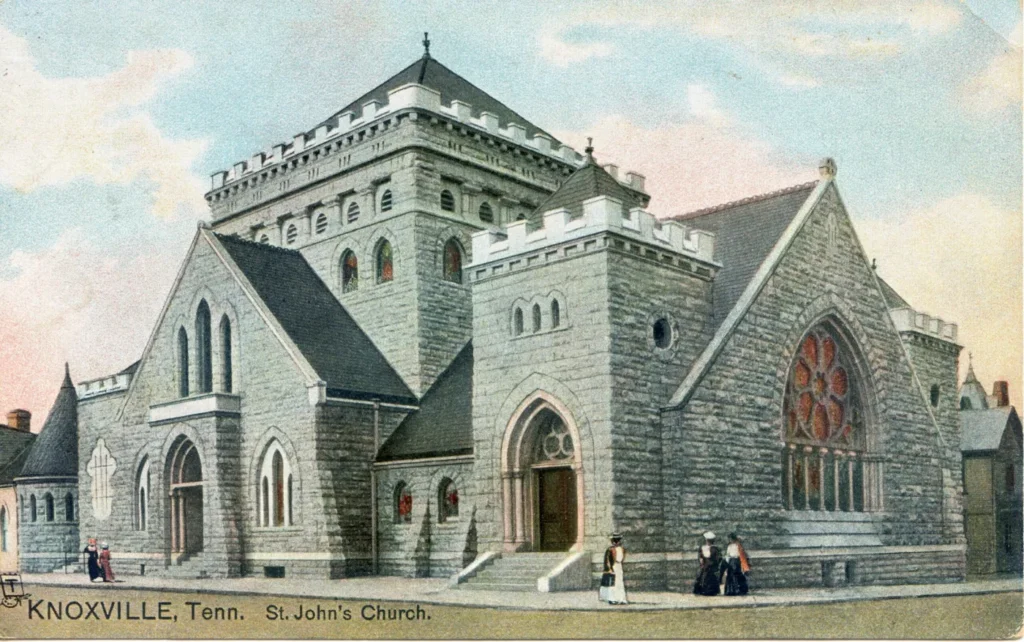
A vintage postcard of St. John’s Episcopal from the early 1900s. (Alec Riedl Knoxville Postcard Collection/KHP.)
In the early 20th century, Knoxville’s own literary son, James Agee, was baptized here and later would sing in the boys’ choir. His uncle Hugh Tyler would gain a commission to paint parts of the church’s interior in 1919. According to writer Paul Brown, Tyler’s contributions “included stenciling on the walls, arches, ceiling, and even designs for a couple of new, smaller stain glass windows.” After a subsequent fire, Tyler returned to redo his work.
Another artistic connection here is Charles Krutch. Particularly known in Knoxville for his paintings of the Great Smoky Mountains in the early 20th century—some called Krutch “the Corot of the South.” He also played the organ here in his day. Across Walnut or Crooked Street, opposite St. John’s, one of the Knoxville History Project’s Downtown Art Wraps features a Smoky Mountain painting of Krutch’s on the traffic signal box there. And right there is also a sunken courtyard, part of the mid-1980s John Duncan Federal Building. Its central feature is a large piece of art called the “Knoxville Flag,” designed in 1992 by Nizette Brennan, which, according to the plaque says that it was “commissioned for the United States by the General Services Administration Art in Architecture Program.” However, the design bears no relation to the city’s original flag designed by the esteemed Lloyd Branson back in 1896. Interestingly, a Wikipedia entry describes it as “the third oldest official city flag in the United States and the oldest flag of any state or city governmental entity in Tennessee.” It would appear that we don’t celebrate that fact, if indeed it is even true.
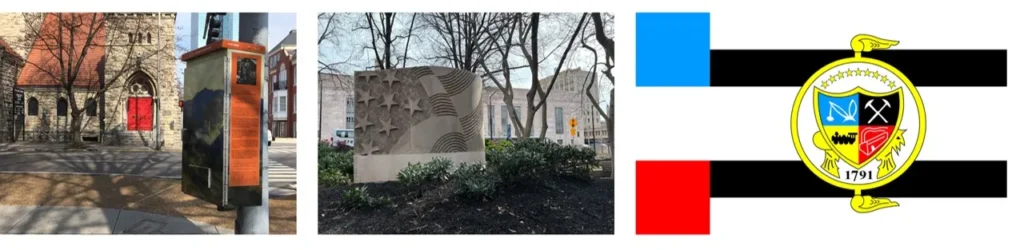
Crooked Street art, including a Downtown Art Wrap featuring a Smoky Mountain landscape by Charles Krutch, the Knoxville Flag sculpture, and Lloyd Branson’s original 1896 design. (KHP.)
Across the street again, this time to the southwest corner of Walnut and Cumberland, again right where the dogleg is, is an unremarkable parking lot for postal employees, but it was here where once stood the house of another Knoxville mayor, William Gass, who served in the role for just one year in 1904-1905. Several notable projects came to fruition during his mayoral term, including two railroad stations, the Southern Railroad Station on Depot Street, and the L&N. Gass is one of the city’s more mysterious of our mayors, as about a decade after his mayoral term, he was charged with bank fraud. It’s not known if he served prison time before leaving town.
In 1907, leaders of the Woman’s Building on Main, the one that burned down the year before (see “Ghost Walking Around the Former Whittle Communications Buildings on Main Street“), didn’t need to go very far to find a suitable location for a new arts center. They recognized much potential in the Gass home after it became available, and envisioned an addition complete with art exhibits space and an auditorium. They would call this new place the Lyceum Building, which lasted about a quarter of century. Later, the Lyceum hosted women’s suffrage activities and banquets before being demolished to make way for a new Federal building.
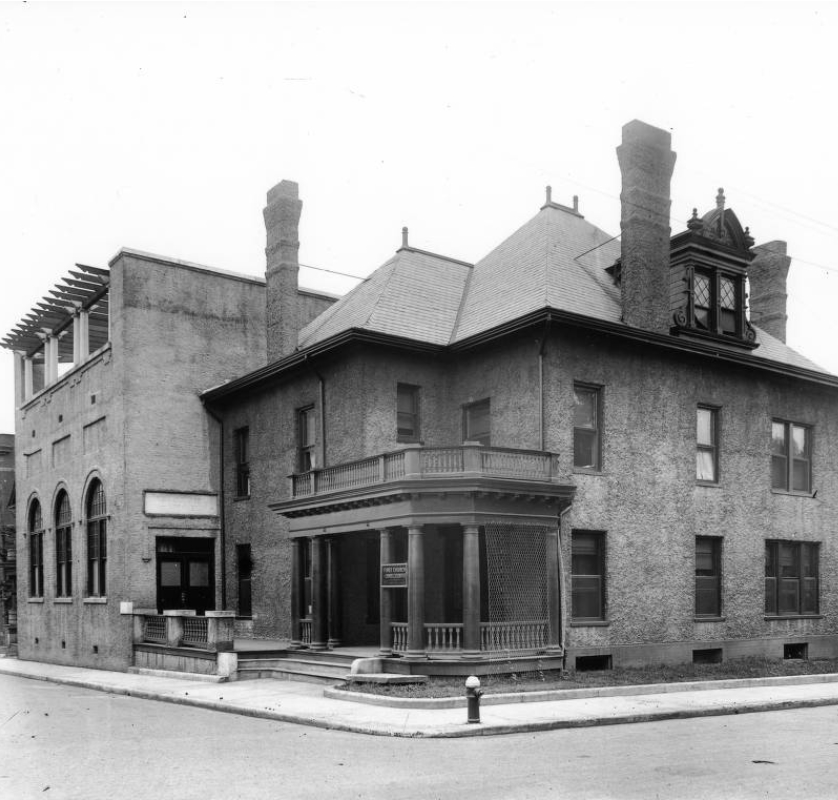
The old Lyceum Building on Walnut Street at Cumberland Avenue, circa 1931. (McClung Historical Collection.)
The downtown post office that opened here on the western flank of Walnut in 1934, served as the city’s postal headquarters for more than 50 years before it moved out west to Weisgarber Road. Still, it resides in a building of style and distinction. Local architects Baumann and Baumann designed it in a neo-classical style. When you enter, note the stylish art deco golden eagles that adorn the doors.
Running along Main Street, between Walnut and Locust, the post office and its interconnected federal courthouse was where Judge Robert Taylor famously ordered the desegregation of Clinton High School in 1956. It now serves the Tennessee Supreme Court. It’s also fun to look inside and see if you can find ancient fossils embedded within the marble walls. And if you’re familiar with the Frist Art Museum in Nashville, you’ll recognize it was designed in a similar style. (The Frist building was also completed about 1934 and housed a post office too. The remodel to accommodate the art museum occurred in the early 1990s.)
But one of the coolest sights downtown can be found on the southeast corner of the building, and along Main, where you can look up and see majestic marble eagles, of which there are four, that adorn the building’s pediment. These sculptures are among the most remarkable of all the carvings made by Albert Milani, a stone cutter from the Carrara region of Italy. It’s been said that he arrived in Knoxville about 1910 with only 25 cents in his pocket, but he eventually developed a long career as the foreman with the Candora Marble Company in South Knoxville. Made from Tennessee Marble, the eagles perhaps remain the most enduring symbols of Knoxville’s claim to be the Marble City.
On the southwest corner of Walnut and Main, on the corner of the First Baptist Church lot, you’ll find another art wrap featuring a photograph of Milani and one of his eagles that gives a sense of proportion to his creations.
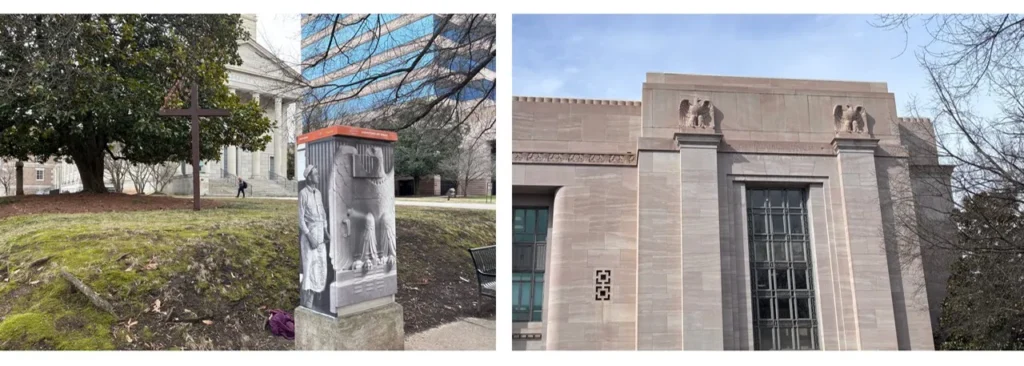
The Downtown Art featuring Albert Milani in front of First Baptist Church, and two of his eagles on the Supreme Court/Post Office Building on Main Street. (KHP.)
For a long time, First Baptist Church stood on Gay Street where the Journal Arcade building is today, but moved into a new church building here in 1924. So, along with the James Park House and St. John’s, the church is another building that has lasted more than a century on this section of Crooked Street. In eight years’ time, the post office building will join that list.
Much further back, 158 years to be exact, just after the Civil War, a violent confrontation took place on about this spot. In July 1868, former Confederate officer Henry Ashby stopped by the office of Major Eldad Cicero Camp, a former Union Officer, at Main and Crooked Street. The two men had quarreled for some time about the war—Ashby felt aggrieved by something Camp had done against him. Camp denied it, claiming he never knew Ashby and had only moved to Knoxville just after the war ended. At any rate, the pair exchanged heated words in Camp’s office and then clashed in the street whereby Ashby allegedly struct Camp with his cane, and then Camp shot Ashby multiple times in the head and chest. Camp was duly arrested, but he posted bail and was eventually acquitted. In his later years, Camp became wealthy from his Coal Creek Coal Company and gained some renown as a philanthropist. The YMCA and local libraries benefitted greatly from his generosity. His Broadway house, Greystone, has for years now been the home of WATE TV. Both are buried at Old Gray Cemetery.
By Paul James, March 2026
“Ghost Walking” is my own take on life on the city’s streets in bygone times; how these streets and their buildings have changed through the years, and how through old pictures and stories we can glimpse the echoes of people’s past lives and particular events. Some of the photos featured in this series are included in Downtown Knoxville that I co-authored with Jack Neely, and part of the popular “Images of America” range. If you’re looking for spooky ghost stories, please allow me to direct you to historian Laura Still’s book, A Haunted History of Knoxville, and her “Shadow Side” walking tours. Laura has been leading historic walking tours for years and she also generously donates a portion from most of her tours to the Knoxville History Project. Learn more at Knoxville Walking Tours.






Leave a reply