
Why the Masonic Temple’s fate matters even to people who don’t know the secret handshake
The latest news about the Masonic Temple, at Locust Street and Union Avenue, is troubling.
My last column (Read Here) on the subject ended on an upbeat note. Late in the summer, I had communicated with a few Masons who were on the periphery of the issue of demolishing their 154-year-old structure, for an undisclosed future use. All the Masons I talked to, including a statewide officer in Nashville, were frankly in favor of saving the old landmark, perhaps with help of government grants, nonprofit help, or local investors. The last I had heard, there was so much controversy within the organization that we shouldn’t expect anything to happen to the property for several months.
I was told the chief local decisionmaker didn’t value the building because he knew little about its history. I thought maybe that was my fault. So I wrote a story about it, in hopes it would stir some positive interest. You could write a thick book about what has happened in that building, without even giving away any Masonic secrets. Those walls could relate a James Michener novel about the Gilded Age and beyond. If Danielle Steel were to cram all the love stories associated with that building into one thick paperback, people would complain that she was getting too fanciful.
Apparently, my story wasn’t convincing. Since then, the city has approved the Masons’ demolition permit, and lately I’ve been told they’ll start destroying the building soon. But at this writing, it’s still there.
Much of the Masonic power structure rests in the hands of a very few. And I’m not sure they get out much.
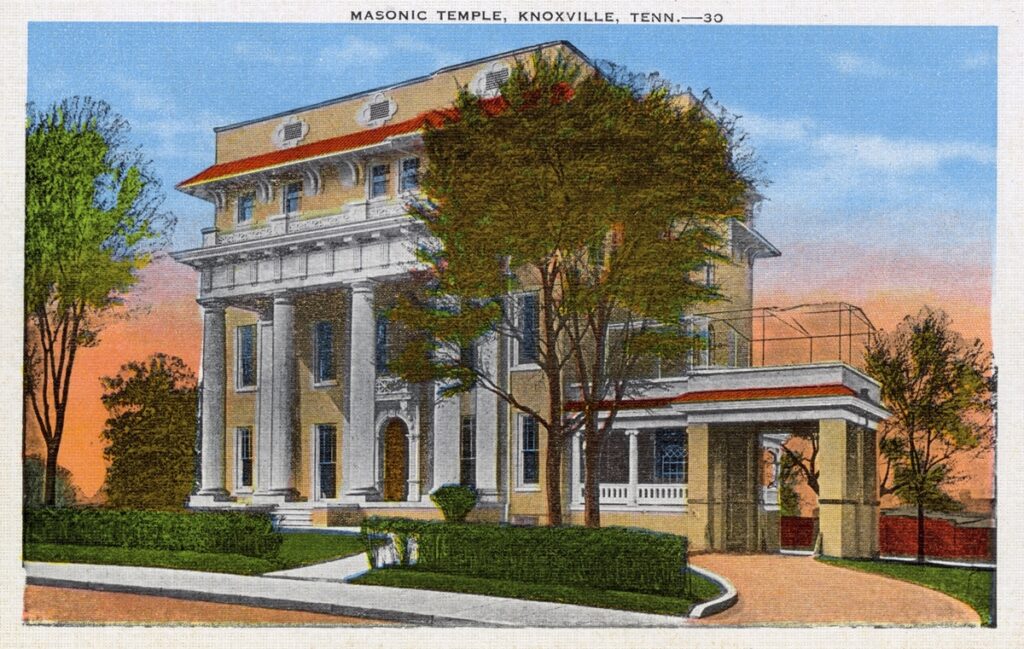
The Masonic Temple at 505 Locust Street. (Alec Riedl Knoxville Postcard Collection/KHP.)
With that fraternal organization, secrecy is not just a habit, it’s a sacred tradition. There’s much I’ll never know about the Masons. What I do know is that this is one of the oldest buildings in downtown Knoxville. It’s the first time since the 1970s that a historic building more than 150 years old has been threatened with demolition. It’s also the only time in my memory, or within my research, that any entity proposed demolishing a building without letting the public know what’s intended for the property, and what problems demolition would solve.
***
Some who may be better-versed in aesthetics than I am claim the building is not beautiful. It’s been painted a dull yellow as long as I can remember. It does have a top-heaviness to it. But it’s interesting to look at, especially if you know what to look for, that the door and the bay window in the south side remain intact from its strikingly different earlier but not-quite-forgotten persona. In 1991, the late architectural historian William Ross McNabb included the Masonic Temple among Knoxville’s 25 most significant works of architecture, in his book, Tradition, Innovation & Romantic Images. In that richly illustrated volume, published by UT’s McClung Museum—the only book I know of about Knoxville architecture—McNabb called it a “monumental classical structure,” describing the Masonic temple’s “robust, beautifully detailed Doric portico” as “one of Knoxville’s finest.”
As an architectural curiosity, it has personal undertones. Its radical makeover demonstrates the sea changes in taste of the very early 20th century. In the 1870s, it was a stylish mansion that could be called “Victorian,” though it was more in the Second Empire style of Napoleon III’s Paris, popular in America in the years just after the Civil War. This house was the creation of Joseph Baumann, and one of the first-known designs by that builder, a son of German immigrants whose career shift from builder to architect made him arguably Knoxville’s first full-time professional architect. No one alive remembers that original version of the exterior; we just have photographs.
But its rare double design is a family story, and whether it suggests a tale of fraternal rivalry is speculative. Albert Baumann, 17 years younger than his brother, partnered with Joseph to create the firm Baumann Brothers. Some 43 years after his big brother designed this house for Knoxville’s most successful and influential businessman, the architectural brothers split up. By then in his early 70s, Joseph was retiring. As it happened, younger Albert Baumann was a Mason, an officer in this particular lodge. Albert gave his big brother’s first mansion a radical redesign, rebuilding most but not all of the façade, to make it look like a properly solemn Masonic temple, with Greek columns. For whatever reason, architectural tastes throughout the English-speaking world changed around the time of the death of Queen Victoria. Neoclassical styles were all the rage. Hence the McGhee House / Masonic Temple has looked like it does since 1916.
Much of the 1872 interior known to financier-philanthropist-titan Charles McClung McGhee and his five lively daughters remained, though, the subject of legend among non-Masons as long as I can remember, until it was reportedly stripped out this September.
***
The Masons have been a part of historic Knoxville since the city’s earliest days. Knoxville had a Masonic lodge as early as 1800, when they met in a riverfront tavern called Love’s. Several early Knoxvillians, including John Sevier, Francis Ramsey, and Samuel Beckett Boyd, were members. They were a secret society, sure enough, but always downtown, and always out in public as civic leaders, proud of being Masons. You can tell by a walk through Old Gray Cemetery. Countless stones have Masonic emblems, suggesting they wanted to be remembered as members forever.
For many years after the tavern era, the Masons met in the county courthouse—then across the Main Street from what we know as the old courthouse. In 1867, the local chapter may or may not have enjoyed a nationally published story, “Eaves-Dropping a Lodge of Freemasons,” by often-outrageous humorist George Washington Harris, who was reportedly a lodge member, himself. Specifically set at the courthouse, it’s probably the first appearance of a Knoxville setting in American fiction.
Fire ruined an attempt to build a Masonic temple in 1868. Four years later, coincidentally the same year of Baumann’s McGhee House, they moved into the third floor of the new Luttrell building at Church and Gay, proud to show the public the frescoed walls of its colorful interior. For a few years after 1900, they were located on another third floor, above a produce store at the north end of Market Square.
The conversion of the McGhee House, on a design by one of their own members, represented the first time the fraternity had a freestanding building to call their own. But it wasn’t just for Masonic meetings. They welcomed the public to use their unique building. During its early 20th-century Masonic era, the building on Locust Street hosted game nights, nonprofit rallies, banking and judicial conventions, women’s bridge tournaments, dances, Welsh immigrant celebrations.
It was a familiar building to many Knoxvillians, regardless of Masonic affiliation, until sometime in the middle part of the 20th century, when for whatever reason it became much more private, an exclusive clubhouse for Masons.
Both of my grandfathers were Masons. My mother’s father, who died when I was a child, was a member, and had his Masonic funeral in that building.
Over the years, I’ve heard the interior was eerily intact, especially the woodwork, left just as it was when Mr. McGhee died in 1907, despite the subsequent makeover. But it’s been so rarely open to the public that I’ve known only a few people who’ve ever gotten to see it.
***
For Knoxville’s heritage, this demolition is a real loss. The building was, for 43 years, a home to several of our most dynamic citizens, especially the kingpin of our railroad-industrial era, Charles McClung McGhee, but also including a pioneering former governor of Wyoming, the young woman who’s memorialized by the name of our public library, and several others whose names occasionally appeared in the national news. It was also, reportedly, the site of our first telephone call.
This unexpected development is also ominous, and may reverberate beyond 505 Locust Street. It’s the only 19th-century building in central Knoxville proposed to be demolished in our own century. By the 1990s, it appeared, we had stopped tearing down our interesting old buildings. That acceptance that we’d take preservation more seriously has borne fruit, often without much public commitment of resources. Look around. Old buildings are marketable. They appear to be the basis of the explosion of interest in downtown Knoxville—and in Knoxville in general. Literally most new downtown businesses, our most celebrated new restaurants, more than half of the new residences of the last 30 years, and most of the music venues that impress visitors during the international Big Ears Festival are located in buildings built before 1930.
The Masons have never seemed to join the party. They’ve kept to themselves, and we’ve left them alone. They did host a two-hour open house a few years ago. I didn’t hear about it until later. In my long career as a journalist and historian, I’ve been all over downtown, on a couple dozen rooftops, I have been in tunnels under the streets, I’ve been backstage at the historic theaters, I’ve been a guest in cheap windowless efficiencies and elegant penthouses. I’ve been in all the downtown churches, and even spoken from three pulpits. But I’ve never been inside the Masonic Temple.
The Masons aren’t quite as exclusive elsewhere. Franklin, Tennessee, my father’s family’s ancestral home, has never been more populous and famous than it is today. I first knew it as a sleepy little town of about 10,000. Now it’s soaring toward 100,000. The oldest historic building in Franklin is the impressive three-story brick Masonic Temple. Just over 200 years old, it’s described as “the oldest public building in Franklin.” Public might seem an odd word to connect with a Masonic lodge, but in Franklin, the old lodge does host public events, chili dinners, tours, coffees, lectures, meetings of unrelated historical societies. They’ve hosted public state preservation awards presentations in that building. Tours of the lodge have been the subject of news features on Nashville TV stations. Franklin’s Masons work closely with the Heritage Foundation of Williamson County, and with their help they have recently received major six-figure grants from the state for maintenance and ongoing restoration. There, saving the old Masonic hall is believed to be a public good. In fact, that downtown Masonic lodge have been designated a National Historic Landmark. That’s a rare honor. In Knoxville, only Blount Mansion has Landmark status.
Franklin seems fond of its Masons, and proud of their historic building.
In my lifetime, Knoxville’s Masons have never been quite that involved in the community. I’ve heard people wonder about the Masons, sometimes make fun of them, but have never heard anyone sharply criticize them, or say they were bad people who were treating their neighbors decently. That is, until now.
The fact that the Masons would propose tearing down an iconic historic building is one thing, but the fact they would so without informing the public about why—citing a “non-disclosure agreement” with an unnamed third party, one apparently more important to them than their host city—raises questions that would not seem flattering to Masonic integrity.
For them, this decision has been, at best, extremely bad public relations. And it makes us wonder what they’re gaining from it. Several sources claim they’re sacrificing their longtime home for the sake of another out-of-state residential developer. If so, the city should expect more of that unnamed third party than the usual big box of luxury student housing we’re getting all too accustomed to.
Of course, the Masons will soon be gone from downtown, and won’t have to share our worries. But if we can’t stop this, what can we stop in the future?
***
Suddenly in the 2020s, everybody wants to be downtown. Why? It’s a great big county. There are places less hilly, places closer to big groceries and car repair and emergency medical care. And almost all other places in Knox County offer easier and cheaper parking.
We should admit downtown is no longer necessary for practical purposes. It’s no longer where we go to buy shoes or tennis rackets or automobiles. You no longer have to go downtown to do your banking or consult with an attorney or an accountant or an optometrist or a pastor. You no longer have to go downtown to mail a package or get your license and registration renewed. Most of those offices are now out in the suburbs, with handy free parking. Still, people crowd around downtown. Thousands of people live downtown now. Tens of thousands visit every week, both locals and now tourists, some speaking French and German, even when there’s not a festival or a ball game. Downtown is what travel writers and visitors talk about when they talk about Knoxville.
What’s attracting all these people? There’s nothing magic about its latitude and longitude. The only thing that makes downtown different from anywhere else in Knox County is its dense concentration of old buildings and real history. Even if people don’t know much about it, even if people don’t think they care, they like the feel of history, the beauty of old materials, the weirdness of mismatched levels, the curiosity of old signage, the resonance of what has happened before.
But we may be peaking. It has happened in other cities. People work for decades to build up the downtown, save the old buildings, made with materials no longer available, by skilled workers who no longer do that kind of work, especially not for what we’re willing to pay. And those who saved these old places do it so well, excite so much interest, that everybody wants to go there. And to accommodate the demand, developers, often corporate types from other states, see opportunities for quick profit. And start tearing down the old buildings to build bigger, cheaper ones.
Downtown Knoxville is a goose that laid a golden egg for us. But at some point, humans can’t resist the temptation. Bit by bit, we destroy what attracted people in the first place. We begin to eat the goose.
By Jack Neely (Oct. 9, 2026)






Leave a reply