
With the recent opening of Lone Tree Pass, the first major construction project on the 200 block of Gay Street in a century, it’s a good time to look back at this section of town.
As already mentioned in numerous stories on Inside of Knoxville, most recently Heather Ryerson’s “From Cal Johnson’s Lone Tree Saloon to Today’s Lone Tree Pass” on Aug. 8, the name of Cal Johnson continues to live on along this block.
Born in slavery to Knoxville’s McClung family, Calvin Fackler Johnson (1844-1925) would make a name for himself at the end of the Civil War moving the corpses of dead soldiers from regional battlefields and transporting many of them to Knoxville to be interred at National Cemetery, just a few blocks north of the 200 block. According to a 1954 Knoxville Journal story, Johnson was awarded a contract after sending what would be the lowest bid to Washington, D.C. and began moving dead bodies.
Cal Johnson was an extraordinary man. In time, he became a talented jockey (just like his father), and a highly successful horse trainer, racetrack proprietor (in South Knoxville by the river, and later in East Knoxville near Chilhowee Park), and philanthropist. He was also one of the most respected businessmen, and the wealthiest African American in the city, if not the region. He would ultimately erect two buildings within a block or two of each other and have his name on both of them. The one surviving building on State Street with the date 1898 on it, across from Marble Alley Lofts, has been renovated in recent years.
Cal Johnson also ran several downtown saloons.
In the late 1870s, he took over ownership of the Poplar Log Saloon that stood on Gay Street at Wall Avenue, and by 1886 moved it to the southwest corner of Gay and Vine. He ran another Poplar Log Saloon down at Vine and Central during the same era. Another saloon he owned was in the Fouché Block, the old 1875 Gay Street building that once stood where the East Tennessee History Center is today.
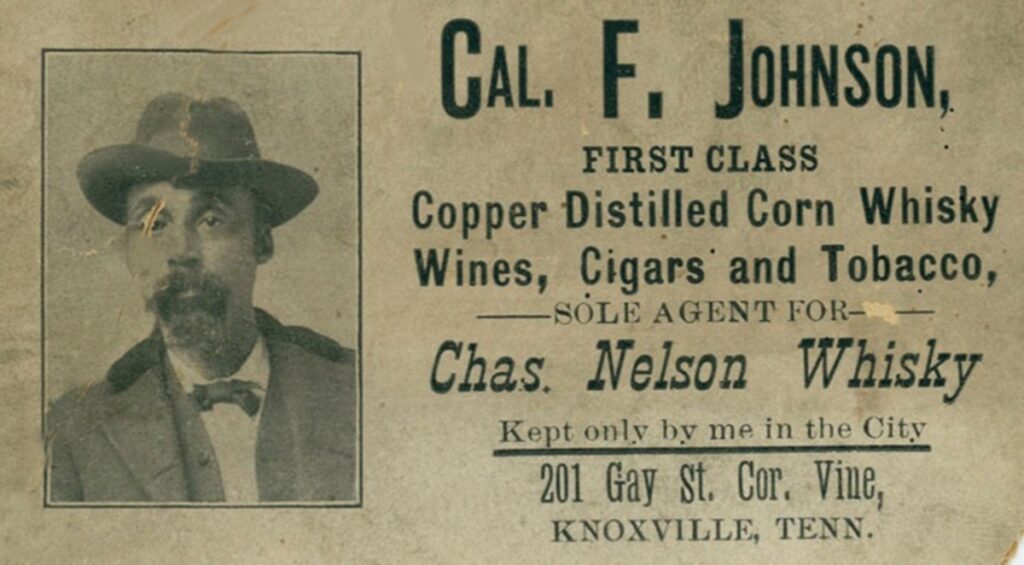
Cal Johnson’s business card. Although the card doesn’t mention the name of his saloon, the address at 201 S. Gay places it at the corner of Gay and Vine. (Courtesy of the Beck Cultural Exchange Center.)
According to a Knoxville Journal article in 1934 (almost a decade after Johnson’s death), the Poplar Log Saloon derived its name from several lumber plants across the river, such as D.M. Rose Lumber and Vestal Lumber. Huge quantities of “poplar logs” were floated down the river to these plants and for years many lumbermen came into town to drink at that saloon.
Johnson’s impeccable reputation extended to his saloons. According to columnist Bert Vincent in his regular “Strolling” column in the Knoxville News-Sentinel, Johnson “never sold liquor on Sunday. He never sold to minors. He never sold to drunks.” It would appear that Johnson never opened his saloons on Christmas Day either.
Before local probation began in 1907, the Poplar Log at Gay and Vine had become known as the Lone Tree Saloon, named for an ash tree, the very last tree standing on Gay Street, right in front of it. Johnson, a lover of flowers and trees, had taken great care of it and even employed a tree surgeon to monitor its condition in years to come.
When Knoxville’s more than 100 saloons were about to close, Halloween that year was the last night one could buy a drink in an establishment for many years—beer would return in 1933, but liquor by-the-drink would not be legalized until 1972.
When all the saloons closed their doors, Cal Johnson retired from the liquor business but ran a soda foundation on the corner of Gay and Vine, while also concentrating on his stables and other business affairs.
Also in 1907, two married Jewish immigrants from Warsaw, Poland, arrived in town with little in the way of money and belongings. After a bleak spell out of work, Louis Tobe eventually found a job carrying stone for a post office building project in town, and with a small savings fund he quickly built up, opened up a tiny “hole in the wall” shoe repair shop within Cal Johnson’s building at Gay and Vine. A few months later, after saloons were outlawed, Tobe continued to stay in his little hole and remained there for many years.
Over the years, Bert Vincent found Tobe to be a source of fascination. In 1956, the year before Tobe died, Vincent wrote a short article about the cobbler, including how in 1919 Tobe took on a 99-year lease on Johnson’s old property and built a new building. On the street front now, he continued his shoe repair business, carrying on the naming tradition with the Lone Tree Shoe Shop. His wife Sarah would run a dress shop in the back for years, too.
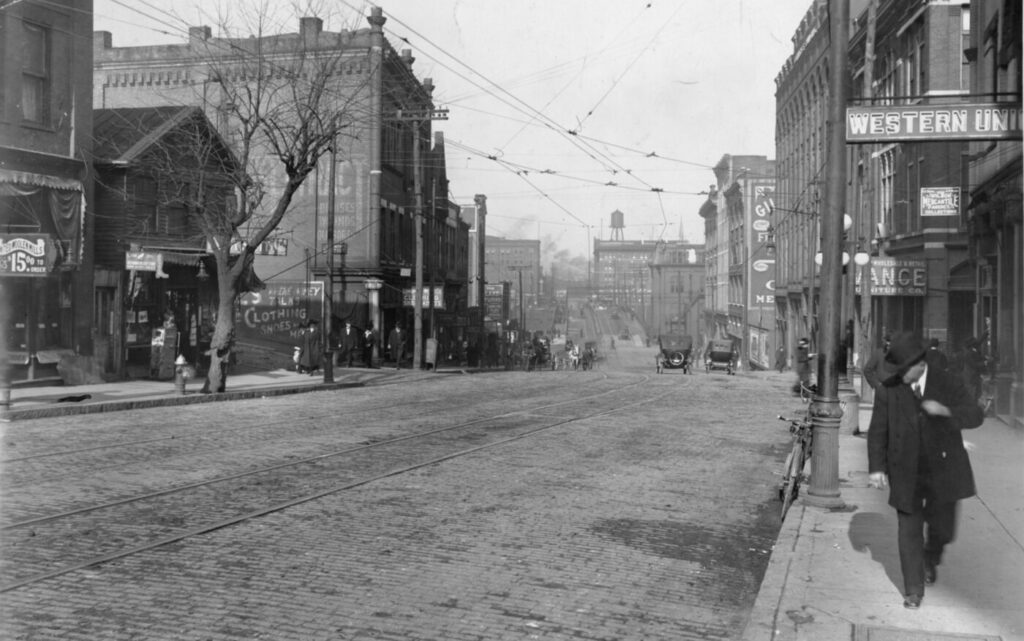
Looking north from the 200 block of Gay Street, circa 1920. On the left is the wooden building that Polish immigrant Louis Tobe built on the spot of Cal Johnson’s Lone Tree Saloon and ran his own Lone Tree Shoe Shop here. (McClung Historical Collection.)
Walking three miles to work and back home each day, Tobe proved to be a bit of a Knoxville character. One of his quirks perhaps was how, just like Cal Johnson had done, he fussed over the lone tree. By the time that Johnson died in 1925, the tree had begun to droop badly, with its roots mostly covered with concrete. In 1929, the tree finally perished and the city removed it.
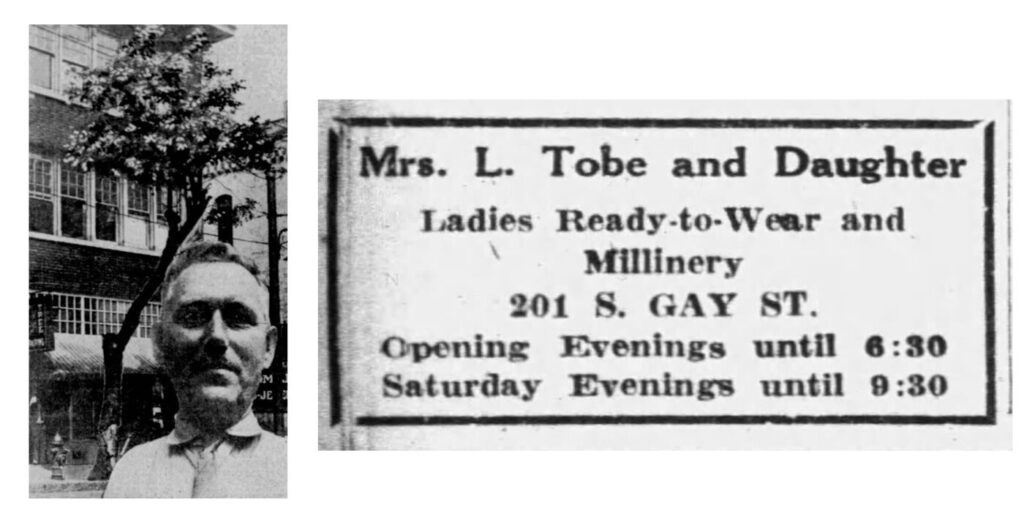
Newspaper clippings of Louis Tobe in front of the “Lone Tree” in 1926, and an advertisement for his wife and daughter’s milliner’s shop at the same address. (Knoxville News-Sentinel.)
In 1962, Vincent picked up the Lone Tree story again and commented that the closest tree to Gay Street was then an old Buckeye on the lawn of the Knox County Courthouse.
Vincent also noticed how some similarities of Tobe’s story jived with that of Italian immigrant Fiorenzo Rebori, who sold fruit and peanuts in a lean-to building right across the street from the Lone Tree Saloon, adjacent to the first Lawson McGhee Library. Rebori purchased that building in 1904 and continued to own it for several decades, while continuing to peddle his offerings right on the street.
In those early days of the 20th century, across the street from the Lone Tree Shoe Shop, on the east side of the 200 block, were durable businesses such as the George Brown wholesale store, and the dry goods and milliners shop McNulty & Borches.
More notable than most was Chapman Drug. For years its charismatic White Lion statue, advertising the White Lyon brand of drugs, stood conspicuously on the sidewalk.
Founded by entrepreneur John Ellis Chapman in 1882, the company’s latter-day proprietor was his son, David, who became widely known as a successful businessman and civic leader. Through his considerable efforts as leader of the Great Smoky Mountains Conservation Association, Col. David Chapman (he served statewide during the 1898 Spanish-American war and took charge of the Fourth Regiment of the National Guard headquartered in Knoxville during World War I) helped establish Great Smoky Mountains National Park. Chapman Highway, the road leading to the mountains, is also named after him.
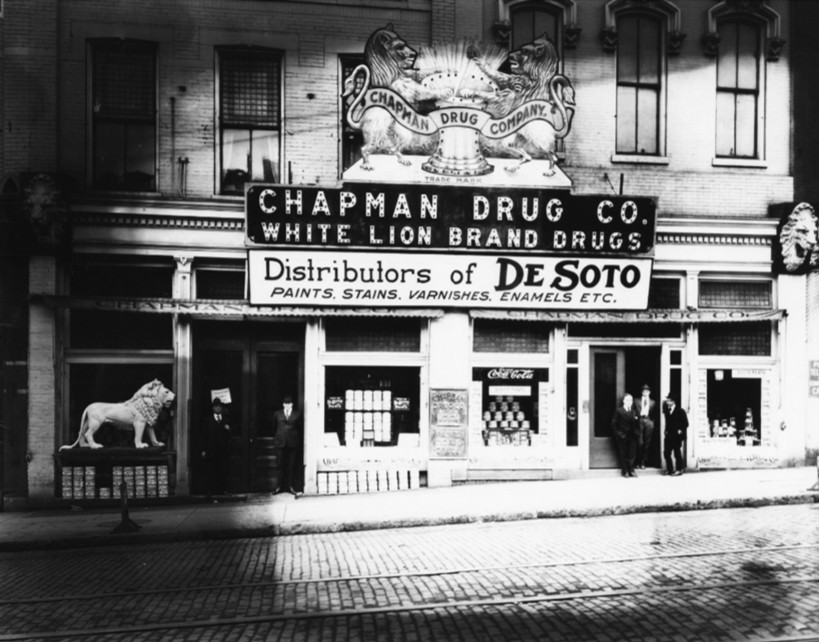
Chapman Drug Company on the west side of the block at 214 S. Gay Street, circa 1919. (McClung Historical Collection.)
The perennial white lion stood where the Cradle of Country Music Park is today, before Chapman Drug moved to a new location on State Street in the early 1920s.
Back on the west side, by the 1920s at least, the 200 block included a handsome row of businesses, including jewelers, clockmakers, and shoe shops. Back then, this block was just another block on Gay Street, an uninterrupted line of shops and businesses and theaters, from the Gay Street Bridge to the viaduct across the railroads tracks just one block north of here.
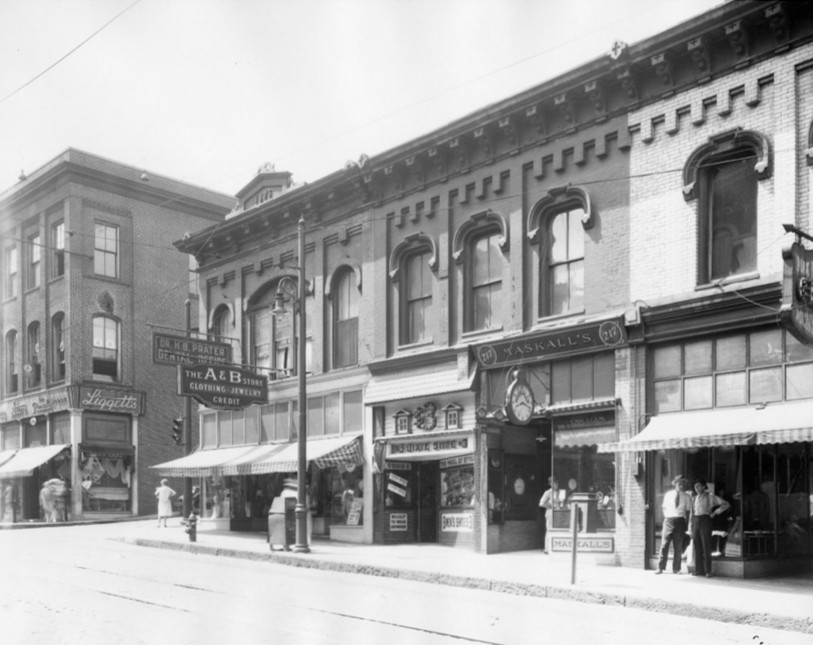
The east side of the 200 block at the intersection of Gay and Commerce Avenue, looking south, circa 1927. The building to the far left is now 301 S. Gay Street, currently the official Visitor’s Center run by Visit Knoxville. (McClung Historical Collection.)
Coming up in part two of this story, we’ll take a look at how this block went downhill (literally and figuratively) in the 1970s. In fact, it would be completely obliterated by the Summit Hill Drive road construction project during the early-mid 1970s.
~ Paul James
Note: For more on the history of Cal Johnson, check out the Beck Cultural Exchange Center’s self-guided “Cultural Corridor Trail: Reclaiming Knoxville’s Black History, one landmark at a time” at: https://www.beckcenter.net/the-corridor
“Ghost Walking” is my own take on life on the city’s streets in bygone times; how these streets and their buildings have changed through the years, and how through old pictures and stories we can glimpse the echoes of people’s past lives and particular events. Some of the photos featured in this series are included in Downtown Knoxville that I co-authored with Jack Neely, and part of the popular “Images of America” range. If you’re looking for spooky ghost stories, please allow me to direct you to historian Laura Still’s book, A Haunted History of Knoxville, and her “Shadow Side” walking tours. Laura has been leading historic walking tours for years and she also generously donates a portion from most of her tours to the Knoxville History Project. Learn more at Knoxville Walking Tours.






Leave a reply