
If one had the opportunity to travel back in time, anytime in Knoxville’s history, and choose a particularly memorable day, you may not go far wrong in selecting Tuesday, October 1, 1872. The occasion: the grand opening of Staub’s Opera House on Gay Street.
A close second might be the opening day of the Appalachian Exposition at Chilhowee Park in 1910, with its mini-World’s Fair appeal, with grand pavilions filled with art, daredevil aerial shows, and the thrill of the Midway with circus animals and sideshows.
But to me, what gives the opening of Staub’s Opera House a bit more gravitas is that when it opened, it was just seven years after the end of the Civil War. Life was extremely tough for everyone in Knoxville, or any city in the South for that matter, during that four-year conflict. However, Knoxville, unlike other Tennessee cities, began to return to some kind of normal or flourish more quickly during the Reconstruction period since Federal troops left here in 1866. Knoxvillians began to pick up their lives to restore the town. Soon, increasing numbers of newcomers, who could envision a future here, and perhaps do well in business, came to Knoxville. One man already here was Peter Staub.
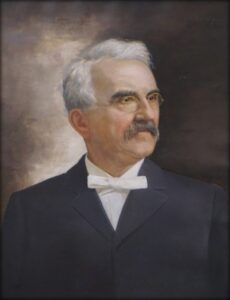
Peter Staub (1827-1904). (City of Knoxville.)
Arriving here four years before the war, the German-speaking Staub, who had immigrated to the United States from his native Switzerland in 1854, established a successful tailor’s shop, and by all accounts, made some shrew land deals as well. By 1869, the Swiss government would appoint him to serve as a U.S. consul to Switzerland. Three years after he opened his theatre, he began the first of two terms as mayor of Knoxville.
It’s hard to imagine a Knoxville mayor today having a strong European accent. But back in those days, several mayors, particularly throughout the late 19th century, spoke with British, Irish and even German accents. Knoxville’s history can be a little wilder than you might think.
Six months before opening day, Peter Staub announced plans for what he promised would be a magnificent “European style” theater, on the southwest corner of Gay Street at Cumberland, right across the street from the Lamar House. The new theater, he claimed, would be “built of fine pressed brick, with marble facings.” No expense would be spared, he claimed, in realizing “an architectural ornament and a public hall that any city might well be proud of.”
Designed in the Second Empire Style by Knoxville architect Joseph F. Baumann, construction on Staub’s Opera House began in the spring of 1872, and took just six months to complete. Construction projects, often dangerous affairs for workers, could also be traps for animals too. One night, a cow wandered into town and fell through the floor in one of the old buildings being torn down to make way for the new opera house. It took workers all day to get the poor bovine out.
As construction progressed into the summer months, artists were brought in to begin painting scenes on the backdrop depicting Staub’s beloved Switzerland. For foreground designs, artists rendered what was described as “the calm and placid waters of the beautiful Lake Wallen [sic] in the canton of St. Gallen,” one of the country’s bodies of water. Drapery was soon added, made of a “rich crimson, fringed in yellow” enhanced with the Tennessee coat of arms. A remarkable fresco, featuring an image of William Shakespeare, on the auditorium ceiling was completed just weeks before opening night.
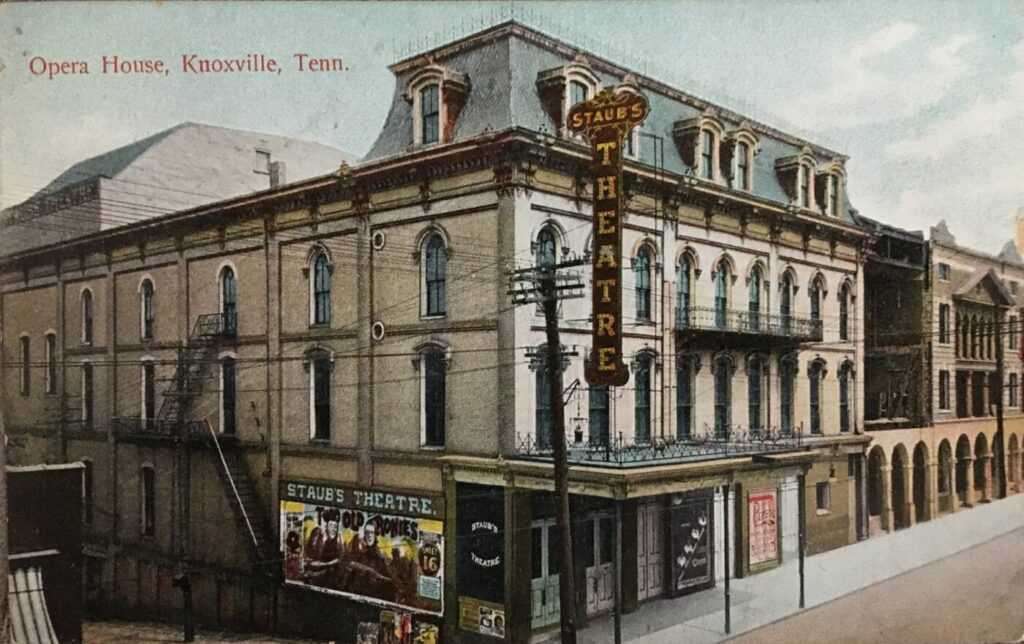
Staub’s Opera House. (Alec Riedl Knoxville Postcard Collection/KHP.)
In contrast, over in the French capital, the far bigger and far grander Paris Opera House, officially called the Palais Garnier, after its architect Charles Garnier, was at the time still three years away from completion. Interrupted by several conflicts, that opera house, with its underground passages and even a lake, on which Gaston Louroux’s Phantom of the Opera (1910) would be based, took almost 15 years to build.
Knoxvillians were excited about their own opera house, and all tickets were sold out ahead of the opening gala on October 1. On the night, although Peter Staub was not scheduled to speak, the crowd repeatedly called for his appearance. Reluctantly, he walked on stage to utter just one line: “Ladies and gentlemen: I can build a house, and I can make a coat, but I cannot make a speech.” For a man who would soon be mayor of Knoxville, let’s hope that he learned to warm up to public speaking.
The opening play also represented Staub’s birthplace: William Tell: The Hero of Switzerland, followed by a “Grand May-Pole Dance.” The crowd lapped up a “side-splitting afterpiece” called “Ilce On Parle Francais.”
Staub’s Opera House would remain the city’s leading entertainment venue for several decades. And as Staub predicted, the theater would attract leading stage actors, singers and musicians from across the country. In time, many nationally known performers came to Knoxville: Norwegian violinist Ole Bull, the legendary actress Sarah Bernhardt, and popular Black soprano Sissieretta Jones—all graced Staub’s stage. Plus, some of the most revered musicians played here with the Boston and New York symphonies, as well as the Knoxville Philharmonic Orchestra.
During the 1890s, the theater received a facelift, increasing its seating capacity by expanding into an adjacent building to the south, and renamed itself Staub’s Theatre. It was then run by Peter’s son Fritz Staub, who later quipped that he didn’t possess his father’s passion.
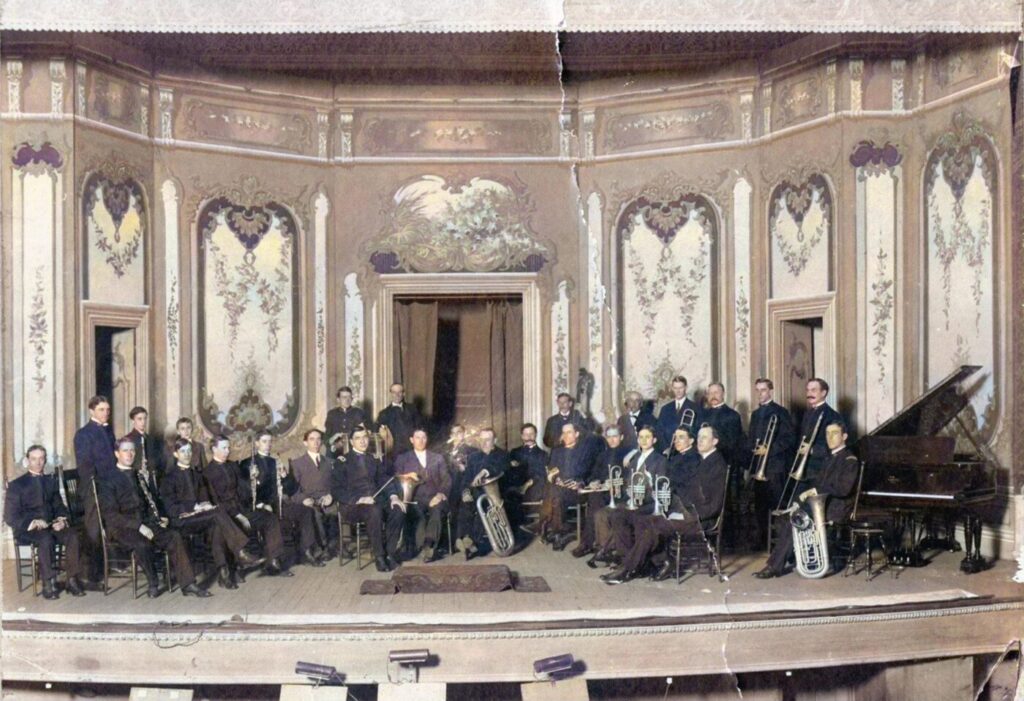
Crouch’s Orchestra onstage at Staub’s Theatre, circa 1890s (colorized.) (McClung Historical Collection.)
In 1907, a new building was being developed adjacent to Staub’s, and here in 2026 one might be forgiven for a feel a little déjà vu while reading about it: it was a new 75-room hotel with a rooftop garden. The owner and developer proved to be C.B. Atkin, who, in addition to running his successful mantel business, also owned the Atkins House Hotel at the northern end of Gay Street.
Atkin claimed that “People of Knoxville have been clamoring for a big hotel” and that the Colonial would attempt to meet the demand for downtown hotels, collectively near capacity. For him, it would have been a short walk, a little over a block, to the Colonial Hotel from his own home on the corner of Gay and Hill Avenue.
Only a decade after the disastrous fire on Gay Street in 1897 that began in the elevator shaft of Hotel Knox, taking out almost an entire city block on the east side, hotel managers and owners were justifiably anxious to fireproof their new hotels. If Atkins’ claims were true, then the Colonial had something that no other hotel in the country had at that time: automatic sprinklers. “Absolutely fireproof” advertisements boasted. It would take some research to proof whether or not it ever had a fire, even a small one, but the hotel would never burn down as the cause of one.
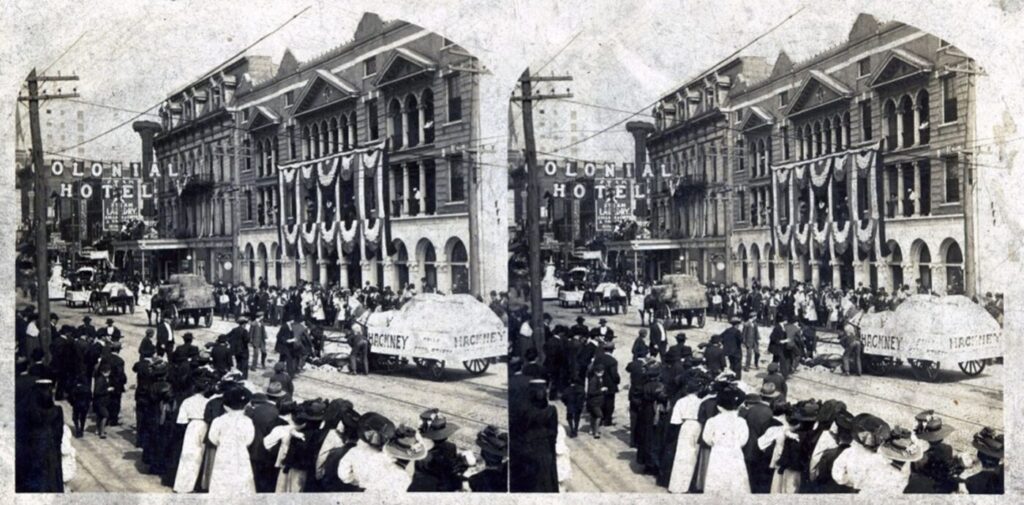
A stereoscopic photograph taken by Knoxville photographer C.A. Wayland showing a street parade going by the Colonial Hotel and Staub’s Theatre. Circa 1910. (McClung Historical Collection.)
When the Colonial Hotel opened that July, only 48 rooms were available. The rest would be soon added in the building formerly occupied by the Knoxville Railway & Light Company, the local company that operated the city’s streetcars. One could catch a streetcar from there that would take you along Gay Street and out down Magnolia Avenue to Chilhowee Park. Or, if you lived in the suburbs, you could catch a handy ride into town to see a play at Staub’s. After it moved from this spot to the 800 block of Gay, the transit company moved up the street to the northeast corner of Gay and Church and became integrated with the Knoxville Power & Light Co., which, including the later Knoxville Utilities Board, would remain an energy-themed corner for decades. Later still, streetcar operations moved back to the west side of the 800 block of Gay to the streetcar barn there.
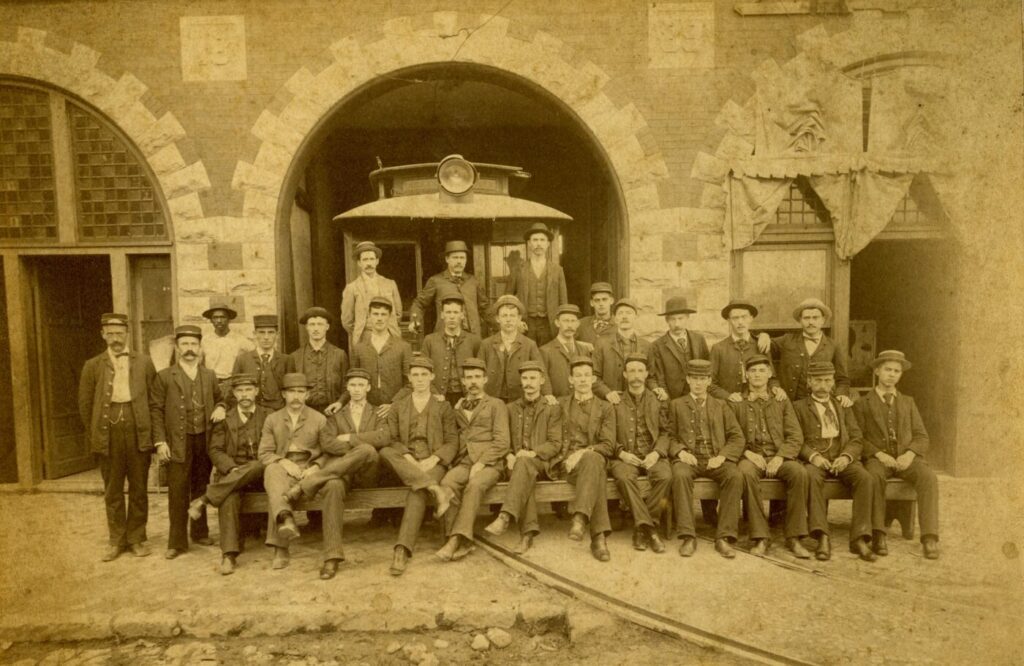
Streetcar conductors and workers pose at the streetcar depot on the 800 block of Gay Street. The building, then owned by the Railroad and Light Co., shows the date of “18-89.” By 1907, it was modified to form the Colonial Hotel.
The three-story Colonial Hotel, not quite matching the height of Staub’s, also had a grand design, with a row of 11 marble archways stretching along the street front. Various offices occupied the first floor with two floors of guest rooms above. And on the rear of the upper floor, toward the back, a rooftop garden afforded views looking east of the city and southward to the mountains.
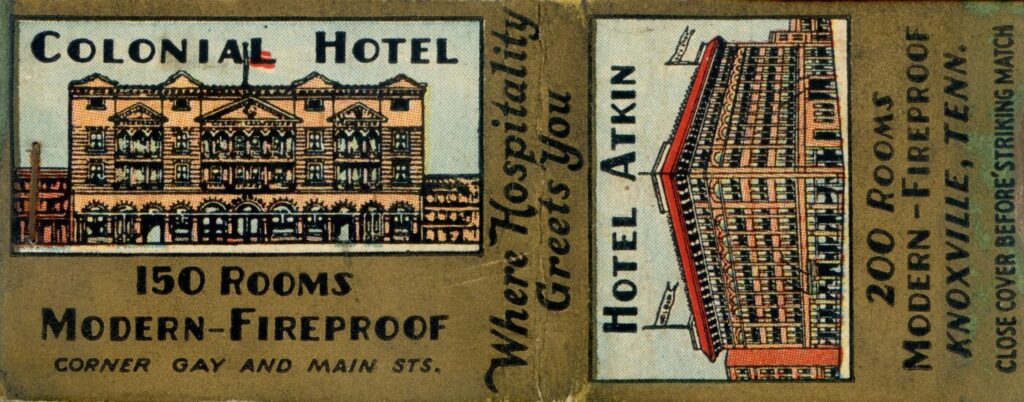
A rare matchbook featuring the C.B. Atkins’ owned Colonial Hotel and the Atkins House Hotel. (Alec Reidl Collection/KHP.)
Unlike the Palais Garnier, Staub’s Opera House and the Colonial Hotel would not last much beyond the mid-point of the 20th century. Miller’s Department store acquired much of the block in the 1950s and began steps to demolish these old buildings.
In 1955, as the buildings came tumbling down, Carlos Campbell, former head of the Chamber of Commerce, and a leading Smokies advocate, recalled the days when “fine cushioned streetcars” left from the 800 block to go all across the city, including Fountain City and Lyons View. The “Burlington Flier” took passengers out to Chilhowee Park and Cal Johnson’s Racetrack. Campbell recalled that “Old timers said that when they saw the headlights of the fast Burlington car, it looked like a ball of fire at tremendous speed as it came through the thickets along the track late at night.”
It’s not recorded, but no doubt that a few of those old timers had colorful memories of Staub’s as well.
Miller’s store project never came to pass, and the undeveloped lot would sit idle for years. It wouldn’t be until the mid-1970s when the current Plaza Tower, still the tallest building in east Tennessee, would rise on this block. Look for the state historical marker at the base of the tower. It’s right about where, many years ago, ticket holders poured into Staub’s Opera House on opening night back in 1872.
~ Paul James
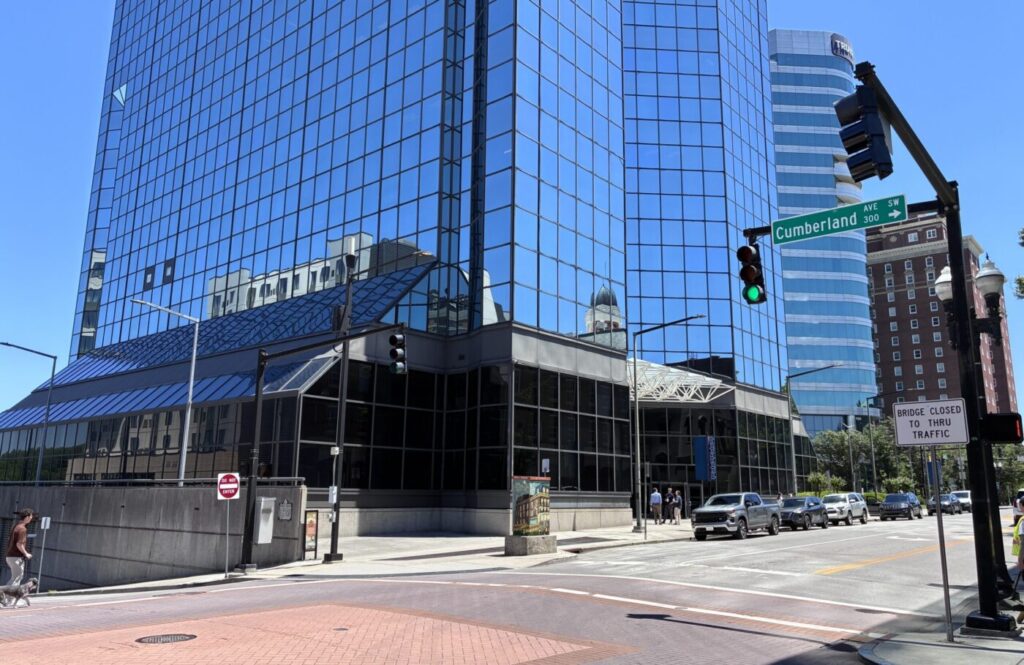
Historical marker on the corner of Gay and Cumberland, looking over to a KHP Downtown Art Wrap depicting Russell Briscoe’s painting of Staub’s, opposite the Bijou Theatre. (KHP.)
The southeast corner of Gay Street and W. Cumberland where Staub’s Opera House once stood, years before the Plaza Tower was built. (KHP.)
“Ghost Walking” is my own take on life on the city’s streets in bygone times; how these streets and their buildings have changed through the years, and how through old pictures and stories we can glimpse the echoes of people’s past lives and particular events. Some of the photos featured in this series are included in Downtown Knoxville that I co-authored with Jack Neely, and part of the popular “Images of America” range. If you’re looking for spooky ghost stories, please allow me to direct you to historian Laura Still’s book, A Haunted History of Knoxville, and her “Shadow Side” walking tours. Laura has been leading historic walking tours for years and she also generously donates a portion from most of her tours to the Knoxville History Project. Learn more at Knoxville Walking Tours.






Leave a reply