
What remains of our last big national celebration, and the mystery of Buster Muggs
It’s America’s 250th, and the nation seems at odds about how or whether to celebrate it. For whatever it’s worth, it does seem to be the biggest celebration since the national bicentennial 50 years ago. People here don’t talk about it much, but the bicentennial had an influence on the landscape of the city as we know it.
The occasion and the opportunity brought some angst at the time, as a recent and surprising New Yorker essay by Jill Lepore, “Scandal, Protest, Goofiness, and Grandeur at the U.S. Bicentennial” reminds us. There were parades, tall ships, bell ringings, and fireworks, concentrated in Boston, New York, and Philadelphia, where much of the Revolution happened. But there was also an effort to make it more than an East Coast party.
In 1974, from the trenches of the Watergate-embattled Nixon administration, emerged a program to develop “bicentennial parks” around the nation. The Tennessee Revolutionary War Bicentennial Commission responded at first by identifying spots in the state that had some association with the Revolutionary War itself. There weren’t many, just five in the whole state, most of them not near where people lived, and none of them in Knox County. During the Revolutionary War, of course, Tennessee was considered the far western half of North Carolina, and sparsely populated by people of any color, but was Native American country. There were no major battles here. Knoxville does have lots of connections to the Revolutionary War, but they each call for more explanation than people usually have patience for when they go to a park with a cooler.
With time, some of the assumptions of what qualified relaxed. Eventually, any city could propose its own Bicentennial Park. And Knoxville looked toward its long-neglected old riverbank.
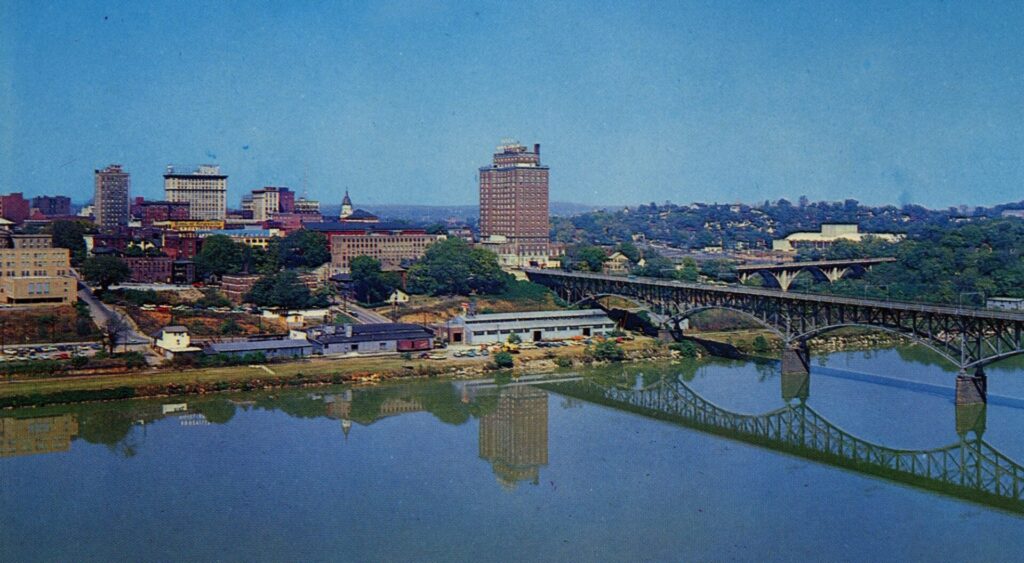
Knoxville’s riverfront, early-mid 1970s. *Alec Riedl Knoxville Postcard Collection/KHP.)
For most of the 20th century, people avoided the river. In the 19th century, downtown’s riverfront hosted two riverboat wharves, and in the late 1920s came some extravagant plans to connect it to our lofty downtown with terraced gardens, but the Depression ended any realistic dream of raising money for something like that. The brown water downtown was dangerously polluted, and it stank. But as modern sewage treatment became a reality, and water-pollution guidelines reduced toxins in the waterways, it became almost tolerable. People got more interested in the Tennessee River: in being close to it, at least, if not touching it. More people began boating to football games at Neyland Stadium, enough that the term “Vol Navy” was becoming something more than a joke.
The places along the river where the Central Street Wharf and the Prince Street Wharf used to be were just muddy banks alongside a highway. But then an excursion riverboat called the Border Star began docking there. Beginning in March 1974, the sternwheeler owned by a riverboat enthusiast in Arkansas, took passengers on 90-minute excursions up and down the river. Such jaunts had once been common, but less in recent memory. The Border Star drew some intrepid passengers, but after three months suffered a “blown engine,” and was docked. By the end of the year it launched, the sternwheeler had been picked apart by nautical thieves. But its original builder purchased it, fixed it up—and sailed it downstream to Chattanooga, where there was more experience in accommodating tourists looking for fun on the river.
In October 1974, during the first Kyle Testerman administration, came a proposal to establish a pulloff from Neyland Drive as at least a token riverfront park. Behind the idea was Guy Lincoln Smith III, the eccentric TV-station sales manager who was son of a firebrand conservative newspaper editor. Originally from Johnson City, Smith had worked in shipping in New Orleans before he returned to East Tennessee. He didn’t inherit his late father’s warlike relish of public conflict, but caused some anxiety among his Sequoyah Hills neighbors when he made a pet of an orphaned African lion cub he named Joshua. And in 1974, Smith was just gaining attention for his efforts to improve the half-derelict Knoxville Zoo, eventually to be home for Joshua.
The park he proposed was originally to be called “City Gate Park.” It featured a passive park with boat ramps and public bathrooms. The city leased the land leased from TVA.
By early 1975, a new organization in City Hall became known as the Greater Knoxville Bicentennial Commission. At the Lawson McGhee Library, which still had that new-library smell, the Commission hosted a few public meetings. Its purpose was to get tourists to stop in Knoxville and have a look around rather than “just letting them zoom right on through to the Smokies.”
In February 1975, the GKBC asked City Council to rename City Gate Park, favoring “Bicentennial Park.” Smith, who was still involved, fleshed it out some. It would first feature a fishing pier. Later, he said, would come shops, restaurants, and even a marina.
“Marina” was a word we were just getting used to. Knox County had had boat docks for decades, but called them “boat docks.” Marina sounded classier. Also in the works was a picnic pavilion, a steamboat dock, and, most ambitiously, a “walkway to UT.”
It was an exciting time to be on City Council. Discussions of the Bicentennial Park overlapped with discussions of a new City County Building, agreements about the controversial Summit Hill Drive project, and a prospective World’s Fair was still in the long-shot phase.
The riverside park project was well underway on Wednesday, Oct. 15, 1975, when a bipartisan trio arrived to dedicate it, including Mayor Kyle Testerman and Betty Blanton, wife of Governor Ray Blanton, four years before their divorce, and four years before public scandals chased him out of office.
Representing the American Revolution Bicentennial Administration in Washington was Mr. John Warner. President Ford was too busy to come represent the federal government’s interest in a tiny park on a muddy riverbank in Knoxville. So, apparently, was Vice President Nelson Rockefeller, Secretary of State Henry Kissinger, and most of the cabinet.
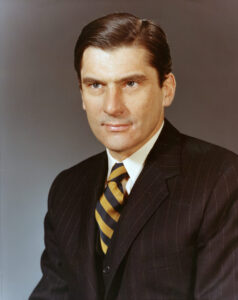
John Warner (1927-2021). Wikipedia.
So instead, we got John Warner. At 48, he was just a former Secretary of the Navy from the Nixon era, but today you might recognize the rugged face in the News-Sentinel photograph. His greatest fame ahead of him. Still in the future was his 30-year career as a U.S. senator from Virginia. And the year after he helped dedicate Knoxville’s Bicentennial Park, Warner became, for a good while, the sixth husband of the violet-eyed Oscar winner, Elizabeth Taylor.
It didn’t all happen as planned. Does anything?
What most Knoxvillians remember of the Bicentennial, if they remember anything at all, is the American Freedom Train. The long, rolling museum spent three days parked at the old Southern station in early June 1976, and drew thousands. Adult tickets were $2. For many, it was the last time they saw the old station, which hadn’t greeted a real passenger train in several years. However, modest Bicentennial Park, with its parking lot and picnic shelter, didn’t attract much attention. It was accessible only by car, and offered little reason to drive there.
It was after the nation’s bicentennial that Smith and city government opened the forlorn little public patch up to other proposals. Known for his cowboy hat, a working-man’s hat that looked like it had actually been around cows, Bill Mullins was a colorful farmer and construction man from New Market. He was also known for his huge, 160,000 square-foot Bill Mullins Warehouse on Prosser Road near Chilhowee Park, a tobacco facility that often doubled as a public event space. (Expanded in 1979, it was often billed as the Bill Mullins Convention Center or the Bill Mullins Exhibition Center. It was used for a variety of public gatherings, from boat shows to Boy Scout jamborees, because the City of Knoxville owned nothing comparable.) Working with Smith, the two proposed something different in 1977: a restaurant built on pilings at the riverfront at Bicentennial Park. When first announced, it was to be called Fisherman’s Wharf.
TVA, which had controlled most of the land, objected that Mullins’ early drawings seemed to call for using all of what had recently been heralded as Bicentennial Park as a restaurant and its own parking lot. Then the Metropolitan Planning Commission had concerns about its architecture, and whether Mullins’ “rustic, Tudor-style building” would clash with the white concrete and glass of the brand-new and extremely modernist City County Building up the hill. Then there were property ownership issues between the city, TVA, and the railroad that hadn’t come to the fore when the property was merely a passive park. The questions and thicket of approvals and revisions delayed the project for years.
Guy Smith may have quietly left the project before Mullins’ restaurant proposal was approved in 1981. No longer Fisherman’s Wharf, it was now to be called Mullins Landing. Construction commenced in May 1981, in time for it to be up and running before the opening of the 1982 World’s Fair.
However, Mullins was soon negotiating with a Nashville restaurant chain called Cajun’s Wharf, and it opened as a Louisiana-style seafood place. Its Nashville flagship had opened in 1978, and its Cumberland River location made it a popular nightspot there.
Knoxville’s version of it opened in late 1981, getting attention for its gumbo, oysters, boudin, and crawfish etouffee, as well as for barbecue, as well as a pretty wide variety of live entertainment, Dixieland jazz by a UT jazz combo, and some offbeat singing groups. A New Year’s Eve Spectacular featured magicians and the Hunley Brothers—including Con Hunley, the young piano player and singer who was Knoxville’s most credible entry in the constellation of aspiring pop stardom.
Parking was often an issue, especially during the World’s Fair. Its parking lot was still known to the city as Bicentennial Park, but sometimes fishermen would find that the restaurateur would call the tow trucks if fishermen, downtown commuters, or Vol fans parked there.
Mullins bought a riverboat called the Patsy M. that docked at the restaurant, but by the end of the World’s Fair he was ready to sell it.
Although reportedly “popular,” Cajun’s Wharf lasted only a year and change, mainly the World’s Fair era. After the hubbub was over, there are inklings that Knoxvillians returning to post-Fair normal considered it too expensive. The Nashville company sold it in early 1983. (The company closed its flagship Nashville restaurant just three years later, but by then had expanded to the west. Cajun Wharfs survived in Arkansas, Oklahoma, Texas, and Colorado for another decade or two.)
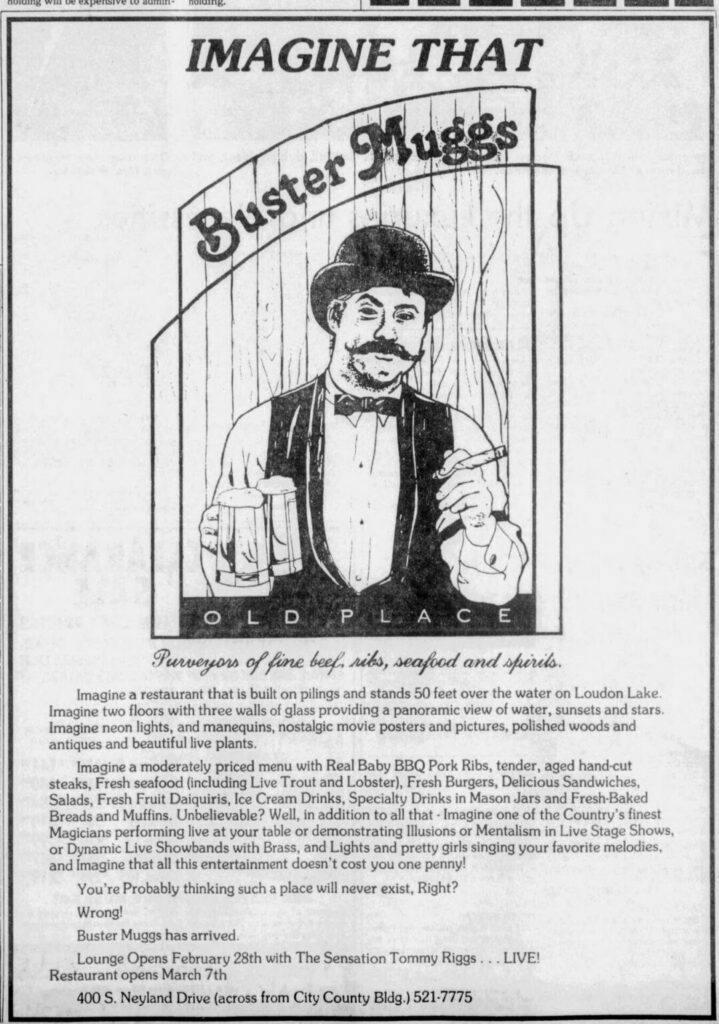
Knoxville News-Sentinel, Feb. 18. 1983.
The concept survived in the building Mullins built, for a while at least. Almost immediately Knoxville’s former Cajun’s Wharf reopened as Buster Muggs Old Place.
Deliberately droll, its advertising intended to suggest some mystery about its namesake, depicted as a stout, jolly fellow with a luxuriant mustache, cigar, bowler hat, beer mug, and hints of an adventurous past. “Has anyone met the real Buster Muggs? The question still has not been fully answered,” went an unsigned column in an advertising section in the News-Sentinel in February 1983. “Whether an elaborate ruse or a planned deception, he is an immensely interesting fellow, and so is his new place (or old place as the new name indicates).”
Buster Muggs Old Place was indeed designed to seem like an old place, serving barbecue and seafood and lots of live entertainment, including roving magicians and live music.
Some of the live music was what you might expect in an upscale fern bar, but some of it wasn’t. Buster’s “Mo-Town in K-Town” series highlighted R&B and pop legends, including the 1980s versions of the Shirelles, the Coasters, the Clovers, Bobby Vee, and David Clayton-Thomas, former lead singer for Blood, Sweat, and Tears—and, memorably, Sam & Dave, who were enjoying an unexpected boost in their careers thanks to the Blues Brothers’ resurrection of their 1967 classic, “Soul Man.” In late September 1983, the original duo played a six-night stand at Buster Muggs, each night to a packed house.
Although it was a great era for small nightclubs on the Strip, offering lots of chances to see alt-rock musicians who would later be famous, no place in town short of the Civic Coliseum was welcoming so many performers who were already famous, on a regular basis.
Buster Muggs cultivated unpredictability. Even Alan Hale Jr.—the Skipper from “Gilligan’s Island”—was on hand in September 1985 to give the restaurant a nautical touch when he greeted crowds at Buster Muggs, still sporting his skipper’s cap. He was still a working actor.
“If it’s going on, it’s going on at Buster’s” was the motto. The tongue-in-cheek sophistication of the concept would seem to suggest a chain with a budget for clever marketing: the name perhaps evoking memories of J. Fred Muggs, the playfully unpredictable chimpanzee on NBC’s “The Today Show” in the 1950s.
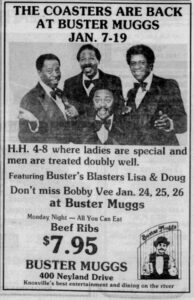
Knoxville News-Sentinel, Jan. 6, 1985.
In fact, a newspaper search proves that the Buster Muggs in Knoxville was the only one, ever.
In the fall of ’83, Buster Muggs’ parking lot—not quite forgotten as old Bicentennial Park—hosted the first Riverfeast, probably Knoxville’s first food-related festival. Eventually under the umbrella of the Arts Council, the competitive barbecue festival lasted for more than a decade, growing in popularity, eventually spreading out at World’s Fair Park.
Buster Muggs lasted for two and a half years, about twice as long as Cajun’s Wharf did. There remains some mystery about Buster Muggs. The presumably local person who came up with the persona of Mr. Muggs and penned those droll promotions may never have publicized his or her connection to the enterprise.
But there are clues. During the Buster Muggs era, the property remained known as Mullins’ Landing, the legal name of the entity that owned it.
Perhaps the biggest band ever associated with Buster Muggs didn’t actually perform in the restaurant. The Four Tops show in June 1983 was presented by Buster Muggs—but the original band, still intact and recording at Motown, performed at the Bill Mullins Warehouse on Prosser Road.
The same Bill Mullins, one of the backers of Buster Muggs’ Riverfeast, revealed himself to be a proud barbecue aficionado himself.
Our theory is the Buster Muggs, to the extent that he existed at all, was another jolly fellow with the same initials, Mr. Bill Mullins himself. But after a while, the tobacco dealer and developer may have been tiring of the restaurant and nightclub business. Buster Muggs’ Old Place suffered a strange and sudden ending.
The person who bought Buster Muggs’ Old Place in October 1985 was one Stan Sissom, a former UT campus book dealer and UT law-school grad who was soon indicted for larceny—and accused of stealing hundreds of pounds of meat from a refrigerated truck parked outside the restaurant. Although that charge was eventually dropped for insufficient evidence, the unusual building closed, and for a while was an empty oddity by the river. Sissom was later convicted of drug trafficking—and imprisoned for attempted murder of a state investigator.
By the end of 1985, the fun was over, and the unusual riverfront building, which had a lot of history for just four years, sat empty. A newspaper columnist dismissed the location as an “ill-fated waterfront site on Neyland Drive.”
It was during that discouraging turn of events that Guy L. Smith III, who had first envisioned a park that would reintroduce Knoxville to its neglected riverfront, died at age 64. By then he was deservedly known for his success with raising the profile of the Knoxville Zoo. His obituary tributes didn’t mention Bicentennial Park.
Mullins’ Landing, as it remained known on occasion, reopened in 1988 as Calhoun’s on the River, a riverfront version of a barbecue restaurant already well known on far Kingston Pike. Despite common opinions of its jinxed location, Calhoun’s prevailed, now one of downtown’s oldest restaurants. Live shows featuring R&B legends may be rare there today, but now and then it gets into the occasional novel, as it does in a short scene from Patricia Cornwell’s 1994 bestseller, The Body Farm. No one gets killed there, but detective Kay Scarpetta’s finds reason to remark about its Louisiana hot-sauce options.
By then, it was accepted—or forgotten—that the city’s Bicentennial Park, christened with some fanfare a couple of decades earlier to celebrate the nation’s birthday, began to serve mainly as Calhoun’s parking lot.
The same year Calhoun’s reoccupied that restaurant, which for a building only seven years old already had a lot of history, old Bicentennial Park attracted another excursion riverboat project. It might seem odd to name a riverboat for a Confederate general who probably never set foot in Knoxville, an infantry commander not known for boating skills, but the Robert E. Lee was a name borrowed from a post-Civil War riverboat on the Mississippi, which won a famous race with the Natchez in 1870, and later inspired a 1912 vaudeville-era song, “Waiting for the Robert E. Lee.”
The larger Star of Knoxville replaced it in 1992, and has operated out of that port ever since.
Announced in 1993, Volunteer Landing, a much larger proposal than Bicentennial Park, would stretch along the riverfront, with multiple attractions.
It was a better and more distinctive name than “Bicentennial Park,” which occasionally reemerged as late as 2000, but by then it would have been confused by Nashville’s much more extravagant Bicentennial Park established in time for the state bicentennial in 1996.
In fact Volunteer Landing, completed in 1999, fulfills some of the promises originally included in the Bicentennial Park dream, like picnic areas and playgrounds, and in some ways takes it much farther, with pedestrian bridges over two creeks, a tower to bridge Neyland Drive toward downtown, fountains, and a statue depicting the conflicting points of view concerning the Treaty of Holston. The “walkway to UT” that sounded far-fetched when Guy Smith proposed it in 1975, did emerge as something much bigger, a greenway—a term we didn’t use much in the ‘70s. It stretched to UT—and far beyond, to Tyson Park, to West High School, and in fact all the way to Bearden, as well as in the other direction, to the east, past the long marina and the forgotten ruin of the city’s first public-water intake facility, and 1890s landmark, and beyond, to another broader boat landing. The shops, restaurants, and marina did arrive, sort of: the marina, especially. Shops have been rare, but there are indeed a couple of popular restaurants down there, including the one that’s the Mullins legacy.
Was Bill Mullins indeed Buster Muggs? Like the coy promoters of 1983, we can’t claim to know. The former tobacco kingpin had withdrawn from the public scene even before Knoxville stopped trafficking tobacco in 1995. He was living in rural West Tennessee when he died six years ago, at age 88. His obituary described him as a “Tennessee tobacco warehouseman, developer, and farmer.” It includes no mention that he once built the largest exhibition center in Knox County—the East Knoxville street alongside it still bears his name—or that he started a popular barbecue festival, or that he ever ran a restaurant or nightclub featuring some memorable shows by performers who are now legends.
By Jack Neely






Leave a reply