
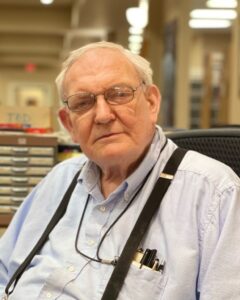
Ted Baehr, Jr. (Courtesy of McClung Historical Collection.)
Ted Baehr was for many years the de facto grand vizier of the Calvin McClung Historical Collection, the no-nonsense supervisor of that reference library as most of its patrons came to know it.
When I first met Ted, maybe 40 years ago, I did not call him Ted. I was a young aspiring journalist who developed an odd habit of climbing the ancient iron stairs of the Custom House looking for background for feature stories to make them more interesting. Up there was a serenely abandoned third-floor courtroom, a grand salon I didn’t know existed. I’d sign in, and behind the desks, in the glow of their lamps, were mostly women, old women like the formidable Pollyanna Creekmore, who was no Pollyanna; intriguing young women who seemed both unattached and unattainable; and that guy.
He did not strike me as someone I could ever call Ted. Even then he seemed an unlikely survivor of another era, perhaps a gruff character from a noir film, a stocky fellow in suspenders and wire-rimmed glasses, with his steel-gray hair slicked straight back. When he spoke at all, he spoke in a baritone growl. In my experience, no one ever made a joke about his name, at least not in his presence.
No teddy bear, at least not on first or second acquaintance, he intimidated some people. He was too distinguished to be a repo man, but he could have done the job. There was a rare gravity about him. He knew what he did was important, and could almost convince you that what you did was important, too. I knew him for several years before I ever saw him smile. But when he did, you’d notice for the first time that his eyes were blue. When he found sometime surprising or funny, they would light up. He did have a sense of humor, and it would begin cascading when you didn’t expect it.
When he went outside to go to lunch, which I never saw him do in those early days, he wore a Panama hat, and when he did on a summer day he looked like he was in Panama, either the canal’s chief engineer or kingpin of a smuggling syndicate, or both.
Slowly I came to understand his role at the McClung Collection. Not the director, he was more or less the managing czar of the place, the one guy who knew where everything was, because he put it there. Ted took Knoxville history, which as I think we’ve established is nearly infinite, and put it in a few thousand Manilla folders, which became “the Vertical Files,” assembled in a long bank of steel filing cabinets. In them are newspaper clippings, but also correspondence, anonymous handwritten notes, pages from scrapbooks, high-school term papers, promotional brochures, pictures and maps, and pages of unknown volumes of ancient lore. The Vertical Files contain details about our city that aren’t anywhere on the Internet. I guess you could digitize them, if you had several years to spare. Don’t expect that to happen in our lifetimes.
His organizational skills made perfect sense, until they didn’t, in which case it just became part of McClung’s mystery. Today you often have to ask a librarian about how Ted chose to alphabetize something, and the librarian might not be able to tell you right away, but he or she can look it up, or at least find sufficient clues, and, always, there it is.
I can never call a story done until I’ve looked at Ted’s Vertical Files.
In my experience he never seemed young, somewhere on the shady side of middle age, but for a few decades he never seemed to age, either. For most of the time I knew him, if you’d ask me to guess his age, I would have felt lucky if I were within a decade. Just last week I learned Ted was just shy of 86.
He was born on the very first day of 1940 in Holland, not the nation but the suburb of Philadelphia, the son of an immigrant from the part of old Prussia that’s now part of Poland. When he was a teenager the Baehrs moved to a farm outside of Albany, N.Y. He studied electrical engineering, then served in the U.S. Air Force for several years in the Seattle area. Something seems to have flipped his switch while he was up there, as he studied at Boise State and the University of Idaho, and the electrician in him yielded to the historian.
In 1972 he found himself driving south to the University of Tennessee, where he studied under Prof. LeRoy Graf, another character who was then in charge of the Andrew Johnson Papers and UT’s History Department. Ted also worked with the late professor and author Bruce Wheeler. By 1977, he was working at the McClung Collection, and was there in 1982 when the collection split away from the main library and became its own destination, in the top of the old Custom House. Ted helped establish the collection, which by then was not exactly like any library collection in the region, in the old courtroom where the outlaw Kid Curry faced federal charges, as its monastic Reading Room.
And there he remained, no one ever more suited to a job, for almost half a century until his retirement just a year or two ago, and we’re grateful for it, grateful to have finally known him.
J.N. – December 2025






3 Comments
What a lovely reminiscence and biographical tribute to Ted Baehr–he was indeed an august presence in the McClung historical research collection. Sometimes curt but always helpful and enormously knowledgeable about the collections. Thank you, Jack, for your warmth, humor, and fine storytelling ability in filling out his life story for us.
I share you respect and yes affection for Ted Beahr. As I conducted research in the McClung Collection, I got to know him much better. Like with you, he eventually warmed up and became more like a friend and certainly a mentor. When you asked him about a matter he would rarely get up and take you to the stacks. I think he wanted you to learn the system so as to help yourself. I am so sorry that I lost contact with him after he retired. I wanted to go visit him but waited too long. How often do we do that and regret it greatly once they are no longer with us. When my wife and I went to Maine a few years ago, we came back through New York state so as to take photos of his mother and father’s tomb stones. He appreciated that very much. We did not know where his former home was but at least made it to the cemetery to get those pictures. Ted and I went to lunch together on occasion and I always felt like a student when with him. We grew closer through the years, and I learned more about Ted the man, the learned mentor. Yes, he had a sense of humor and anytime I was in the library, he would come to my table, and we would talk for a while, catching up on many topics. He was an Andrew Jackson man for sure, and we sometimes talked about Jackson the hero and the Scoundrel. I don’t do much research in the McClung Collection anymore, but when I do, I shall always think of Ted my friend and learned pedant.
I didn’t know Ted that well, but I have been researching in the McClung Collection since the early 1990’s and Ted was always there. I don’t think he aged a day while my hair went from brown to gray to white. The article describes him as “gruff” and yes, that fits…no small talk from Ted. I always said, “Hi,” and ususally got a nod and in later years a “Hello” in return. But if I needed to find something, I knew Ted was the one to ask. He was like a living card catalog. One of my favorite professors at UT was Dr. Bruce Wheeler, that I had for honors US history, starting with my first freshman fall. I remember him saying, “If you want to chat with your friends, cuddle with your boyfriend, or take a nap, go to the Undergrad Libray. But if you want to study, go use the Graduate Library.” I took that to heart. I can see him and Ted getting along fine. We’ll miss your presence in the library’s quiet, Ted. Rest in peace.