
Originally written by Paul James and published by Inside of Knoxville.
“Here comes Santa Claus, here comes Santa Claus, right down Santa Claus Lane,
Vixen and Blitzen and all his reindeers pulling on the reins,
Bells are ringing, children singing, all is merry and bright,
So hang your stockings and say your prayers, ’cause Santa Claus comes tonight.”
So sang the singing cowboy Gene Autry (who performed in Knoxville a couple of times during his career) about the jolly man in the red suit. While that song came out and rode high in the pop and country charts in 1947, it seems a fine way to describe Knoxville’s Christmas Parades along Gay Street. The first of its kind here came along toward the end of the roaring ‘20s, in 1928.
Cities of Knoxville’s size likely had been clamoring to get on the Christmas parade bandwagon since watching the Macy’s Christmas Parade be wildly received in New York in 1924. (Even though the first one was staged on Thanksgiving Day, 1924, that Christmas parade was renamed the Macy’s Thanksgiving Day Parade in 1935.)
Beginning life as a parade for Macy’s employees with floats and animals borrowed from the Central Park Zoo, the event captivated the public. Crowds just grew and grew. By 1927, the creative puppeteer and illustrator Tony Sarg, who designed Macy’s shop window displays in his day job at the company’s marquee store at Herald Square (Broadway at 42nd Street), introduced air-filled character balloons. The following year, he super-sized them into giant helium balloons. In high winds, the balloon handlers struggled to hold onto to them.
For a few years, when the giant balloons (that had small air-release valves built in) reached Herald Square, they were released from their moorings and floated up high above the massive crowds, up above the Big Apple skyscrapers. Many were later found and returned for cash rewards. But it would take a while for places like Knoxville to add inflatables to their own Christmas parades.
It was in 1928 when the morning daily, the Knoxville Journal took steps to stage the very first Christmas parade here. They preferred to call it a Santa Claus Parade. Excitement built up during the fall, and as the days drew nearer, downtown stores and office buildings began to decorate. About 3,500 Christmas trees were staged along the parade route, accompanied by thousands of yards of festive bunting. It’s hard to know if they were all real trees or simply decorations—widespread artificial trees were still in the future.
But the weather just didn’t cooperate—a thorough downpour that Friday scuppered plans. Following a last-minute announcement, and fielding 15,000 calls on the Journal switchboard, the parade was moved to the very next day, December 1.
Parade floats and special guests gathered for assembly on Main Street before stepping off at Gay and Main at noon. In many ways parts of that street would be unrecognizable to us today.
The Knox County courthouse was there, the First Baptist Church was almost brand new, but the Supreme Court building including the post office, and the Medical Arts Building were still a few years away. Much of Main Avenue was still a residential street.
Once it started the parade headed north on Gay Street and continued beyond the railroad tracks, turned right onto Fifth Avenue, before finally coming to a halt in front of Knoxville High School. Col. James Gleason, veteran of the Spanish-American War and World War I, a leader in the local Red Cross movement, and a seasoned marshal of the Armistice Day parade, led the inaugural Christmas parade.
Knoxville’s parade differed from Macy’s in the positioning of Santa Claus in the lineup. Rather than bringing up the rear, as the magnificent finale, organizers placed him at the rear of the first section behind Knoxville Mayor James Fowler and dignitaries, city fire and police chiefs, the Knoxville High School band decked out in distinctive blue and white capes, and a troop of local Boy Scouts.
Resplendent in traditional crimson attire made from a reindeer hide trimmed in white fur, and accompanied by a St. Bernard, Santa was pulled along in his sleigh on wheels by a team of four reindeer. Twelve policemen, six on either side, accompanied the sleigh, assuring some protection for the most-awaited guest on the route.
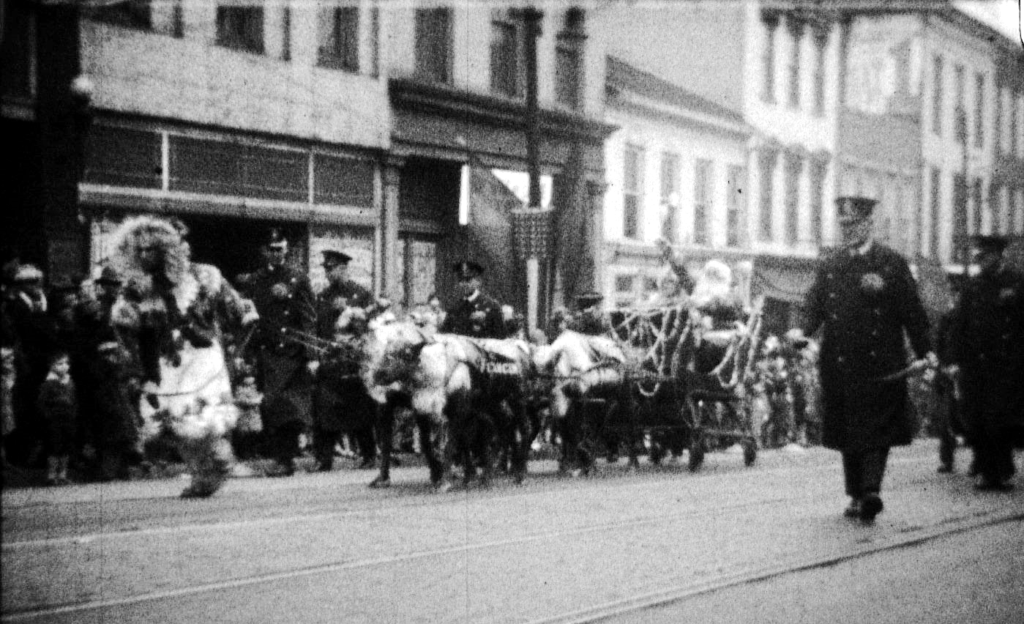
Santa Claus and reindeer. A still from the 1928 Santa Claus Parade. (Courtesy of the Schmid Family Film Collection/TAMIS.)
Specially brought in from northern Alaska, the reindeer, along with handlers native Alaskans James Ahkla and his family, traveled by ship to Seattle and then boarded a train headed to Knoxville via Memphis. After the event here they headed west to take part in another spectacle in Nashville.
The reindeer themselves posed a bit of a puzzle for some among the crowds, particularly those questioned why the animals didn’t have any horns. Mr. Ahkla was on hand later to reporters to explain that reindeer lose their horns during their breeding season, and that cleared things up.
Local merchants, 31 in all, entered decorated floats, many like that first Macy’s Christmas parade, designed in the theme of nursery rhymes. Floats depicted Humpty Dumpty, Little Boy Blue, Old Mother Hubbard, and Little Red Riding Hood, to name just a few. Also featured were tableaus depicting the Night before Christmas, the Man in the Moon, and Old King Cole. It seems odd that few religious themes or depictions were used. Perhaps organizers were looking for fun more than tradition.
I don’t need to describe the parade in too much detail because, remarkably, film footage of it survives in the Schmid Family Film Collection at the Tennessee Archive of Moving Images and Sound (TAMIS), part of the McClung Historical Collection.
Adolph Schmid shot the footage on a 16 mm camera from a vantage point on the northwest corner of Gay Street and W. Church (where the “Row Boat Man” statue is today). The son of a Swiss immigrant from Zurich, Schmid was a partner with Alex McMillan Co., a local real estate company that had been thriving for almost 40 years, and was developing a new West Knoxville neighborhood named Sequoyah Hills. If he had chosen to wait a year and record the second Christmas parade he may not have been able to. Following the Wall Street crash of late October 1929, Schmid ultimately lost almost everything after his firm went into receivership a year later. Fortunately, most of his amateur footage didn’t get tossed out or sold. The crash set the Sequoyah Hills development back a year or too as well.
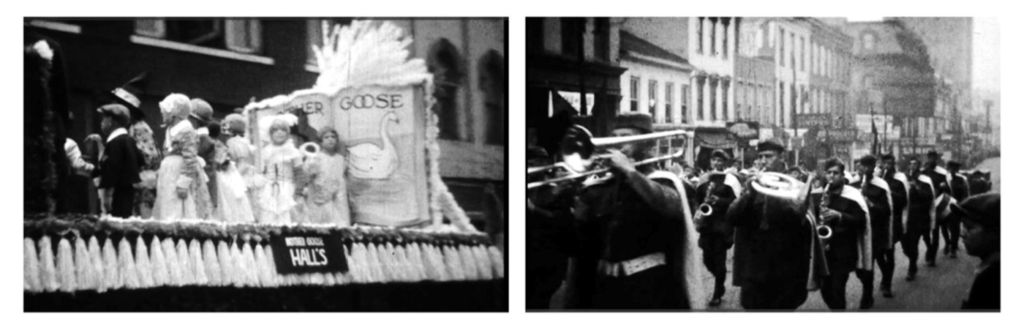
Mother Goose Float and High School band. A still from the 1928 Santa Claus Parade. (Courtesy of the Schmid Family Film Collection/TAMIS.)
In the film, in the distance on the east side of Gay Street, you can see the Andrew Johnson Hotel (it was nearing completion but wouldn’t open until to the following summer), and also the old Staub’s Opera House, then called the Lyric Theatre. In the foreground, behind Santa’s sleigh, is the old Knoxville News-Sentinel building, which later moved to a larger complex, and more modern, a block down the hill on State Street.
After the parade’s conclusion, many poured into downtown stores to buy Christmas presents and vie for a chance to meet Santa himself, though who actually portrayed him appears to be a mystery. Most would have only been able to glimpse him for a few moments. In the space of about three hours following the parade, he went on breakneck series of personal appearances in about 16 stores along Gay Street and on Market Square. It’s a safe bet that the pulses of thousands of local children rose a bit that afternoon.
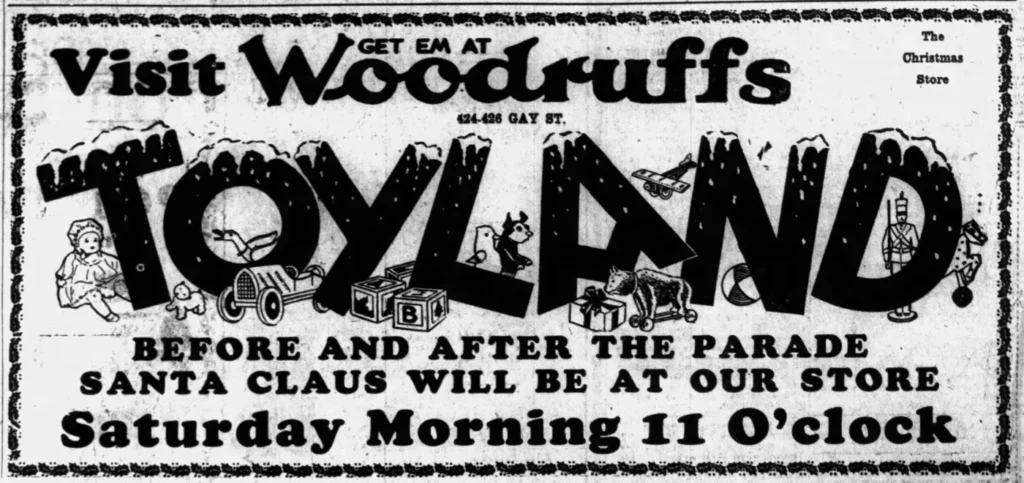
Santa promised to appear at numerous downtown stores including Woodruff’s on the 40 block of Gay Street. (Knoxville Journal, Nov. 30, 1928.)
The event was also touted as being the biggest crowd ever assembled on Gay Street. An estimated 60,000 or more parade watchers attended. Gay Street sidewalks, from Main Street all the way to Fifth Avenue, were packed deep, and every shop window too.
A few parade watchers had other emotional experiences. In among all the pushing and shoving, six children got separated from their parents. Despite a few anxious hours, local police were able to round up the missing kids and happily (mostly perhaps) reunited all of them with their parents by early evening.
Post parade reviews can be summed up by one local merchant who quipped, “It was the most colorful peacetime parade in Knoxville’s long history.” Another said, “The parade was one of the most beautiful spectacles I have ever witnessed.”
There is something special about being number one. For some, none of them could ever top that dazzling inaugural parade. Even though the Santa Claus Parade came back again in 1929, despite the Wall Street crash a few weeks prior, it continued to wow crowds with plenty of new spectacles every year for some time. However, it would take about 20 years before those large character balloons like the ones seen in the Macy’s parade rolled along Gay Street.
“The largest puppet of sorts made from a rubber skin” appeared in the 1946 parade, a 12-feet- tall balloon of Peter Rabbit, accompanied by a freak show of other characters, including Pete the Pirate, Slimy the Serpent, and Tobo, a two-headed tomcat. Where the balloons came from has not been ascertained, but they reportedly the 20 balloons took two weeks to design and 10 weeks to manufacture.
Even though they would have been dwarfed by Macy’s super-sized balloons made by Goodyear, the mini versions that came to Knoxville were still very popular, and perhaps just as fun.
In this second short clip from 1950, look for Humpty Dumpty, a strange creature called Porkey, and an impressive 80-feet long serpentine dragon that, if it looked like it was straight out of a Macy’s parade catalog, then it could well have been—one just like it really did make it down NYC’s Broadway in the mid-1940s.
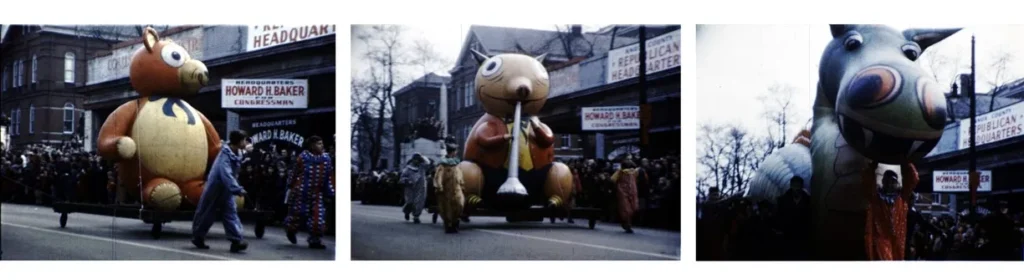
Character Balloons on wheels. Stills from the Knoxville Santa Claus Parade, 1950. (Courtesy of the Paulette Franklin Film Collection/TAMIS.)
Community-themed floats replaced the big balloons in the early 1950s and in the 1960s, then the parade took a break, transitioning into to a short-lived pageant of Christmas scenes outside the Civic Auditorium. The parade did return in the 1970s, though not always every year after that until more recent times where it has enjoyed a solid run and continues the annual tradition begun almost 100 years ago.






Leave a reply