
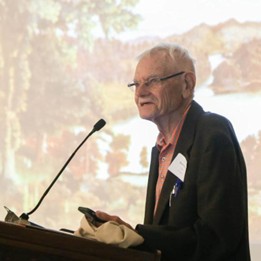
We’ve lost another of a generation of groundbreaking stalwarts of Knoxville history in the passing of author and teacher Fred Moffatt. He was a historian who went his own way, and brought light to some stories we might not have heard otherwise.
If you lived in Knoxville in the last 60 years, you probably saw him, more than most professors, certainly, if only out of the corner of your eye, a slim fellow with a gray mustache. He was an urban hiker, known to leave his desk and cover dozens of blocks at a time around downtown, Fort Sanders, and UT campus. You might be forgiven for steering clear of him, because he often looked like a guy who’d been sleeping outside and was looking for trouble.
Appearances weren’t a priority for Fred, and in his case they were deceiving. Constantly curious, he was always seeking pieces of the puzzle and noticing things others weren’t likely to. His walking around sometimes seemed like wandering, in the English countryside tradition. He traveled widely in Knoxville. But often, if something interested him, like a lecture or an art show, he would stop to behold it.
If you could call him an introvert, he was a friendly one. He might come and go from those events without saying anything to anybody, but if you said hello he’d smile and offer you an eloquent and logically composed paragraph, with fresh humor and insight, an educated quip that could have been written for William Powell to impart in a tuxedo.
A West Virginia native, he was a young man in his early 30s when he landed in Knoxville in the late 1960s, having spent much of the interim in Connecticut, Arizona, Boston, and Chicago, not to mention six years in the U.S. Army Reserves along the way. He came here to teach art history at UT, and did that for almost half a century.
He and his wife, Anne, who was in some ways his opposite—outgoing, ebullient, hip—lived outside of town, somewhere in the hill counties, but were both familiar on the sidewalks of downtown, albeit rarely at the same time. Their symbiotic devotion lasted almost 60 years.
Contrary to the prejudice that people pursue the study of art because they’re uncomfortable with words, Fred, a former reporter, was a very good writer. I regret I never took any of his classes at UT, but I was probably a student when I first encountered his fascinating and vividly ironic essay called “A Tale of Two Monuments,” a sometimes-bizarre dual narrative of the major Confederate and Union monuments still standing in cemeteries across town from each other in central Knoxville.
By then, Moffatt had written a scholarly book about 19th-century Massachusetts artist Arthur Wesley Dow, an obscure painter and art theorist who Fred saw as an underappreciated precursor to modernism. He wrote a few art catalogues and other monographs, such as one he wrote in 1981 after the premature death of UT artist Walter Hollis Stevens, perhaps the boldest modernist of the deliberately edgy cadre known as the Knoxville Seven. Some of Fred’s longer pieces were published in booklet form. But at what is retirement age for many, he ramped up his productivity, writing thicker, more thorough, scholarly, sometimes esoteric books like Errant Bronzes: George Grey Barnard’s Statues of Abraham Lincoln. He followed that, at age 70, with The Life, Art, and Times of Joseph Delaney, the first and to date only biography of that Knoxville native. The younger and lesser-known brother of daring abstract expressionist Beauford Delaney, Joseph made a name for himself in styles and perspectives distinctly different from his internationally famous brother, specializing in New York street scenes, before returning to Knoxville to serve as Artist in Residence at UT. (Moffatt’s book about Joseph Delaney is a good deal longer than the definitive biography of his big brother Beauford, but still a good read.)
Then, approaching 80, he had another surprise for us, a thick, scholarly book about an artist few have ever heard of, Scottish-born portraitist and landscape artist James Cameron—who’s of special interest here because the landscape that may be his masterpiece is also arguably the first real work of fine art with a Knoxville theme, “Belle Isle at Lyons View.” The landscape he saw in 1856, from what we now know as Lakeshore Park, preoccupied Cameron, and he painted it again and again, years after he left Knoxville. With Paintbrush for Hire, Fred told his whole story, including that of his wife, Emma, who kept a quotable diary.
Along the way, Fred also contributed the chapter “Painting, Sculpture, and Photography” in Heart of the Valley, still the most comprehensive history of the city ever published (ETHS, 1976). He was a rare surviving contributor to that 700-page reference book, still handy after almost 50 years.
Fred was an especially good friend in recent years and was our annual luncheon honoree in 2023.
~J.N. August 2025






Leave a reply