
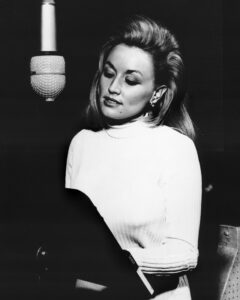
Dolly Parton. (Courtesy of the Dollywood Foundation.)
Like most of you, we may have a hard time getting used to a world without Dolly Parton.
She grew up in the hillier parts of Sevier County, and never lived in Knoxville, but had relatives here. But during her early youth, Knoxville was the place where East Tennessee musicians went to get noticed. Her uncle Bill Owens, who sometimes performed in clubs around here, knew some people, and helped get her on WIVK, the relatively new country station, Knoxville’s first single-format station. She arrived in the waning days of live performance radio, when some stations still had small studio audiences. WIVK had a second-floor studio on North Gay Street, across from Regas Restaurant. It was here, she remarked in a memoir, that “I fell in love with my audience.” Soon she was also performing on Walker’s early-morning variety show, “The Farm and Home Hour,” on WBIR.
She apparently had fans here, most notably grocer-impresario-demagogue Cas Walker, as famous for his broadcasting host as for his discount groceries and City Council tirades. By various accounts she performed on local shows here for six to eight years, even as she got very little attention in the press. One of the first times we ever heard her name was when they advertised the “Hillbilly Homecoming,” the annual outdoor festival of sorts in Maryville, on the 4th of July, 1957.
It was an amazing lineup. Legendary singers Patsy Cline and Jim Reeves were there, a few years before they both died in separate plane crashes. Pee Wee King, who by then was known for composing “The Tennessee Waltz,” was there, as was comedian String Bean. Even Sen. Estes Kefauver was there, a few months after his run for vice president. Dolly, who was just 11 years old, was on the same stage, listed as one of “Cas Walker’s Entertainers,” along with singer-songwriter Carl Butler, and her own uncle Bill Owens.
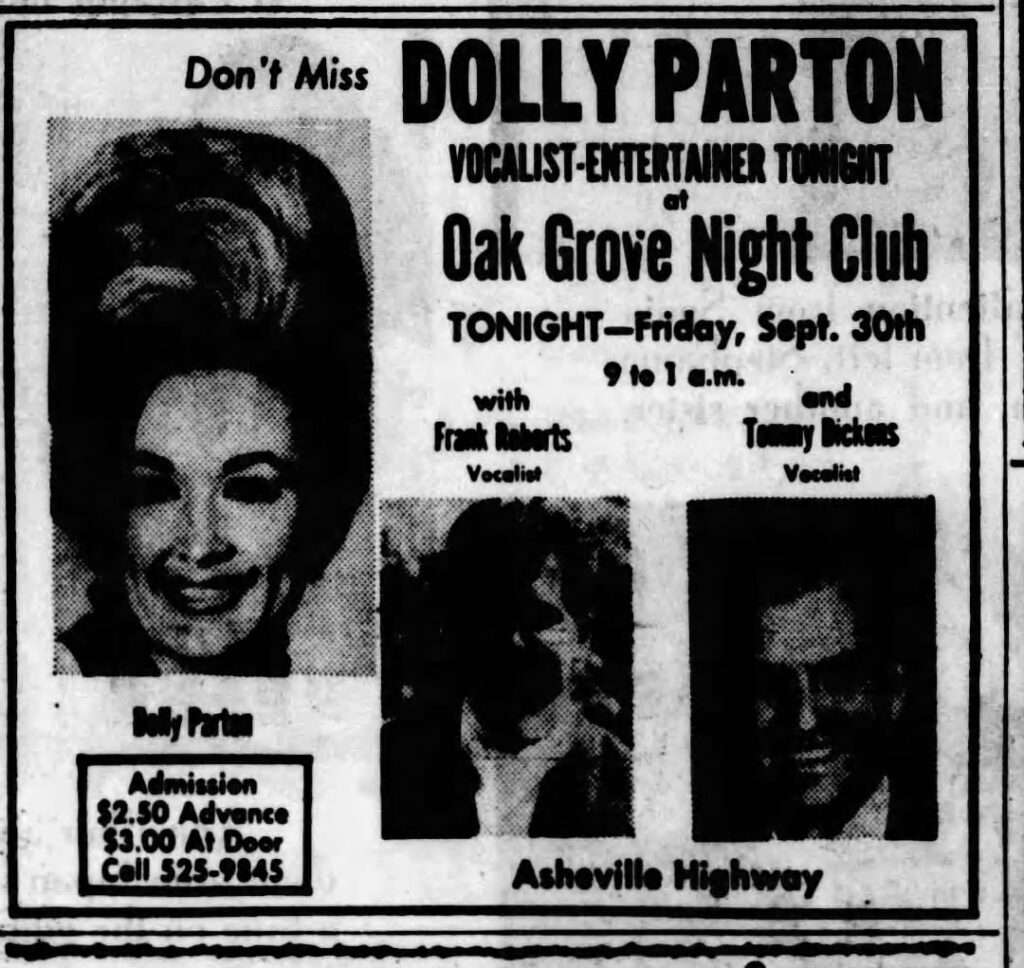
Knoxville News-Sentinel, Sept. 30, 1966.
She was hardly mentioned in the Knoxville papers again until five years later, when the Knoxville Journal ran an unsigned four-paragraph Page 7 story with a picture of a 16-year-old blonde from Sevier County High who had made a record of her own, called “Sure Gonna Hurt.”
But during that whole time, she was performing on the radio and television. Doing the math based on her published memories, she may have performed in Knoxville as many as 300 times. Her audiences obviously enjoyed her songs, but by the time she got started, she was one of the youngest practitioners of live-performance radio. Ironically given that it was the beginning of her career, she was arguably the last product of a medium was already regarded a remnant of former times, and losing steam. By the late 1950s, almost nobody thought live-radio performers were important enough to be considered news.
As the legend has it, she took off for Nashville, where the recording industry was roaring, the day after she graduated high school. By Cas’s own account, he drove her there. And there she stayed, a singer and a songwriter both, only occasionally coming home to perform. The first time she’s known to have done a ticketed show here was 60 years ago, at the old Oak Grove Night Club on Asheville Highway, once a meccas for country-music nightclubs, the night before she performed with a WIVK multiple-performer “Shindig” at the Civic Coliseum. It’s not clear that she ever headlined a show in Knoxville until 1977, at age 31, and it may have been her last one here for more than 30 years.
She was, after all, busy, not just as a singer-songwriter in Nashville, but by then as an actor in Hollywood, then a significant entertainment entrepreneur and major philanthropist like no other. Still, she would occasionally be sighted in town, visiting a radio studio on Kingston Pike, or suddenly getting off an Jackson Avenue elevator, or wearing a disguise to watch a friend’s show at the Bijou.
She had a global audience. Earlier this summer, we got a call from a young journalist for BBC Wales, who was looking for information about her mother’s Welsh-immigrant heritage. The Welsh have a proud, centuries-long heritage of singing, and he was interested to make that connection.
The little girl who sang on the radio in a walkup studio on North Gay in the late 1950s became a global phenomenon, something more than a pop star, a benevolent uniting spirit. She left us when we needed her most.






2 Comments
“She left us when we needed her most.”
Truth! In an age when it seems there are almost no public figures for anyone to admire, she stood apart from everyone else – at least, she did to me. Her heart was in the right place and this was on display in just about everything she said and did.
She wasn’t related to me, but it feels like I lost a family member. What a precious soul she was.
Thank you for filling in these crucial Knoxville links to her early career! In 1975, when I was director of the Sevier County Library, a writer and photographer from People magazine spent the afternoon at the library looking for source material ahead of the annual concert fundraiser Dolly did every year at Sevier County High School to raise money for the band‘s uniforms and instruments. They took me with them to the concert that night. We sat close up on bleachers in the gym. I will be forever grateful for getting to see first-hand how she radiated warmth, joy, and beauty, hear her beautiful voice, and experience how much Sevier Countians loved her.