
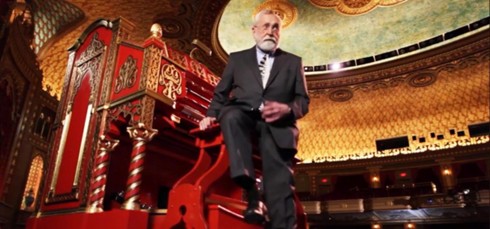
Bill Snyder. (Courtesy of Tennessee Theatre.)
We grieve the loss of our friend Bill Snyder, a remarkably unusual fellow in the history of any city. The respected engineering professor became dean of UT’s College of Engineering, and then the chancellor of the University of Tennessee, a role we may not imagine many engineers imagine for themselves. But Bill was a musician, too, and when he was still one of UT’s highest-ranking administrators, he became the house organist at the Tennessee Theatre. In 1979, when we were slowly realizing what a treasure that defunct movie theater was, and that by some crazy bit of luck, it still possessed its original 1928 Mighty Wurlitzer organ, even if it hadn’t been played in years. He had learned to play the organ before he was an engineer, back in the late ‘40s at the grand old Second Presbyterian Church on Church Avenue. Bill heard the theater, willing to try anything to get people in the door, were going to be showing the old Clark Gable movie San Francisco, and he came up with some appropriate Bay Area tunes to play just before the movie, concluding with, appropriately, “The Tennessee Waltz.” An elderly woman came up to him in tears, sharing memories of the organ and her late husband who had proposed to her in that room in 1936. Realizing that engineering students never responded to his lectures that way, he became associated with the organ, and with the Tennessee Theatre. First mainly a volunteer organist, a role he performed for 39 years, he became more and more involved in the management of the theater. When several for-profit ventures to revive the theater failed, it became a nonprofit, and Bill was one of its original directors. He loved that old organ, came to understand it better than anybody alive, and around 2001 launched a weekly mid-day organ recital, called Mighty Musical Monday. It became popular on its own.
His luxuriant gray beard and colorful suspenders suggested nothing of his roles as engineering professor or a university administrator, but more of a British sea captain or kindly warlock. Eventually he bore the title of Director of Community Relations, keeping an office backstage in the theater, and became the benevolent spirit overseeing the theater’s massively transformative restoration and expansion in 2003-2005.
It was not long after that was complete and declared a success that Bill proposed a historical narrative of that historic theater. He brought me a drink or two at the former Gay Street bar Sapphire, that it was important to tell the story of the theater, both its movie years and its memorable live performances from 1928 to the 21st century, and he thought I should do it. All we had were a few random photos and some lists of barely remembered performers left us by deceased lovers of the theater; it was hard to make sense of some of them. With months of research, much of it cranking through microfilm, we came up with a much more elaborate book than either of us expected. The Tennessee Theatre’s story offered a selective glimpse of almost a century of American culture, from architecture to jazz to Hollywood’s Golden Age—to urban decline and revival.
I was finished with my part of the book in late 2014 when I learned, suddenly, that I no longer had a job as a newspaper columnist. With no particular title anymore, and no salary, I felt lucky for the distraction of book signings, and to find a new identity, as an author of this grand new book about a fascinating theater. Bill’s inspiration and encouragement, and the popular reception of the book, was a big part of what convinced me there was maybe a place for something like the Knoxville History Project.
~ J.N. September 2025






Leave a reply