
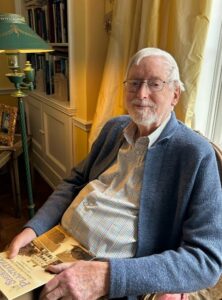
 We’re very sorry to lose our friend and consultant, Sandy McNabb, who was an important scholar of art and architecture, especially concerning his hometown of Knoxville. He died on the Lyons View hill where he grew up, in his strikingly unusual Italianate home, decorated by his late wife, Helen, who was a talented artist.
Although he traveled often, both in body and spirit, he spent most of his life on that hill, in the vicinity of Rostrevor, his grandfather’s mansion, now gone, and among what was left of the formal gardens that were part of the lives of the affluent of the Edwardian era. Several of his ancestors are notable in Knoxville history, including his great-grandfather, candymaker/wholesaler Martin Luther Ross and his grandfather, banker-industrialist William Cary Ross, but none are better remembered than his mother, Helen Ross McNabb (1910-1997), famous for her work with the mentally ill and founder of the center that bears her name.
As a child he was an aspiring artist, originally interested in automotive design, known for his drawings of modern cars. He credited his early interest in architecture to his fascination with a neighborhood landmark, the 1928 Hollywood-palatial Westcliff mansion of inventor Weston Fulton.
He attended Duke University and graduate school at Vanderbilt, then returned home to volunteer for the old Knoxville Arts Center, sometimes working with his cousin, philanthropist Ellen McClung Berry, whose artistic sense he admired. As a young man in the early 1960s, Sandy McNabb became director of the then-new Dulin Gallery of Art, forerunner of the Knoxville Museum of Art, planning several of its popular exhibitions of important artists, both local and national.
After leading an unsuccessful effort to save one of downtown’s most architecturally significant buildings, the ca. 1812 Strong House on State Street, from highway-exit construction—its demolition, replaced with nothing much, “radicalized me,” he once said—he co-founded the city’s first sustained preservationist organization, now known as Knox Heritage. That group did save the Bijou Theatre from demolition to become one of 21st-century Knoxville’s most appreciated musical venues.
He wrote the substantial chapter called “Architecture” in Heart of the Valley: A History of Knoxville, Tennessee, published in 1976 by the East Tennessee Historical Society, still respected as the standard scholarly history of the city. During that era, he served as president of ETHS.
In 1991, inspired by a Knoxville bicentennial exhibit at UT’s Frank H. McClung Museum, he authored Tradition, Innovation, & Romantic Images: The Architecture of Historic Knoxville. It was the first popular book about the city’s architectural legacy.
He was the 2024 recipient of the Knoxville History Project’s William Rule Award for lifetime achievement in local history. He has been a valuable source for information about our architectural past, and a good friend.
A lifelong student, he remained interested in world architecture and enjoyed sharing what he had learned. He traveled much in later years, especially to Italy, where his learned affect earned him the sobriquet “il Professore.”
He leaves his family and his intellectually lively Friday lunch club, and the many friends who attended his memorable family Christmas parties.
~J.N. April 2025






Leave a reply