
The House on Locust Street
The Masonic Temple, and its depth of dramatic history
A lot of us are perplexed about the recent news that one of downtown’s architectural landmarks is under immediate threat. The old neoclassical building of amber masonry and lofty columns known as the Masonic Temple has stood there on the crest of the hill of Locust Street from the earliest memory of anyone who’s alive today. Much longer, in fact; in a previous era, its appearance changed so radically that it’s a nominee for the most peculiar historic building in Knoxville.
It’s not publicly for sale, and the owners have made no public plea to save it. But at this writing, a demolition permit is in process.
Just as the Masonic Temple, it’s plenty old, dedicated as the Masons’ downtown headquarters 110 years ago. Its current persona has a birthday coming up. On October 27, 1916, the Masons proudly presented their new “temple” to the world, with a program printed: “Erected to the Glory of God / Dedicated in the Name of Holy Saint John / to The Service of Humanity.”
An orchestra played, a quartet sang, and there were dedicatory speeches. It was a matter of great public acclaim, even among people who are not Masons. The Knoxville Sentinel declared in a headline, “No City Its Size Can Boast of More Beautiful Masonic Temple.” A reporter called it “one of the most attractive in the country.”
***
That’s how it seemed in 1916.
In fact that building is much older than that. It’s a rare survivor of the era when the western part of downtown was known mainly for single-family homes. There were few just like this one. At the Masonic Temple’s core is the old McGhee Mansion, which was a Gilded Age icon. In the fields of business, industry, and finance, Charles McClung McGhee (1828-1907) was Knoxville’s single leading figure during Knoxville’s period of most rapid growth. Descended from Knoxville’s founders, McGhee had resources to begin with, but in an era when there was no income tax, he made millions in railroads and coal and iron, and was also involved in banking, textiles, flour, and higher education. Everything he touched took off, and he translated his successes into major philanthropy toward the city he helped build, emerging in history as our own version of Andrew Carnegie.
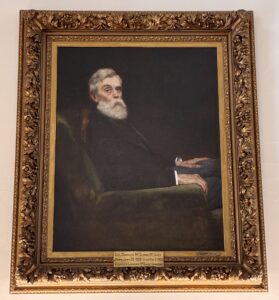
This painting of Col. Charles McClung McGhee by French artist Benjamin-Constant hangs in the McClung Historical Collection.
When he was born, on a farm in Monroe County, Knoxville was a stranded leftover of a previous age. The wonders of steam travel, of steamboats and railroads and factories, showed little interest in an old frontier town hemmed in by the mountains. Knoxville was just the remnant of a pioneer capital where hardly more than 1,000 people were finding some reason not to move somewhere more relevant to the changing times.
But during McGhee’s remarkable 79 years, Knoxville grew to be more than 35 times the size it was when he was a kid. It became a real city, with competing daily newspapers, two 24-hour train stations, a big opera house and other competing theaters, a major university, baseball teams, an efficient and modern electric-streetcar system, more than 100 saloons, and a diversity of major industries, much of it made possible by McGhee’s advances in connecting Knoxville to the rest of the continent by railroad. He created the Knoxville and Ohio, and he was once the chief of the East Tennessee, Virginia, and Georgia Railroad, which he cobbled together from parts of lesser railroads, creating the biggest railroad ever based in this part of the country, and one of the two or three major railroads in the South. It was one that especially interested McGhee’s younger contemporary, J.P. Morgan, who eventually bought it to create the Southern Railway.
It was pretty early in that dynamic American story that McGhee built his house there on the hilltop in 1872, on a design by Joseph Baumann, a talented young man of German heritage who was just then advancing his career from building contractor to Knoxville’s first full-time architect. Baumann designed the McGhee house in the fashionable Second Empire style, the Gallic cousin of Victorian architecture that became famous during the reign of Napoleon III, when that latter-day emperor rebuilt Paris anew. The same year, Baumann had used a related Second Empire design to create Peter Staub’s grand Opera House on Gay Street; the first big theater ever built in Knoxville, it seated more than 1,100 and hosted dozens of the greatest performers in the world for 75 years.
The McGhee house’s 40-plus years as a residence could fill a dramatic novel of triumph and heartbreak, the sort of saga that might be adapted for a PBS miniseries. By my count, at least a dozen people lived there over the years, most of them women. Several of them found their way into the national news, happily or otherwise.
Here the widowed McGhee lived with his second wife, Cornelia. Although she was granddaughter of Irish immigrant Thomas Humes, who had built the Lamar House in 1816, she was also the great-granddaughter of James White. She and McGhee were second cousins. They had five children, all girls. The second oldest, born just before the Civil War, was Lawson McGhee, whose name you may have heard before. She was about 12 when the family moved into the house. For her and everyone else, it was an exciting day.
Although some found the house gloomy and forbidding, its grounds were colorful in the spring, a lush bouquet of flowering trees, including redbuds and dogwoods before they were widely popular.
C.M. McGhee could seem dour, but the majority of residents in his house were women, and they enjoyed entertaining, and that house was built for it, with parlors, dining rooms, a reception hall, and a library. The parties they hosted lingered in some memories for decades to come.
The House on Locust Street hosted notable parties, including a crowded reception for the new Republican president in 1877. Rutherford B. Hayes had arrived on McGhee’s railroad. Less known is the fact that the same house would later be home of a former governor. More about him in a bit.
According to a story recorded half a century later, the first telephone call in Knoxville’s history happened in that building. It didn’t get in the news at the time, but in years to come, elderly educator Lucy Crozier claimed it happened at a New Year’s party at the McGhee house, probably at the beginning of 1878. Among those present were several excited young society women, including Lucy’s sister, future suffragist Lizzie Crozier French. It was an in-house call, she said: a young man named Edward Parmalee and Lewis Baxter, an impressive young lawyer and banker who had connections to the McGhee family and later ran for governor, “rigged up something between the reception hall and the dining room” and suggested that one of the women speak into one end of the contraption, as the other listened in the other room. They were amazed and delighted with the results.
That story from a 1928 newspaper story is credible; the resourceful Col. McGhee was known to be interested in Mr. Bell’s new invention, and installed one of the first lines to connect two local offices of railroads in which he had an interest.
It was a lively household dominated by talented young women. By the time they were in their late teens, McGhee’s two oldest daughters, Margie and Lawson, were notable for dramatic performances. The duo were close, and enjoyed their unusual advantages, sharing a steamship trip to Europe in 1875, one of many trips to Europe for the footloose McGhee sisters. Back home, Lawson and Margie were crowned as two “Maids of Honor” at the “Bal Masque” at Staub’s Opera House in 1877. For the Aonian Society, Lawson assembled a tableau called “Magic Mirror.” What that looked like is regrettably elusive.
In early 1880, Lawson was a bridesmaid for Margie’s wedding to George Baxter, the son of the famous and once controversial Judge John Baxter. But handsome, mustachioed Lt. George W. Baxter himself was an ambitious young cavalry officer with a surprising political destiny. Serenading the wedding at St. John’s Episcopal Church was the celebrated soprano Sue Boyd Barton, “Knoxville’s Jenny Lind.” Officiating was the president of the newly christened University of Tennessee, Dr. Thomas Humes. Son of the aforementioned Irish immigrant, Dr. Humes was an Episcopal reverend and the former rector at St. John’s. He didn’t do much of that anymore, but then Cornelia McGhee, the mother of the bride, was his sister.
At 21, Lawson McGhee sometimes hosted receptions at her father’s grand house on Locust, but also accompanied her married sister on vacations. In October 1881, in New York, Lawson married businessman D. Shelby Williams of Nashville. They said they were settling in Knoxville, but happened to be in New York a little more than a year later, when she gave birth to a daughter. Three weeks after that, likely as a too-common result of childbirth, she died. By one account, she had pneumonia; by another, typhoid. She reportedly used her final breaths to sing, “Nearer, My God, to Thee.”
Her crowded service at St. John’s was, according to the Tribune, “the saddest funeral Knoxville has known for a long time.” Late mourners had to be turned away at the door. The officiant was Dr. Humes, still president of UT; and once again, the incomparable Sue Barton sang: this time, a secular song called “Bring Flowers,” about the death of a young bride, and at least partly about her home: “She is leaving the home of her childhood’s mirth / She hath bid farewell to her father’s hearth….”
Lawson McGhee was buried at Old Gray Cemetery.
Don’t look for Lawson’s stone there near the prominent McGhee obelisk. The story is that she never had a stone, because her father could not have borne to see it. Instead, he donated money to found a library, the first durable one in Tennessee history, and to name it after his daughter, Lawson McGhee. (A reference to a married woman by her maiden name was unusual; we can only guess what it implied, concerning McGhee’s attitude toward Mr. Williams.)
The baby, “left alone and motherless,” is rarely mentioned afterward, but was named May Lawson for her mother. By one report, she died four months later, at Montvale Springs, then considered a health resort.
C.M. McGhee returned to his home on the hill. He had just married another daughter, Annie, off to a second cousin, Calvin Morgan McClung. The successful wholesaler is remembered today as the antiquarian whose library would be the basis of what’s now known as the McClung Collection.
One of the mansion’s happiest occasions, in February 1886, was the wedding of Bettie McGhee to dashing young cavalry officer Lawrence Davis Tyson, who had recently been involved in the campaigns against Geronimo and the Apaches. The ceremony took place “at the palatial residence … in the magnificent salon, parlor, and dining halls of the elegant mansion…. All that the eye and ear could wish for was placed at the command of the invited guests.”
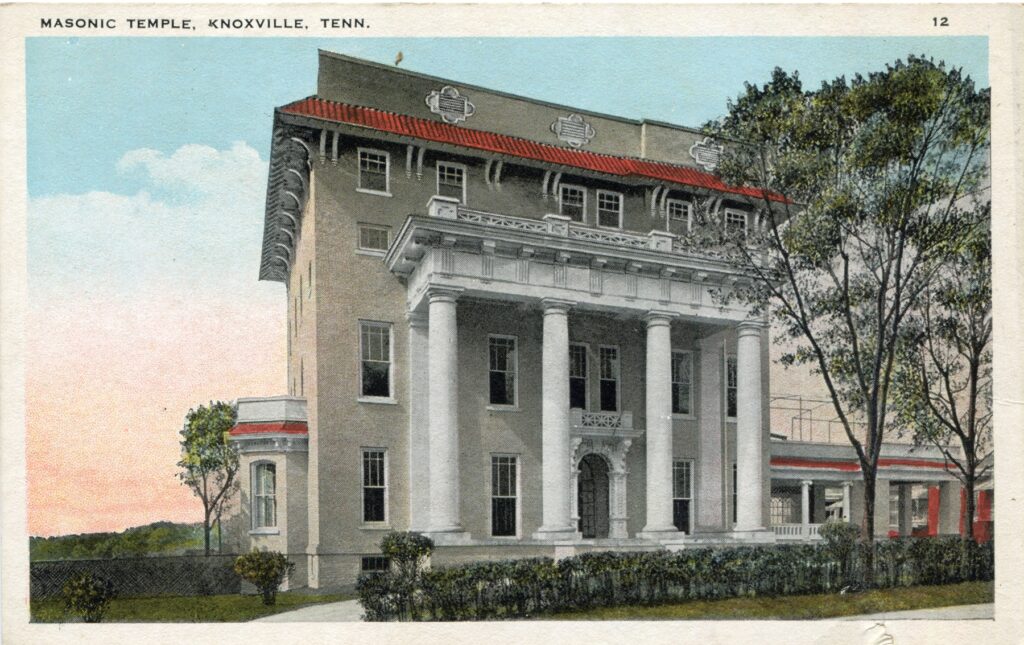
The Masonic Temple showing the south-facing bay window, a prominent feature its days as the Charles McGhee house. (Alec Riedl Knoxville Postcard Collection/KHP.)
That bay window, still visible on the south side of the building, advertised the union to pedestrians on Locust Street with a large “wedding bell.” Bettie joined her husband at military posts out west for about five years, when they sometimes connected with her sister, Margie, in Cheyenne. Lt. Tyson gained an appointment at UT in his wife’s hometown, to teach military science, and moved back here, where he got involved in industry, like his father-in-law. Tyson later served as a colonel in Puerto Rico, in the wake of the Spanish-American War, as brigadier general in World War I, and finally as a U.S. senator from Tennessee. He was also a Mason.
Naturally, given that Rev. Thomas Humes was Cornelia’s brother, the McGhees were close to St. John’s Episcopal Church, a three-block walk from home. Built in 1892 to replace the previous building, the stone church with the red door we know today was largely made possible by the generosity of Col. McGhee.
***
Despite their resources, tragedy wasn’t done with the McGhees. Married to ambitious wholesaler C.M. McClung, who was creating a mail-order empire, Annie McGhee McClung was known for her “sweet spirit and loveable character.” She had at age 35 survived two childbirths, and had spent a summer in Europe with her family, including mother, youngest sister Eleanor, husband, and two daughters, when they stopped in the fashionable resort of Sarasota, N.Y. Out on the town, Annie fell from a horsedrawn carriage. It appeared that a badly broken arm was the worst of it. But after a painful evening, she died the next day, reportedly of unnoticed internal injuries.
His household much diminished, father C.M. McGhee, who by age 70 had lost two of his five daughters, became scarcer in the old mansion with its memories, favoring the financial world of New York.
After 46 years of marriage, matriarch Cornelia died in New Orleans in 1903, the day before her 67th birthday. Her funeral, at the house on Locust, drew Knoxville’s most prominent and talented, including future Supreme Court Justice E.T. Sanford; editor/mayor William Rule; medical authority Dr. John Mason Boyd; pharmaceutical executive A.J. Albers; Judge O.P. Temple; future football-field donor William S. Sheilds; and Swiss immigrant civic leader Peter Staub. It was a musical funeral in the beloved old house; among the singers there was Mary Fleming Meek, who later wrote the song sung by tens of thousands in Neyland Stadium, UT’s alma mater.
By his early 70s, McGhee had two daughters who were still alive and in town. Bettie and Margie had something in common: as wives of Army officers, they’d both ventured out to live in the Wild West, and both spending time in Cheyenne, Wyoming, adventures unusual for daughters of eastern millionaires.
The middle sister, Bettie, who had married Lt. Lawrence Tyson, had a son, known here as one of Knoxville’s first golf champs. But Lt. McGhee Tyson was also the enthusiastic pilot who was killed in an aerial crash in World War I. It was Bettie’s idea to memorialize him with the name of a city park and a municipal airport. She would be an important figure in Knoxville’s ambitious if sometimes frustrating efforts of the City Beautiful movement, involved in park proposals all over town, including Caswell Park, which still exists, and Luttrell Park, which doesn’t. Bettie McGhee Tyson, who grew up in that house, should be considered a motivating pioneer of Knoxville’s public-park system.
In spring 1907, just as the dogwoods were blooming, Charles McClung McGhee was back home on Locust Street after a vacation in Florida when he came down with pneumonia. He was 79, penicillin didn’t exist, and it looked serious. His three surviving daughters, Margie and Bettie who were back in Knoxville after their Wild West adventures, and Eleanor, from her home in Memphis, gathered at their old home place when he died on the evening of Sunday, May 5. News of his death made headlines in New York, Washington, St. Louis, New Orleans, and Cincinnati.
His oldest daughter, Margie, remained in the home with her husband, George W. Baxter. They were in their 50s, and it was their family home for just about five years. Baxter, the former cavalry officer, was not as well known here was he had once been out West.
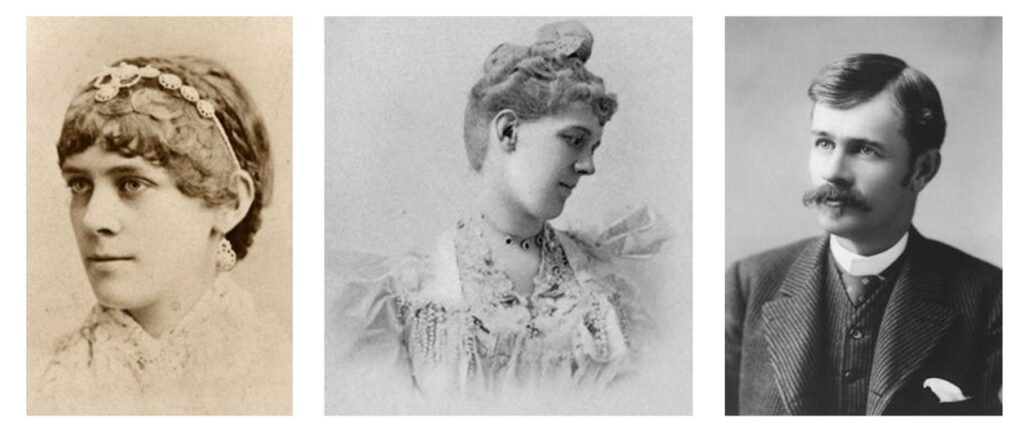
L-R: Lawson McGhee, Bettie McGhee Tyson, and George Baxter. (FindaGrave.com.)
More than 20 years earlier, in November 1886, President Grover Cleveland had appointed the young cavalry officer from Knoxville to be the territorial governor of Wyoming. Retired from the Army, Baxter had remained there as a popular young cattle rancher, and the news of his elevation to the territory’s chief executive was reportedly caused “great rejoicing among the people” of Cheyenne. The rough-edged town of about 10,000 greeted Baxter’s accession to the territory’s highest office with a torchlit procession, band music, and “impromptu meeting” with speeches, and fireworks.
Settlers had just begun building Wyoming’s impressive capitol building in Cheyenne, in the southeastern corner of the state, close to Colorado and Nebraska.
Wyoming was remarkable for several reasons, one of which is that it was the only state or territory in the 1880s to allow women to vote. Yellowstone, the nation’s first national park, was already there, and under federal control, implying some role for the territorial governor. But it was also a land of outlaws, in the years just before the Hole in the Wall Gang coalesced, including Kid Curry, who would later find his way to Knoxville. And things weren’t yet settled with the Shoshone, Arapaho, and other natives. Wyoming was an administrative challenge.
However, it emerged that Baxter had erected fences on public land in Wyoming, strictly contrary to the cowboy way. He resigned after only seven weeks on the job. It wasn’t the shortest term for a Wyoming territorial governor. But maybe he’s now a trivia-night question: Other than William Blount, what former governor once lived in a building still standing in downtown Knoxville?
When Wyoming became a state, four years later, apparently having mended fences—or perhaps removed them—Baxter was the Democratic nominee for governor. When that didn’t work out, he was twice nominated for U.S. Senate from Wyoming, also without success. Perhaps tiring of the vicissitudes of Wyoming politics, Baxter and his family moved to Denver, then, very early in the century, back to Knoxville.
When he lived in the house on Locust Street, the society-page editors often referred to him as “Governor Baxter.” (By the way, the New York Times sometimes referred to him as the former governor of Tennessee; others claimed he was the former governor of Colorado.)
Baxter and his wife had mostly daughters, too, and like the previous generation of sisters, they lived transatlantic lives, spending time overseas. Three of them, Margaret, Cornelia, and Katherine, would be hailed in Europe as “the Three American Beauties”—according to the Des Moine Tribune, at least. (It seems a little cruel that they excluded the youngest sister, Eleanor.)
The oldest sister, Cornelia, named for her grandmother, got in the national news, especially in 1901, when she, engaged to be married to the son of the governor of Colorado, suddenly had other ideas. With the wedding invitations already sent, she met and suddenly married San Francisco Wells-Fargo millionaire Hugh Tevis, 21 years her elder, and took off for a honeymoon in Japan. (By some accounts, she preferred to be known as Constance; that may have been an aspiration.) But Mr. Tevis, having landed this famous beauty, died of appendicitis in Japan, leaving Cornelia his fortune, in spite of the fact they’d been married only a few weeks.
But it was a significant few weeks: she soon learned she was pregnant with a son. Much in demand both for her beauty and her fortune, Cornelia spent most of the rest of her life in Europe, marrying three more times. The woman who courted scandal by marrying a much-older millionaire completed her marital career by marrying a man 24 years her junior, one William Gower—who had previously been married briefly to another famous heiress, the mysterious Hughette Clark, subject of a recent nonfiction bestseller called Empty Mansions. That book briefly mentions George W. Baxter and Cornelia, sometime residents of the House on Locust Street, though it refers to Baxter only as “a wealthy politician from the western states.” When there are McGhees and Baxters involved, it’s always a challenge to tell the whole story.
Cornelia was in the news again when the son she was carrying when her first husband died in Japan sued his mother for that inheritance. That seems to be still another story.
There’s a lot to keep up with, and obviously a lot more to the story of all the people who lived in the House on Locust Street.
Cornelia’s father, “Governor” George W. Baxter, and his remaining family still lived in the McGhee house in 1911, when the Knoxville Sentinel ran an unusual tribute to the house, calling it a “Model of the City Beautiful,” illustrated by photographs taken by the talented young photographer Jim Thompson, and emphasizing its welcoming reputation: “during the 40 years of the present house’s existence, no door in the city swings open more readily, and none has been more justly famed for its generous and splendid hospitality.”
By 1914, when their youngest daughter was 18, and George Baxter and Margie McGhee probably figured they didn’t need such a big house anymore. They sold it to the Masons.
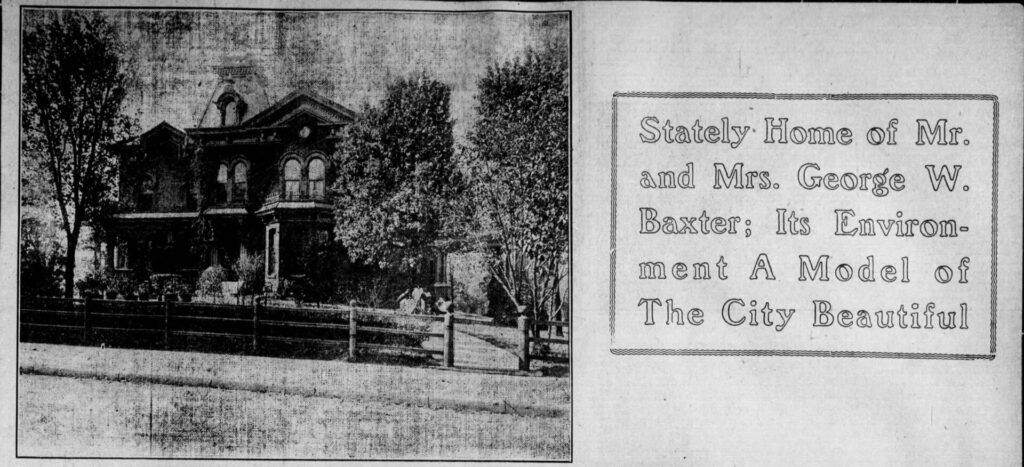
Knoxville Sentinel, April 17, 1911.
***
The old house, with its tower, was big enough, but it didn’t look like any kind of a Temple, and by that 20th-century era of automobiles and airplanes, its Second Empire style was steeply out of fashion. Despite its associations with Paris, it struck young people as gloomy. The Masons enlisted A.B. Baumann, the much-younger brother of the McGhee house’s original architect, to connect it to a new purpose in a new century. It probably wasn’t a difficult hire: Baumann, who made the building look like it does today, was one of the directors of that chapter of the Masons.
Baumann chose to make it a neoclassical monument, with tall Doric columns. Although it looks like an utterly different building, Baumann left a few features of the mansion his big brother designed for McGhee, 45 years earlier. The grand front door is almost exactly the same. And the bay window on the south side, where the “wedding bell” for the McGhee-Tyson wedding of 1886 was displayed, is still visible.
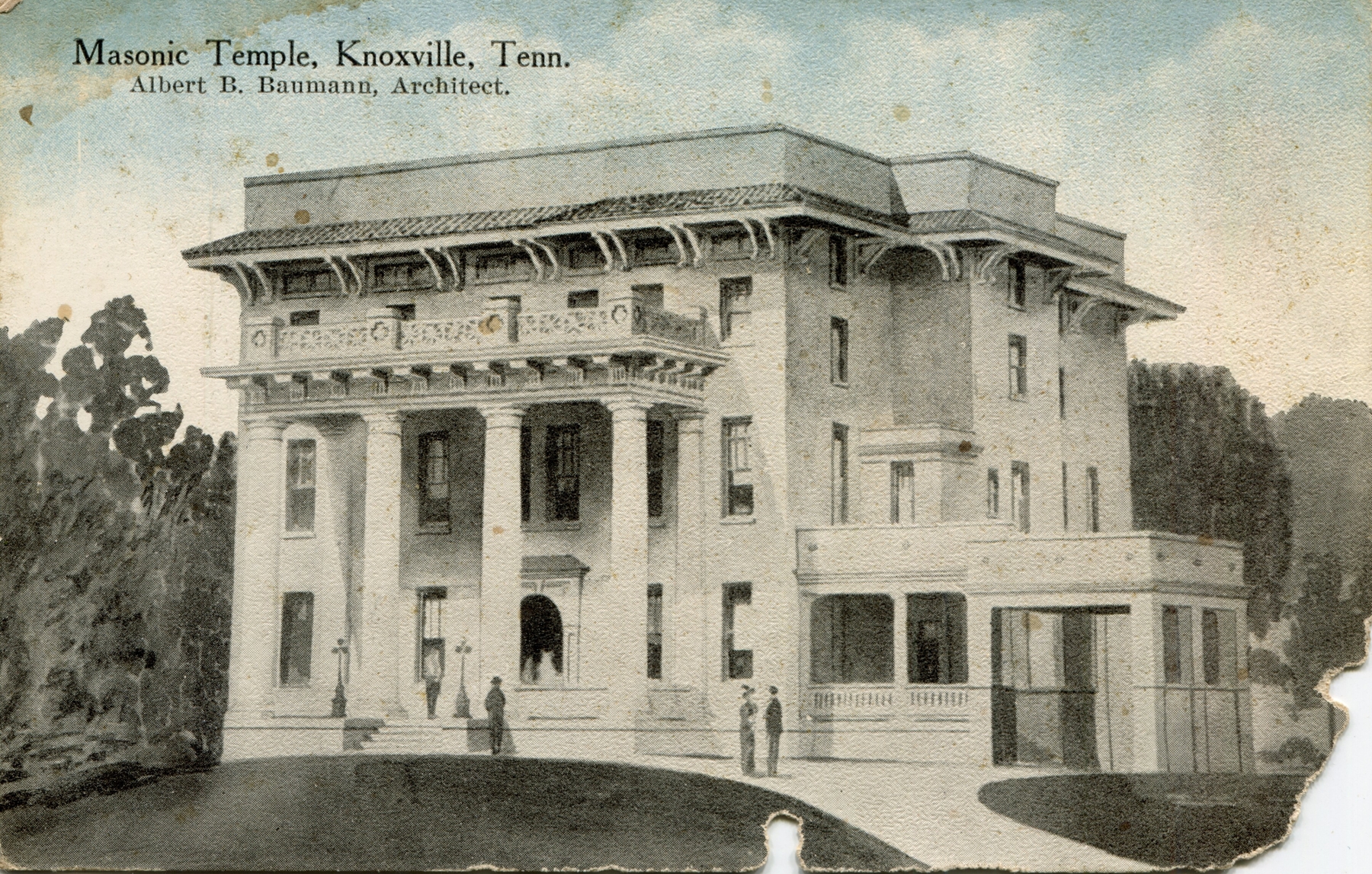
On this vintage postcard, Albert B. Baumann is identified as the architect who remodeled the McGhee house for the Masons. (Alec Riedl Knoxville Postcard Collection/KHP.)
McGhee’s 1872 mansion is the oldest existing building associated with the architecturally prolific Baumann family. The remodel was the last work of the Baumann family before A.B. Baumann’s college-educated son, A.B. Baumann, Jr., joined the studio to create the firm known as Baumann & Bauman.
(It’s interesting, but probably a coincidental sign of the times, that the Tyson house where Bettie and her husband lived near UT’s campus, underwent a very similar extreme facelift around the same time to ditch the old Victorian style for a cleaner, neoclassical look, with columns out front.)
Rarely is the construction of a Masonic temple so closely watched by a non-Masonic public and press. The second and third floors were redesigned to accommodate secret Masonic rituals, as the Sentinel described it, “the mystic rites of the order will be performed amidst paraphernalia suitable to their solemnity.”
J. Putnam Stevens, “imperial potentate of all the Shriners of North America,” declared it to be “probably the best in the United States, considering the amount of money expended on it.” The temple has been admired beyond East Tennessee. A photograph of it hangs at the Masonic building in Washington, characterized as a model of good Masonic architecture.
In its early years, the Masons seemed committed to honoring the house’s open-door reputation, rendering it a public asset, just down the sidewalk from Market Square, what we might call an event space. Inside and out, the Masonic Temple became even more familiar to Knoxvillians than it had during its Gilded Age era. It was only months old on March 1, 1917, when the Welsh Society of Knoxville entertained a reported 500 people there for St. David’s Day, celebrating Welsh culture with a buffet luncheon and a musical program dominated by star sopranos singing familiar tunes, some of them in Welsh. In 1918, during World War I, it was the location of a Red Cross workroom, where as many as 200 women assembled to make bandages for soldiers and make “dresses and aprons for French and Belgian orphans.”
The Tennessee Bankers Association held their three-day convention there in 1919. The legal fraternity Phi Delta Phi held its banquet there in 1920, involving several of the best-known lawyers in Knoxville: John Webb Green, Hugh B. Lindsay, D.C. Webb, and the legendary John R. Neal. Three years later, the same organization gathered there to toast one of its members, Judge E.T. Sanford, as he left town to take his place on the U.S. Supreme Court. Sanford already knew the house well; his father and McGhee had been close partners. The whimsically mysterious young women’s social club called Losu-Wriba, which was at least partly a bridge club, hosted one of its first dances there in 1920. In 1923, the Daughters of the American Revolution hosted lectures there, including Mme. Mary Boyce Temple, talking about her recent adventures in South America. In 1924, after nearby Boyd Junor High School burned down, the Masons offered their building to be used by public-school students for classrooms.
The Masons used it too, of course, sometimes hosting carnival-like “entertainments” for the public in that building, as in 1919, when they produced a program called “Sylvan Gardens,” which reportedly included actual gardens but also games. For decades, a women’s auxiliary, the Order of the Eastern Star, held meetings there, and often got more attention in the newspapers than the men did. One of the lodge’s most prominent members was a name many boys might recognize, that of W.P. “Buck” Toms, industrialist and progressive civic leader who introduced the Boy Scouts to Knoxville, and for whom the region’s best-known Boy Scout camp is named.
But it appears that by the Roaring ‘20s, many non-Masonic Knoxvillians had fond memories of social events held inside the unusual building. But everybody saw it. It was there when they built the YMCA building right next to it in 1929.
It would seem that public-event era dwindled in years to come, but for most of us the unusual building on Locust remained a familiar and unique landmark. When author James Agee returned to his hometown in 1935 to write an often-quoted feature article for Fortune magazine about the strange new Tennessee Valley Authority, he used this old building for orientation: TVA’s headquarters, where hundreds were making region-changing decisions in the building now known as the Pembroke, were “a block this side of the Masonic Temple.” In the late 1950s, the elderly Buck Toms announced they were looking to leave the downtown temple, about 40 years after they moved in, just to find a site with more parking. They apparently found a work-around.
On a few rare occasions, the building has been open to the public, as in 1991, for its 75th anniversary, when the late Mike Flannagan wrote a feature about it for the News-Sentinel, and again for two hours in 2011, when Alan Sims, of InsideofKnoxville.com, visited and took some photographs. Everyone remarks on how much remains intact, much of the interior woodwork surviving from the original days of C.M. McGhee and his hospitable family.
Arts historian W.R. “Sandy” McNabb published history’s only book to date about Knoxville architecture, Tradition, Innovation, & Romantic Images, published in association with a then-current exhibit at UT’s McClung Museum. In the book, McNabb displayed colorful photographs of Knoxville’s most notable buildings. The McGhee house, both versions, got a full spread. It’s one of only nine historic residential houses still standing that made his list.
Of course, he may have had some personal interest in the building. He was a descendant of C.M. McGhee and other people who lived in that house. In fact, if we were to make a list of all the people who are descended from people who lived in the House on Locust, it would be long and impressive, not just locally but nationally, from Helen Ross McNabb, local champion of the mentally ill; to Drew Gilpin Faust, author and first female president of Harvard; to my old boss, Joe Sullivan, longtime publisher of Metro Pulse.
But just as a building, just as a Masonic Temple, it has served important purposes, in housing the region’s oldest fraternity, one that has supported important charities, and played a memorable role in the lives of hundreds of freemasons themselves. I learned just this summer that my grandfather’s Masonic funeral ceremony was held in that building in 1968.
In a city that saved very few of its original buildings, and only a handful that were built before the Civil War, the distinctive building on Locust Street is one of the 10 oldest buildings downtown, older than the Knox County Courthouse, older than the Custom House, older than any downtown church, older than any building in the Old City area. Even if we leave out the specific stories of the McGhees and the Baxters, it would be very hard to argue that it’s not historic.
It needs a new roof, and has some leakage problems that suggest repair, but I’m told it’s still a pretty solid building, most of it in good shape. I’ve spoken to a couple of Masons about the dilemma who have expressed an interest in preserving the building somehow. They have a complex organization, with both local and statewide governance. There’s been some mention of a non-disclosure agreement, and some question about who’s ultimately responsible for it. But at this writing, despite the demolition permit, it doesn’t sound like it’s doomed, though it may take some cooperation with local agents to help make a long-term solution a reality. So for now, the unusual building with the big columns is still there to behold, even for us on the outside, and maybe ready for the next story to unfold.
By Jack Neely
- PARTNERS
-

-

-

-

-

-