
The Elusive Knoxville Mardi Gras
(Or, what do Frances Hodgson Burnett and George Takei have in common?)
We may not often associate Knoxville with Mardi Gras, a French term to describe a Catholic tradition. But there’s more to it than we might expect.
To begin with, Knoxville had several associations with New Orleans. They’re both 18th century cities that were once capitals. When Knoxville was capital of the Southwest Territory, then of Tennessee, which both bordered on foreign lands, New Orleans was the next capital over, capital of a Spanish territory, then a French one. Decisions made in New Orleans were of some concern to the first Knoxvillians.
I’m not sure New Orleans worried as much about Knoxville, but they did like our liquor. Even before the era of steamboats, young Tennessee riverboatmen seeking to sell East Tennessee whiskey at top prices tended to find themselves downriver at New Orleans. You may know, but I’ve often found that not everybody does, but New Orleans is where all the water that flows by Knoxville eventually goes. The Tennessee flows south into Alabama then north into the Ohio, which flows into the Mississippi, which flows south. It’s a long trip. On a raft, or a flatboat, it takes a few weeks. Liquor wasn’t the only valuable those early riverboatmen brought. The hardwood of their flatboats, rare in southern Louisiana swampland, was useful in architecture. They’d sell their Tennessee whiskey, then break up their flatboats, which were useless at the end of the one-way river, and sell it for architecture. Some wooden buildings in the French Quarter show the bores and rope burns of their origin in flatboats.
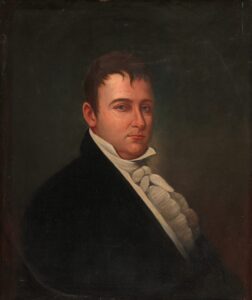
William Charles Cole Claiborne (1773/1775-1817). Portrait of Claiborne as Governor by Andres Molinary, 1912. (Wikipedia.)
And we had some interesting individuals in common. A future New Orleans legend was a familiar figure in Knoxville’s earliest days. W.C.C. Claiborne was often in downtown Knoxville between 1794 and 1801, including a period when, as a college-age kid, he was a judge with the Tennessee Superior Court. Then he was here for a few intensive weeks in early 1796, when at age 23 or so (no one knows exactly when he was born) he became the youngest signer of the original Tennessee Constitution. Then he became one of Tennessee’s first congressmen. Claiborne County is named for him. The same guy moved to New Orleans in 1803 representing the Jefferson administration as governor of the newly formed Orleans Territory, later to be elected first governor of the new state of Louisiana. Although his legacy is complicated, he tried to seek peace among the stew of cultures in the potentially volatile and foreign culture. He was likely invited to a few Mardi Gras parties. Did he have an influence on Mardi Gras? It’s not absurd to think so, because he seemed to try to encourage cultural acceptance, in hopes that New Orleanians would someday accept Anglo Americans. Today, the longest street in New Orleans is named for him. Claiborne Avenue fits like a long hat over the top of the oldest part of that city.
One family who took that trip after Claiborne were the Farraguts, when after the Louisiana Purchase, Jefferson cherry-picked French and Spanish-speaking people, to help Claiborne represent the U.S. government in New Orleans. One was Spanish-born Jordi Farragut-Mesquida, who ran a ferry across the river near Campbell’s Station. His Knox County-born son, David Glasgow Farragut, would grow up mostly in New Orleans. (His familiarity with his second hometown would come in handy in 1862, when as a U.S. admiral, he led his fleet up the river at high tide to seize the largest city in the Confederacy without even killing anybody.)
During Claiborne’s era and into the mid-19th century, the native Spanish and French-speaking Catholics of New Orleans were celebrating Mardi Gras. It was the last option for parties before the abstemious era called Lent. But those early Mardi Gras parties were mostly invitation-only affairs, masquerades and society balls held inside the halls and courtyards of the Vieux Carre. Mardi Gras parades aren’t known to have been held until 1857, and they were kind of renegade parties, populated mostly by non-Catholics of all races. To enjoy them, you didn’t have to know anybody or pay anything or even observe Lent.
Except for a few interesting predecessors in Mobile, which claims to have introduced the concept of Mardi Gras, the first organization to sponsor a big Mardi Gras parade was New Orleans’ Mistick Krewe of Comus, which was said to be an offshoot of the Pickwick Club, an organization of young men who were fond of novelist Charles Dickens’ early book, Pickwick Papers, known for its eccentric characters. The same book had fans in Tennessee, of course; Hardin County’s Pickwick, Tenn., the namesake of TVA’s Pickwick Dam, was inspired by the same book. At least one member of the krewe that launched that first parade was a native of Wilson County, Tennessee.
Knoxville was at least aware of the hubbub. A vivid account of the second Mardi Gras parades in 1858 appeared in The Southern Citizen, Irish fugitive refugee John Mitchel’s Knoxville-based Secessionist paper, though the account seems to have originated via a Cincinnati correspondent. “The grand Catholic fete of Mardi Gras, or the last day of the Carnival, was celebrated this year with more than usual eclat. The day first appeared with grotesque masquers at the street corners …. At noon the masked figures—males and females, friars and nuns, Indians and Negroes, riding and walking, drunk and sober—had become numerous. They were street characters, and their business was to amuse with tricks …. It was in fact a holiday to all kinds of business, save that which ministered to the pleasure of the senses…. The grand out-door finale of the occasion was the procession of the ‘Mistick Krewe of Comus’” represented “a very perfect succession of masked groups, representing all the gods of Heathen mythology….”
But the war, aided Union occupation enabled by Farragut, suppressed New Orleans’ Mardi Gras for a few years. It came roaring back into the public consciousness after the war, especially in the early 1870s, when Mardi Gras seemed to be catching on all over the South. In 1872, even Knoxville jumped in, with a big party at the Franklin House, a hotel that stood where our later “old courthouse” was built. The Bal Masque, as it was called—a masquerade—seems to have been organized and attended mostly by Germans, including Nicholas Eifler, who came as Mephisto, the devil from Gounod’s opera, Faust. Opera was especially popular among the Germans, that year of the opening of Staub’s Opera House. Another Knoxville Mardi Gras reveler, Joseph Gratz, “looked every inch a Napoleon.”
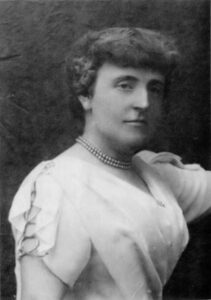
Frances Hodgson Burnett (1849-1924), photographed in 1888. (Wikipedia.)
Several British immigrants were also prominent, including the young lady who won a prize for “Best Lady Mask” for her costume as “Aurora.” Her name was Fannie Hodgson. Already a successful writer selling stories in national women’s magazines at the age of 22, she would later be better known by her married name. Frances Hodgson Burnett, author of The Secret Garden and many other internationally popular novels. She was awarded a “beautiful bouquet.” Maybe she was happy with that, but the male costume-context winners won bottles of champagne and smoked hams.
Her brother John, then a popular bartender, came as a “fierce Papal Zouave.” Her other brother, Herbert Hodgson, led the dance band.
Another more distant literary connection was celebrating there, as well—William Wood, the English-born watchmaker who would be grandfather of the yet-unborn author Joseph Wood Krutch, came in an embroidered French coat as “ze Grand Monarque.”
The Knoxville Chronicle noted “the most outre characters were the Shanghai Cock … and the perambulating German Windmill.” Perhaps readers in 1872 might have been able to comprehend and picture this rare sentence: “Spotted Tail was there with his scalping knife and arrow, zealously guarding a nymph from the approaches of an ape, while in the next set might have been seen a shaven monk tripping the light fantastic with a jaunty vivandierre.”
They served supper at midnight. “The party present was large and more than the room could comfortably contain,” reported the Chronicle, “but space was cleared for the dancers and all enjoyed themselves splendidly.”
Despite its rousing success as reported, that event may never have been duplicated.
You wonder whether it might have grown if not for the distraction of the railroads to the cities that started it all. The following year, railroads were advertising “Grand Excursion Trips” to Mardi Gras in both Mobile and New Orleans, and we know some Knoxvillians did make the trip. That year, William Yardley, the noted African American attorney, took the train to Memphis to celebrate Mardi Gras there. Memphis, Nashville, St. Louis, and other river cities started their own Mardi Gras traditions.
For decades, Knoxvillians of means took the trains to the Gulf Coast and river cities that celebrated Mardi Gras in a big way, and with the most festive among us away for the week, local Mardi Gras celebrations seemed to evaporate—or at least we didn’t often use that term for local fetes. Still, that Tuesday often got pretty fat and crazy anyway.
More universal, among some Christian denominations at least, is the concept of Lent, the 40-day period of abstinence which would seem to undermine the late-winter social calendar. Though it’s not a Biblical command, and not observed by most fundamentalists, Catholics, Episcopalians, and many Lutherans and Methodists did observe Lent. Society folks who liked to host parties were obliged to squeeze them in before Ash Wednesday, so naturally the previous Tuesday became a popular day for last-ditch parties, even if we didn’t use a French phrase to describe them. Knoxville sometimes used the old English term, Shrove Tuesday.
It appears that phenomenon was notable by 1885. With Lent approaching, noted the Daily Chronicle, “most entertaining will have to be done before that time. The Shrove Tuesday festivities will equal the earthquake in Spain.” Historians might find reason to question that analogy. The recent “Andalusian earthquake” destroyed almost 5,000 buildings and killed 1,200.
One of the most extravagant of these urgent pre-Lent parties was in February 1892, when Lizzie Crozier French’s relatively new women’s organization, the Ossoli Circle, hosted a party to which each of its members could invite three guests—plus Ossoli’s male counterpart, the literary Irving Club. It happened at the apparently capacious home of Dr. and Mrs. Robert M. Rhea, on what’s now known as 17th Street. As described in the society pages, “it fittingly closes the gaieties of the season until the expiration of Lent. About 250 celebrants were expected. But by one account, about 400 showed up that Tuesday night in West Knoxville.
But years passed, and things changed. I doubt my most pious friends would disagree that Lent itself has become more of a token thing, when the most observant might give up Coca-Cola or Hot Pockets for 40 days, but happily attend or host parties during that period. So the social pressure eased off that Tuesday, and Mardi Gras was relegated to the Gulf Coast cities. Knoxville never had a sustained Mardi Gras tradition. At least, not until about 1988.
That was when the nonprofit Community Shares took a shot at it, starting it as a fundraiser party, with some gumbo and zydeco music, later promoting it with a downtown parade.
It wasn’t very difficult to get permission to parade downtown on a Saturday in the 1990s, when there wasn’t much traffic, and only a few Gay Street businesses, like Harold’s Deli, were open, and the Old City, often struggling to be relevant, was grateful for any kind of attention. Floats were simple, some of them just pickup trucks bearing minor dignitaries, like alternative newspaper staffers, as I recall—but some parades made the news. Community Shares claimed its parades of the 1990s were the only Mardi Gras parades in Tennessee.
Grand Marshals were part of the attraction. Several were predictably Vol personae, including Coach Phil Fulmer, a few years before his national championship, and former quarterback Heath Shuler, then in the middle of his pro-football career, prior to his later career as a Democratic congressman from North Carolina. Peyton Manning had broken several of his old passing records, but Shuler still had fans in Knoxville.
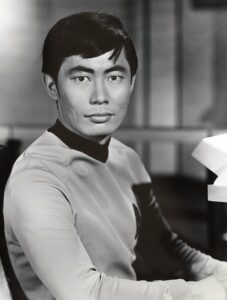
George Takei (b. 1937), original Star Trek alum, served as the grand marshall in Community Shares’ Mardi Gras parade in downtown Knoxville in 1992. (Wikipedia.)
The biggest surprise, then and now, was 1992’s grand marshal, Japanese actor George Takei. It helped that he was here for a Star Trek convention, but he was game to show up as a Mardi Gras celebrity. He was then 54 years old, not yet an author, not yet openly gay, and not quite done playing Sulu, and hinting to a local reporter that there might be a Star Trek VII (at this writing, that movie series ended at VI.) The parade reportedly drew over 10,000, a rare moment when Knoxville approached a New Orleans-sized crowd for a Mardi Gras parade. That seems to have been Knoxville’s biggest Mardi Gras celebration in history.
But in 1995, there were two dueling Mardi Gras parades in downtown Knoxville, one for the Epilepsy Foundation in the Old City, with Congressman Jimmy Duncan as grand marshal. Community Shares planned its own parade, restricted to a circuit of Market Square. In 1995, Duncan’s drawing appeal might have rivaled Community Shares’ celebrity attraction. The grand marshal of their parade was just a singer who used to live in Luttrell, a ball player from Gibbs High named Kenny Chesney. It was eight years before the country superstar drew 61,780 paying customers to Neyland Stadium.
Knoxville’s Community Shares Mardi Gras tradition, the city’s longest sustained Mardi Gras tradition, seemed less festive after 2003, about 15 years after it started. The story I’ve heard was that it was not always a moneymaker when Mr. Sulu wasn’t there.
That’s not to say we can’t try it again.
— Jack Neely
- PARTNERS
-

-

-

-

-

-