
The tragic story of a once-controversial architect who’s in the national news again.
The last year has brought a lot of unaccustomed anxiety in Washington and across the country about presidential initiatives concerning iconic national architecture, new and old. There’s the White House ballroom annex fracas, of course; the Kennedy Center renaming and redesign affray; the proposed triumphal arch consternation; and the Eisenhower Executive Office Building skirmish.
That last one may be the least dramatic aspect of the president’s proposed makeover of the District of Columbia, because it doesn’t involve either demolition or major construction. Our chief executive just wants to paint a very old stone building white.
The author of that building has an interesting Knoxville connection. The sometimes-controversial architect who designed it was also responsible for two of Knoxville’s most notable buildings.
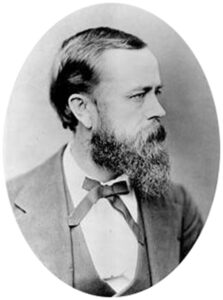
Alfred Mullet (1834-1890). (Wikipedia.)
Alfred Mullett was English by birth, born in 1834 in the ancient town of Taunton, Somerset, not far from the Bristol Channel, and the sea. When he was a schoolkid, his family moved to America, and suburban Cincinnati, where he trained and worked as an architect just before the Civil War, under the tutelage of well-established architect Isaiah Rogers, about the time Rogers was working on the Ohio Statehouse in Columbus and the famous Maxwell House in Nashville. After service in the Union Army, Mullett moved to Washington, where in 1866, at a surprisingly young age, he became supervising architect for the U.S. Treasury Department. Over a period of several years, he designed multiple post offices and custom houses across the nation, especially in the South, where the Treasury Department was taking some pains to build large, permanent buildings to emphasize that the federal government was in charge, and wasn’t going to leave. Among them was the big stone Custom House still standing in New Orleans, in sharp contrast to the rest of the French Quarter. But he designed and supervised buildings built all over the nation, from the San Francisco Mint to the old New York post-office building known, a little unkindly, as “Mullett’s Monstrosity,” and eventually demolished.
Although founded as a federal administrative center, Knoxville had never been home to a significant federal building before 1870. A post-office project commenced in theory just before the war was never built. In early 1870, during the early presidential administration of Ulysses S. Grant, attorney and former Whig-turned-Republican congressman Horace Maynard was coordinating the effort to build an all-purpose federal building in downtown Knoxville, and announced that Alfred Mullett himself would soon be in town.
Apparently several landowners were hoping to sell downtown property to the government for “an extortionate price”; an item in the paper warned that Mullett would be untempted by such offers. “We are satisfied that Mr. Mullett will act for the best interest of the citizens; that he is competent, and will not likely be biased in his judgment by matters of trifling importance,” opined the Weekly Chronicle.
“Work will be commenced on the building soon, and if fruitful according to design will be a credit to the government and an ornament to the metropolis of East Tennessee.”
His visit came that May, and a crowd gathered at the Board of Trade to greet him. Knoxville was just emerging from the chaos of war, and a postwar recession, and eager to see something permanent materialize in town. Introduced by merchant and civic leader Perez Dickinson, the 35-year-old Mullett outlined the issues. The pre-war appropriation for Knoxville’s never-built post office had expired, he explained. Among those in the room were the New Jersey-born industrialist recently elected Knoxville mayor, John S. Van Gilder; and businessman-banker Thomas O’Conner, who guaranteed at least $3,000 for the project. (He was the same fellow who died in a gunfight on Gay Street 12 years later.)
Mullett’s resume suggests some difficulty getting along with powerful people. Former Union Gen. John Farnsworth of Illinois was an enemy, accusing Mullett and others of corruption. But Knoxvillians seemed to like him. “Mr. Mullett is a very pleasant and courteous gentleman, and has made many friends among those of our citizens who had the pleasure of making his acquaintance yesterday,” noted Captain William Rule’s Republican-leaning Chronicle.
Mullett inspected nine available downtown sites, and after flirting with a Gay Street plot he initially preferred, he eventually favored one on the southeast corner of Clinch and Prince Street, much later renamed Market. He announced that the new Custom House would be built of East Tennessee marble.
East Tennessee marble had been used in limited ways before, as in some of the interior décor of the U.S. Capitol in Washington. But Knoxville’s Custom House is known today as the first large public building built primarily of our distinctive local marble.
There was little fanfare about that fact in 1870. In late 1872, however, Mullett remarked for a national journal that “our marble, in his opinion, could not be surpassed in the United States for durability.” Later he called it a stone of “unsurpassed beauty and durability.” Considering the amount of Tennessee marble employed in architecture in the capital over the next 75 years, the Washington-based Mullett became an important early promoter of what would be one of Knoxville’s proudest industries.
Mullett visited Knoxville several times over the next four years. Newspapers found him quotable on each visit. “He expresses himself as highly pleased with Knoxville, and thinks if our marble interests are properly developed, it will prove to us a source of great wealth.”
In March 1873, Mullett returned to “visit the government quarry six miles above the city,” likely a reference to the marble quarries of the Forks of the River area. It suggests that quarry was a source of the marble for the Custom House, and also maybe that it showed promise as a supplier for other government projects under his supervision.
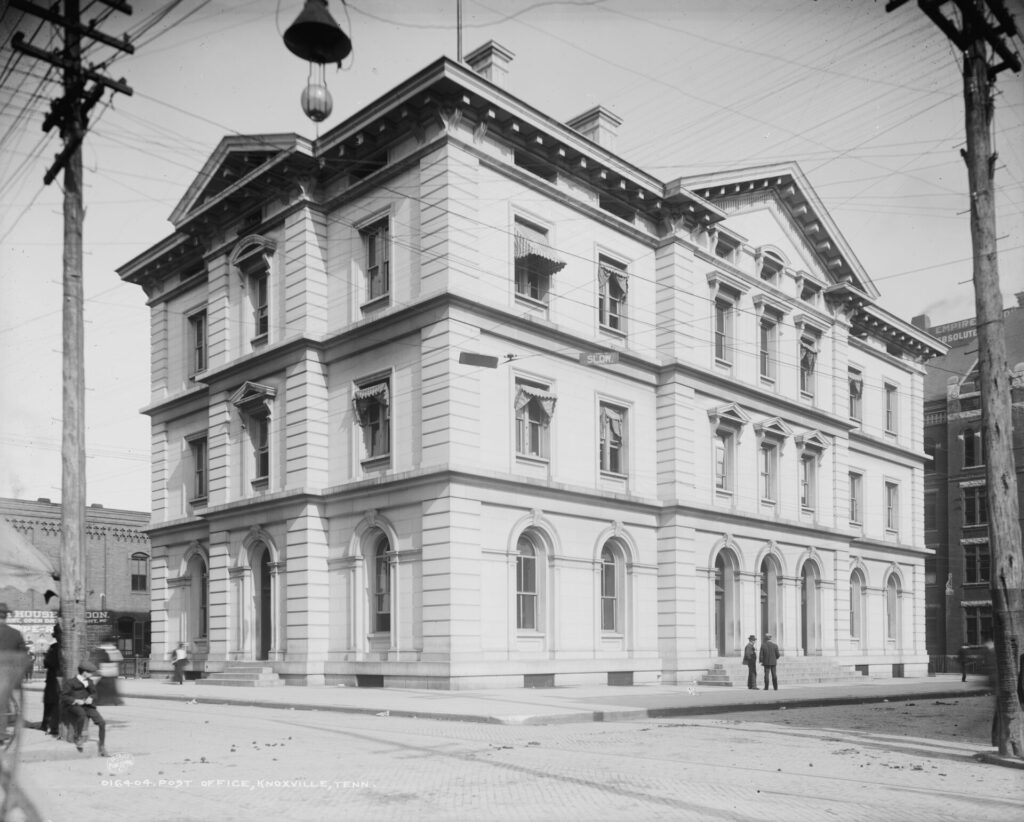
The Alfred Mullett-designed Custom House and Post Office at Prince Street and Clinch Avenue, ca. 1905. (Library of Congress.)
It was while the Custom House in Knoxville was under construction that Mullett began work on the mammoth five-story State, War, and Navy Building in Washington. His previous designs had been conservative, working in white marble and classical styles. But for that big building near the White House, he shifted to an extravagant architectural trend then sweeping Europe, the French Second Empire style, which was then gaining attention in Knoxville, as with Swiss immigrant Peter Staub’s Opera House.
The enormous palace of a building in D.C., which Mullett seems to have regarded his masterpiece, would take many years to finish—most of the remainder of Mullett’s life, in fact.
Returning to inspect Knoxville’s finished Custom House building in April 1874, Mullett liked what he saw. “He was exceedingly well-pleased with the building, and called our attention to the exterior as remarkably well-executed,” reported the Daily Press & Herald. “Mr. Mullett said the white marble with which the building is constructed is unequalled in this country for building purposes—it possesses all the merit of granite with all the brilliancy of marble. The pearl-tint, which characterizes it, is a decided advantage, as it will not readily stain, and is devoid of the intensely unpleasant glare of perfectly white marble.”
Playing the role of an experienced if unpaid consultant, Mullett also made some interesting recommendations for Knoxville’s urban design. Market Square was too small for a growing city like Knoxville, he thought, and Clinch Avenue, then with an unsightly hump, was an eyesore, as were Knoxville’s narrow streets crowded with cheap buildings. To display his new Custom House to its best advantage, he said, Clinch should be leveled and the Market Square’s space for produce should be extended southward, by widening the road one block to Clinch—or better yet, two blocks to Church, with the Custom House a prominent building standing stately in the middle with few neighbors. Such a project would open up the center of town, he said, and adorned with shade trees and fountains, Mullett said, “you have an attractive place for your evening promenade.”
Knoxville had no public parks at the time, and the Press & Herald liked his ideas. “Mr. Mullett charged nothing for his professional opinion as to what Knoxville might do to beautify the locality, and it will do no harm to consider the matter. If we can get a breathing space in the centre of the city, beautified and ornamented as a public plaza or park, with stately edifices and widened avenues, then Knoxville will surely have a ‘lion’ to show visitors.”
Mullett didn’t know it at the time, but the completion of the Knoxville project was near the end of his career as the federal government’s Supervising Architect. That fall of 1874, he had a fierce argument with the new Secretary of the Treasury, Benjamin Bristow, about control of finances, and quit. Bristow fancied himself as a crusader against graft in the Grant administration, accusing many people of many things. The Washington Post later remarked that Mullett had quit “only on account of his dislike to Secretary Bristow, under whom he refused to serve.”
Mullett was re-hired after the resignation of Bristow in late 1876, reportedly just to finish the architectural jobs left incomplete with his resignation two years earlier. He often argued with other politicians and architects, including one successor as supervising architect, James G. Hill. Mullett joined a group of plaintiffs who accused Hill of fraud, leading to a cessation of his duties. But Hill was acquitted.
By 1883, Mullett was working as an architect on private projects, including theaters, churches, and homes in Washington. Mullett designed lots of buildings, both in government and out, but his grand opus was arguably the palatial creation of granite, slate, and cast iron known as the State, War, and Navy Building: finally completed in 1888, after 17 years of design and construction.
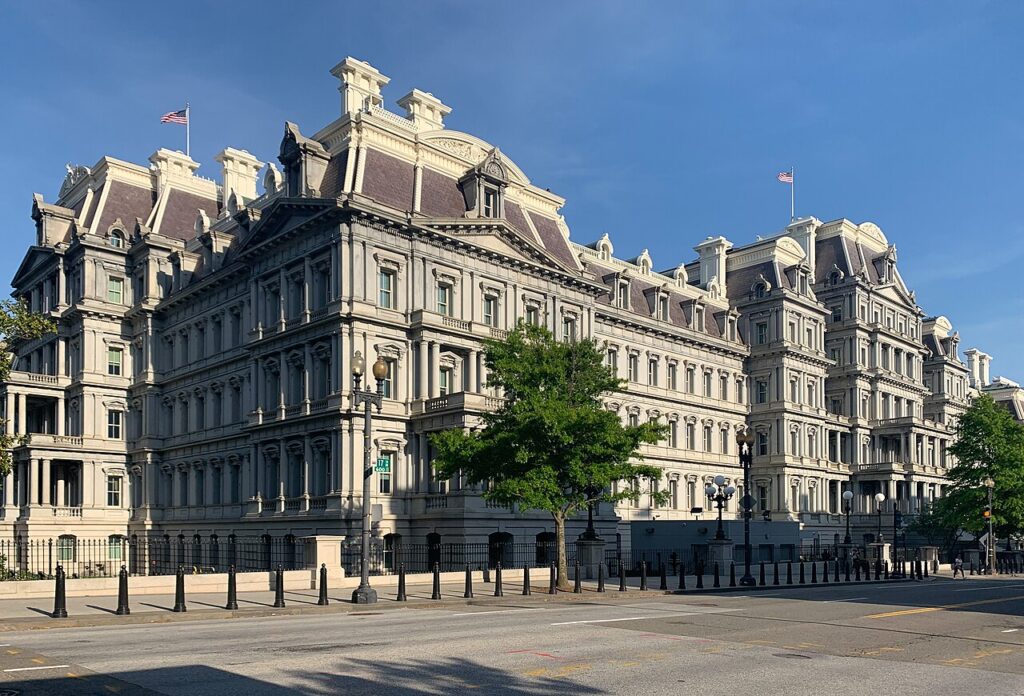
The Eisenhower Executive Office Building in Washington, D.C., photographed in 2021. (Wikipedia.)
It looked like a large European building, perhaps a Hohenzollern palace, dark in complexion and far out of character with Washington’s staid white classicism, and some hated it. Henry Adams called it an “architectural infant asylum.” Even Mark Twain called it the ugliest building in America.
Incongruous though it was, its main defect may have been that it had taken so long to build that upon its completion, its pronounced Second Empire design was out of fashion. Architectural styles changed rapidly in the Gilded Age, and people noticed.
Mullett still had friends in Knoxville. In April 1889, the month the architect turned 55, the Journal & Tribune announced he’d be back for another project. Eldad Cicero Camp, a former Union major who had shot a former Confederate colonel to death in an insult-driven street fight in 1868, was not only exonerated, but soon afterward, during Grant’s presidency, appointed a U.S. attorney. In business, he became a major coal baron who wanted to build a mansion that reflected his wealth and achievements.
“Maj. E.C. Camp has received the plans and specifications from A.B. Mullett, ex-supervising architect of the treasury department, for a magnificent residence to be built on Broad Street near Brookside Avenue,” reported the Journal & Tribune. “The superstructure will be of the gray sandstone so abundant near Coal Creek, with appropriate linings and embellishments. The arrangement of the interior as well as the finish will be of the latest and most elegant kind.”
Camp and Mullett were hardly strangers. Both had served federal roles in the Grant administration. And as a young U.S. attorney at the time Camp was designing the Custom House, he had likely taken a special interest in the project.
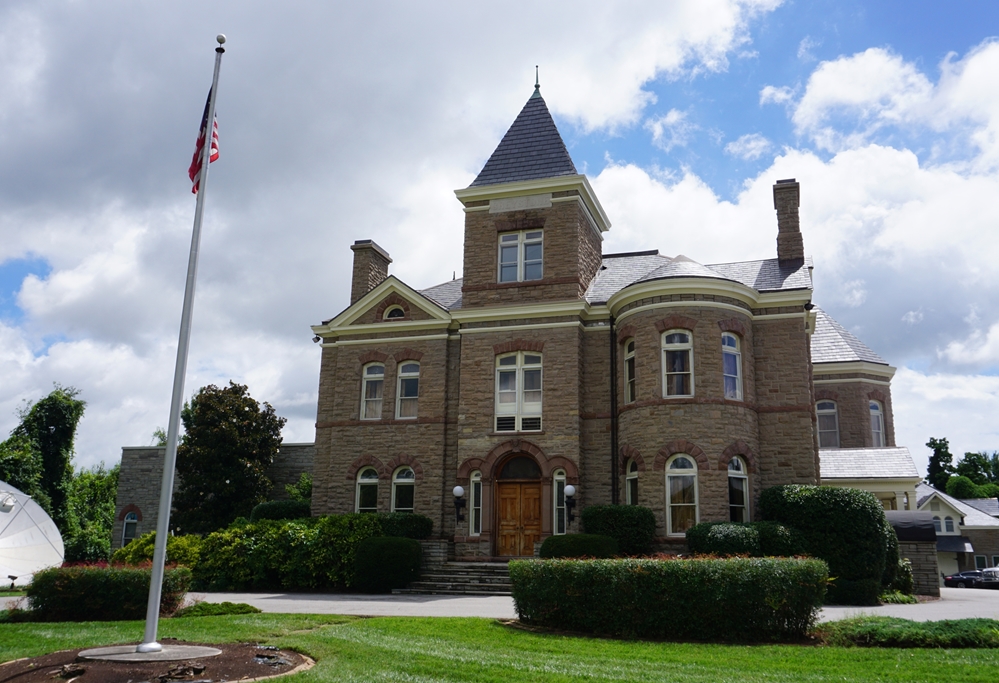
C.C. Camp’s Greystone, designed by Alfred Mullett, now the home of WATE TV 6. (KHP.)
Washington contractor Gustave Gade, the German immigrant who had reportedly worked on the original Smithsonian Institution building, and with whom Mullett had often worked on government buildings, would move to Knoxville to work on the project.
While the largest office building in Washington was still under construction, Mullett sued for additional consideration for his design work. But a judge ruled his role with the building had ended back in 1875, and that he was already compensated by salary.
Mullett’s plea seems like a desperate move by a man who was ill and in debt. He had suffered other disappointments, too, including three new houses in D.C. that weren’t selling, and what would be described as “several unfortunate investments.”
Four months after the disappointing legal judgement, he had returned from work to his impressive home at the corner of Pennsylvania Avenue and 25th Street, and told his wife he was tired. As she was making him some beef broth, Mullett loaded a pistol and shot himself in the head.
Mullett left his wife and five grown children, including two sons who helped him in his architectural firm. The Washington Post described Mullett’s death as “one of the saddest and most startling tragedies enacted in Washington for many many years.”
The architect’s suicide was reported just weeks after Greystone was completed. The Knoxville papers referred to his two most famous, and most controversial buildings, the grandiose New York post office and the overwhelming State, War, and Navy Building in Washington. For whatever reason, editors chose not to mention the ill-fated architect’s two Knoxville buildings.
However, Mullett left a legacy beyond the stone landmarks. His associate, Gustave Gade, settled in Knoxville and worked here for decades to come. Gade built a stone fountain at Emory Place, the Anderson County Courthouse, and numerous houses and small-town railroad stations. He was a leader in the German Lutheran Church, and stayed with the church even when they started speaking English, and changed their name to First Lutheran. Mullett’s old associate died in Knoxville in 1934.
His most famous building, the State, War, and Navy Building, has witnessed drama and history. The Spanish American War was declared there. World War I Gen. John “Black Jack” Pershing worked there for most of his post-combat career. It held the offices of several notable secretaries of state, including John Hay, who helped plan the Panama Canal; William Jennings Bryan, whose pacifism impelled him to resign in the early days of World War I; and Tennessee’s own Cordell Hull, who was in that building when he contended with the Japanese surprise bombing of Pearl Harbor, and a few years later, when he helped found the United Nations. It’s been the address of most of the vice presidents of the last 65 years, and the temporary office of some presidents, including Herbert Hoover and Lyndon Johnson.
Its name changed over the years, to reflect its purpose, becoming the Executive Office Building, the Old Executive Office Building, and finally the Eisenhower Executive Office Building.
Its current name may seem ironic. The popular general and president was less associated with the building than most presidents before him, and in 1957, his administration proposed demolishing the building to replace it with something modern. But more than 40 years later, Congress added the late President Eisenhower’s name to it. In politics, popularity always trumps history.
And now another president wants to paint its granite white to resemble the marble monuments of the capital. Architects of all political persuasions discourage painting natural stone.
In Knoxville, Mullett’s stone creations from the century before last, all of them unpainted, have held up well. His buildings are both in unusually good condition for their age, especially considering that most of Knoxville’s 19th-century buildings have been torn down. After 60 years as our post office and federal courthouse, followed by several decades serving various offices of the Tennessee Valley Authority, his 1874 Custom House became the East Tennessee History Center. Inside the building, the second and third floors are mostly intact. Its beautiful third-floor courtroom would be recognizable to both Judge E.T. Sanford, who worked there before he joined the U.S. Supreme Court, and Harvey Logan, a.k.a. Kid Curry, the Wild West outlaw who was tried in that room on manifold federal charges in 1902-1903, until his daring escape.
Greystone, a private residence into the 1920s, has been the headquarters of new innovation that would have astonished Alfred Mullett. Inhabiting his last known creation for the last 65 years has been the headquarters and studios of WATE-TV.
Meanwhile, Krutch Park, which was not established until a surprise bequest enabled it in the 1980s, could be seen as an accidental adaptation of Mullett’s strong proposal in 1874, that Knoxville needed an opening-up in the middle of town, a tree-shaded place with a fountain: an attractive place for our “evening promenade.”
– Jack Neely, April 2026






Leave a reply