
FORTNIGHTLY TOASTS
Wednesday, Aug. 19, is the 105th anniversary of a bizarre lynch-mob riot along Hill Avenue. It started with the arrest of a Black itinerant laborer named Frank Martin for an alleged sexual assault in North Knox County. Almost two years after the Maurice Mays “Red Summer” riot, which had resulted in deaths and major damage to the jail and the sheriff’s own home, when almost 2,000 rioters formed outside the jail, Sheriff W.T. Cate chose to deal with this one more decisively, responding with armed deputies and state troopers. Unlike any race riot, the 1921 event was whites vs. whites, law-enforcement vs. lynch mob, with gunfire. At least 28 rioters were wounded, and though several were claimed to be killed, that evidence didn’t convince law enforcement or newspaper journalists. Some were arrested, and the “ringleader” of the mob was identified as a Canadian World War veteran, carrying a British award for valor and a note from King George V, perhaps suffering from post-traumatic stress — a newcomer who had lived in Knoxville for only a few weeks. In the end, Martin, who had been the target of the lynch mob, was quietly freed for lack of evidence. He thanked the sheriff for keeping him safe, and returned to his home in Alabama. READ: MORE DEADLY IN PURPOSE.
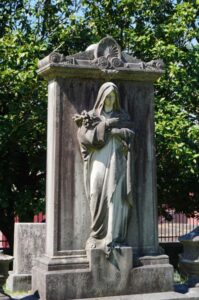
Eleanor Audigier grave at Old Gray Cemetery. (KHP.)
Aug. 25, 1931, is the 95th anniversary of the death in Rome of Eleanor Audigier (1864-1931), grande dame of Knoxville’s artistic renaissance at the turn of the century. Co-founder of the Nicholson Art League, Audigier was a talented artist herself, but was content to promote the work of others of her era, including impressionist Catherine Wiley. She and her husband, a writer, photographer, and UT professor, lived on Kingston Pike, coincidentally on the site of what was later the Dulin Art Gallery. She moved to Italy with her husband, Louis Audigier, but stayed in touch with her artist friends in Knoxville. Her husband returned her to Knoxville for burial, under an unusual melancholy stone with a mournful Madonna figure at Old Gray Cemetery. Louis Audigier moved back to Knoxville for a time, living in a house still standing on Magnolia Avenue (now being transformed into the River and Rail dramatic venue). The Audigiers left her impressive collection of mostly decorative art from around the world to the University, where it was on display for several years at the old Audigier Gallery in the Hoskins Library building, until a series of thefts in the 1970s sent it into deeper storage. The McClung Museum occasionally puts parts of it on display.
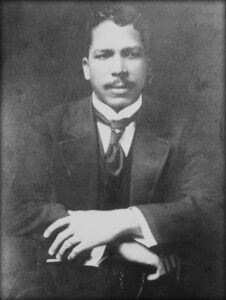
Dr. Henry Morgan Green. (Beck Cultural Exchange Center.)
According to his own gravestone at Freedmen’s Mission Cemetery at Knoxville College, Wednesday, Aug. 26, is the 150th anniversary of the birth of Dr. Henry Morgan Green (1876-1939; other sources differ, offering a range of birthdates from 1873 to 1879). Knoxville’s leading Black medical doctor for many years, Green studied in several nations in Europe and earned a national reputation, especially concerning research into diseases of the poor, serving as president of both the National Hospital Association and the National Medical Association, both Black professional groups. In 1922, he built the three-story Medical Arts Building on East Vine Avenue (predating the building of the same name on Main Street), with surgical and X-ray facilities, to improve access to medical care for Black people where they lived. Closely associated with Knoxville College, Green was chief of staff at the college’s Wallace Hospital, established before Black patients had full access to other hospitals in town. Near the end of his life, he also pushed for the establishment of the Negro Wing of Knoxville General Hospital. (That building still stands, at Bernard and Wray.) Also a civic leader, Green was Knoxville’s last Black city councilman before the modern Civil Rights era, serving from 1908 to 1912, after which time Knoxville changed its form of government to a commission of only five members, all elected at large. Green School was named for him to acknowledge his efforts to improve education for Black children
- PARTNERS
-

-

-

-

-

-