
Everything New is Old Again
Why downtown’s amazing developments all seem surprisingly familiar
Look around, if you haven’t yet: Knoxville has changed in ways that make some parts almost unrecognizable. Not just on Gay Street, but in other environs of downtown—Blount and Sevier Avenues, East Hill Avenue, West Cumberland, Concord Street, and several other places, developers are building rapidly and often vertically.
People like me who remember Knoxville, especially the downtown part, as it was in the ‘60s, ‘70s, and ‘80s may encounter the changes with some consternation, as if it as an alien landscape. Massive new residences, not just downtown but on all sides of town, and even more astonishing, new hotels, some of them big and luxurious. Fancy restaurants that get national attention. If it’s traumatic, it’s partly an upbeat sort of trauma.
Whether we like what we see or not, a lot of it’s what we wished for. These changes seem to leave in the dust many of our past assumptions of a city that was limited by its own suburban nature. But it’s the historian’s duty to remind folks that much of what seems new, shockingly, bewilderingly new, isn’t new at all, at least in concept.
Take brewpubs. You don’t have to be very old to remember when the idea of making beer in the same building where you drink it seemed bizarre and probably illegal. Beer came in cans from St. Louis or Milwaukee, and most of the people who drank it didn’t complain about that fact. But today we have so many brewpubs they almost seem to outnumber old-school beer joints.
The words brewpub and microbrewery were little known in print before about 1985. Since then, most American cities have independent brewpubs, sometimes dozens of them. The brewpub industry has become a major driver, an operating principle for American cities. However, though the words are new, the concept is not. Knoxville had brewpubs—saloons where the saloonkeeper brewed the beer he served—125 years ago. Michael Dewine, the Irishman who used his profits to help establish what became St. Mary’s Hospital, was only one of our best-known microbrewers—even if he never heard the word.
A welcome newcomer to downtown in 2025 is baseball. The Smokies stadium just west of the Old City has been a municipal homer. But downtown baseball isn’t new. The first team sport in Knoxville history, it started downtown, on the flood plain just below the 400 block of Gay Street, and by 1867, it was a sensation. It later moved away, but never very far. Pro baseball’s longest tenure was at Caswell Park, finally home of Bill Meyer Stadium—named for the son of a German microbrewer—which was about a 20-minute walk from Gay Street, for almost 80 years ending in the late 1990s. And the new stadium is adjacent to the same First Creek that runs through old Caswell Park; it’s hardly a quarter mile downstream from the old ball field.
There are more sports on the fringes. Today, people are startled, sometimes inspired, sometimes perplexed by how many bicyclists are downtown. In the 1990s, practical bicycling was catching on in cities across the country, but many promoters assumed it would never take off here, because of the heat and the hills. For 25 years or so I rode a bike to work regularly, the five miles from my house, but was pretty lonesome in that pursuit. Sometimes, upon meeting me somewhere downtown, a new acquaintance would recognize me: “Oh, I know you. You’re that guy who rides his bike.” My white Raleigh was often the only bicycle chained to a post on Gay Street. People could always tell where I was. After an expensive accident proved to me how brittle half-century-old bones can be, I’m no longer as enthusiastic about biking as I was. But I’m glad to see that a lot of people half my age are keeping the faith.
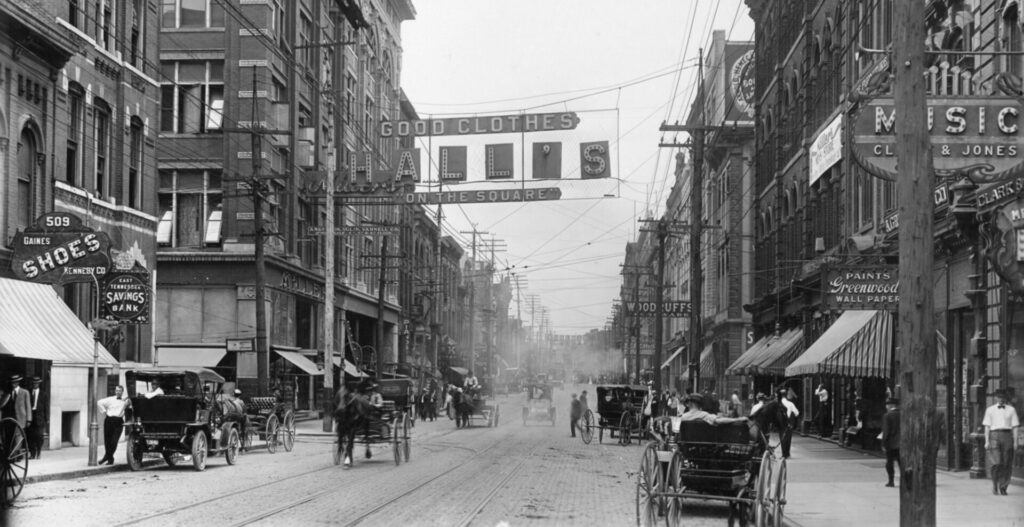
Life on Gay Street at Union Avenue with multiple forms of transport, circa 1906. (McClung Historical Collection.)
But more than that, Knoxville has become a bicycling mecca for the same reason people used to say it never would, because of the hills. The extensive mountain-biking trails of South Knoxville, where the challenging hills are even steeper than they are downtown, attract thousands of hardy cyclists from all over the country.
All that cycling may seem new. If you’re of a certain age, you may remember when bicycles were pretty strictly for kids. But adults were riding bikes here in the 1880s. You see them in old photographs of downtown, riding alongside electric streetcars, and horsedrawn buggies, and even horseless carriages. By the mid-1880s, bicycle racing was all the rage, with young men, and even some women.
“Bicycle tracks,” usually flat tracks less than half a mile in length, became common in the 1890s, associated with both beginning cyclists, men and women both, and with occasional formal races. Even Woodlawn Cemetery built one, perhaps just to promote their new burial ground. But the best-known one was at Lake Ottosee—Chilhowee Park—and Cal Johnson’s former riverside horse-racing track was converted into a bicycle track with both leisurely riding and occasional races, featuring teams of both races. (On days that featured both vehicles, the bicycle races always came before the horse races, for obvious reasons, galloping horses can leave potholes, not to mention other sloppier hazards.)
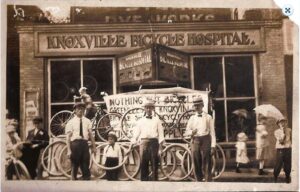
The downtown-based Knoxville Bicycle Hospital, later to become Greenlee’s Boke Shop, early 1900s. (Courtesy of the late Conrad Majors.)
Early races were short ones, usually on those circular tracks, but in July 1894, a dozen two-wheel racers rode from Gay Street to Fountain City and back, a 12-mile run. A couple had injurious wrecks along the way, but the winner made it back in just over 40 minutes. Which is sometimes hard to do today even in an automobile.
Among those early cyclists were important businessmen of the future, including Cary Spence, who became a World War I hero, and Cowan Rodgers, who perhaps ironically is the fellow who in 1898 introduced the automobile to Knoxville, a contraption he built in a downtown bike shop. He later founded a company known as Rodgers Cadillac, the longest-lived dealership in regional history.
And there’s Market Square. It’s an old place, established in 1854 for a purpose that already seemed old fashioned then—for local farmers to sell their wares. But about 65 years ago, it was so old-fashioned that a common belief was that it wouldn’t work unless the old square became a convenient parking lot, and we got rid of those embarrassingly old-fashioned-looking buildings—or at least modernized them, with plastic or aluminum siding on their facades. Same for the old Miller’s Building, which got the mirrored-glass treatment. We gave it several different modernizing treatments, including the briefly famous concrete-toadstool look. By the 1980s, farmers were skeptical of whether there was still a market for fresh tomatoes downtown, and only one or two, or more often none—bothered to set up.
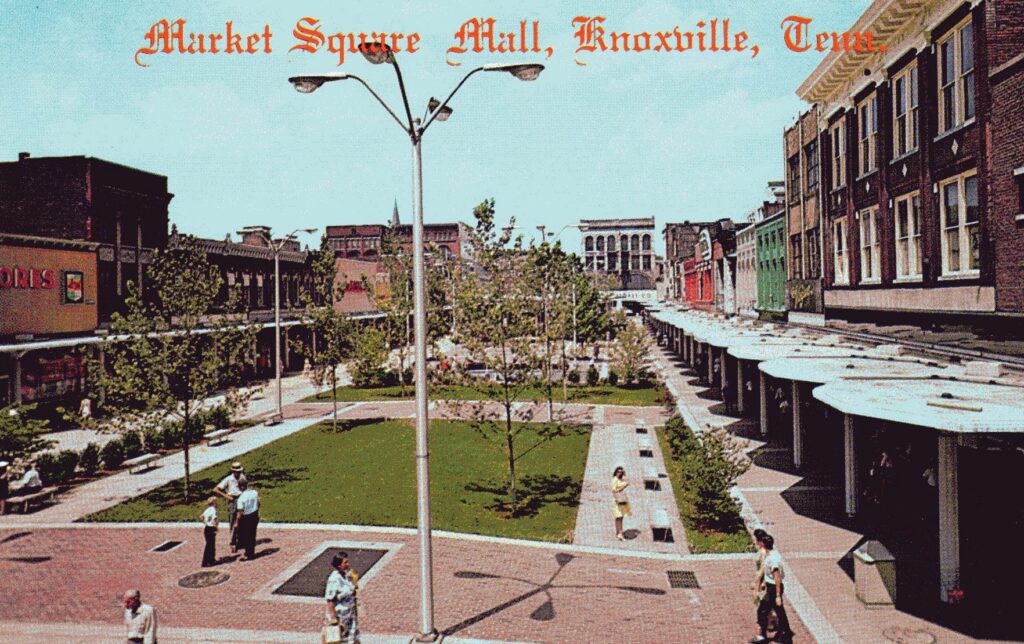
After the iconic Market House was torn down in 1960s, the city re-envisioned Market Square as a park-like space with concrete storefront awnings, colloquially referred to as “toadstools.” (Sam Furrow Knoxville Postcard Collection/KHP.)
But today, especially on Saturdays, the same old square draws thousands—as it did in 1900, when a reporter described it as “the most democratic place on earth—only there to rich and poor, black and white jostle each other in perfect equality.” I’d read that years ago, and tried to picture it, but never witnessed the actual jostling until the 21st century.
And hotels. To many, that’s the single most surprising thing about 2026. In the 1990s, we were wondering if we could keep four downtown hotels in business. Now we have about a dozen, with talk of more. I would not have forecast that we could support that many hotel beds downtown. Can you imagine?
Our ancestors certainly could. In 1900, there were about 20 hotels downtown, not even counting boarding houses, which were like hotels, but homier. Of course, most of them were smaller than the average downtown hotel today. And travel was different. With no airport, downtown was the center of transportation, with both of the region’s major train stations, as well as the bus stations. And the travelers who stayed in hotels were mostly salesmen or conventioneers, not tourists. We have a lot of tourists now, maybe more than ever before, not counting the months when we were hosting the big expositions of the early 20th century, when we were hosting as many as 500,000 pleasure-seeking travelers a month.
But tourism on a daily basis is indeed something that’s fairly new. In the 1930s, tourism associated with the new national park in the Smoky Mountains did have an impact on downtown, but was, for the most part, disappointing. It affected the construction of the big Andrew Johnson Hotel on Gay Street—but developers pretty quickly got wise and found out they could make money building modern and cheaper motels much closer to the mountains. We didn’t build another big hotel downtown for 40 years after the AJ—and it was the suburban-style, automobile-centric Hyatt Regency.
Now suddenly we’re building a new downtown hotel every year or two.
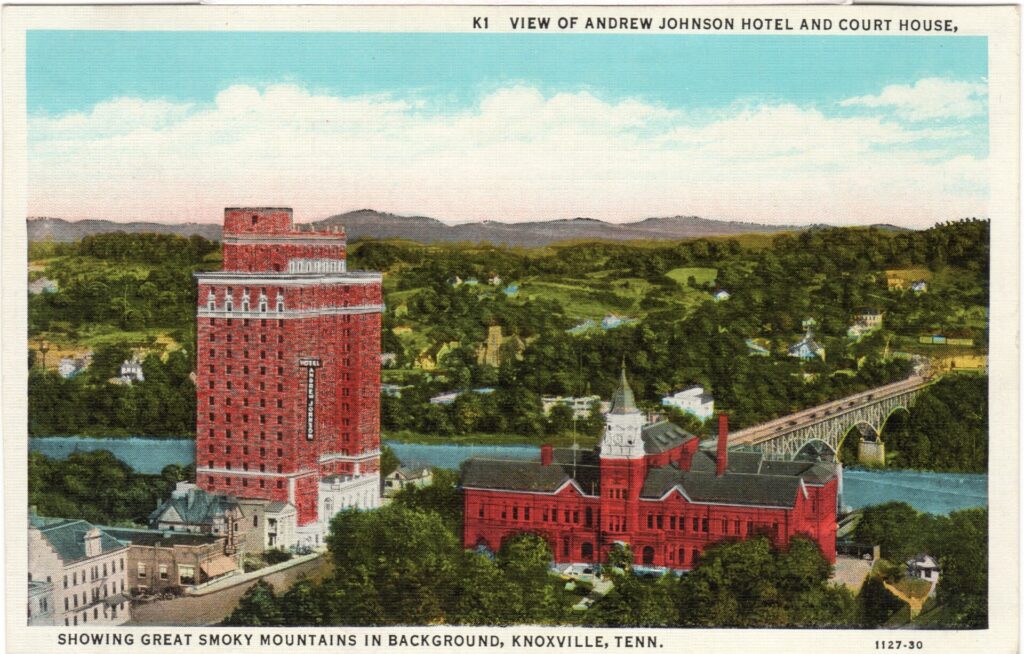
Completed in the late 1920s, the Andrew Johnson Hotel hoped to attract new tourists heading to the new national park in the Smokies. (Alec Riedl Knoxville Postcard Collection.)
When asked about what was driving downtown hotel tourism, a knowledgeable developer suggested one big driver was the series of Broadway shows that have emerged as a regular diet at the Tennessee Theatre, especially since the creatively big 2005 restoration/addition that made big-production Broadway and opera productions possible in a theater that was built mostly for movies and small stage shows. Big-time Broadway productions weren’t unknown in the Knoxville of our youth—they occasionally landed at the 1962 Civic Auditorium. (It was just distant enough that its impact on downtown was limited. The adjacent parking garage made it convenient to drive to the theater, then drive home.)
But London and New York musicals staged in downtown Knoxville go much farther back, about 150 years back, to the era of Gilbert and Sullivan, when H.M.S. Pinafore opened at Staub’s Opera House on Gay Street in 1879, the year after its London debut, and only a few months after it arrived in New York.
The musical comedy A Trip to Chinatown, with its familiar sheet-music song “After the Ball,” has been called the first big Broadway hit; its traveling version was at Staub’s in 1893 when the show was only two years old, with some of the original cast and the original set, and was so popular it returned a month later.
In 1909, the Bijou opened with one of the biggest Broadway hits of recent years, Little Johnny Jones (and its signature tune, “Give My Regards to Broadway”). For the Bijou’s early years, Broadway shows alternated with vaudeville bills to keep the crowds coming. In the Knoxville of 120 years ago, it was hard to be convincingly bored.
With a few exceptions, like two at the Tennessee Theatre in 1935—Broadway shows in Knoxville seemed to diminish in the middle part of the 20th century, the era of live radio and sound movies and then TV. Now we can say Broadway shows are more popular than ever—or, rather than they’ve been here since about 1910.
***
Maybe the biggest, most shocking new thing people notice with a drive around town is how many people are living downtown, or very near this historic quarter. Of course, there were always downtown residents, but 40 or 50 years ago, you could probably name them. Most were proud eccentrics. It went without saying that in the future people would be living in the suburbs, and getting around in automobiles, if not jet packs or hovercraft. “The Jetsons” forecast a future of Zoom meetings and floor-vacuuming robots and electronically ordered food, but in their world, as you may have noticed, there’s no downtown. By 1973 or so, many of us were living in a very modern Knoxville, with hardly any need to come downtown unless we were under indictment. The best restaurants, the newest movies, the latest fashions, they were all in the suburbs. And so were our bedrooms.
Now, we’re amazed to contemplate, there may be more than 5,000 people living downtown today–if we take a recent central-business-district census of about 3,300 and add new walking-distance developments on the near north and east side–with the likelihood of approaching 10,000 in the near future. Is that even possible?
As history suggests, of course it is. In previous generations most Knoxvillians lived downtown: regardless of class or race or income, it’s where people chose to live. It was a good plan for most folks, considering that the option of living out in the country demanded the care and feeding of a pet horse. In 1890, because Knoxville’s city limits didn’t extend west of Second Creek, or north of the intersection of Broadway and Central, we can tell how many people lived in the immediate downtown area; it appears that more than 20,000 people lived within a 15-minute walk of Market Square. That’s an urban density we haven’t seen since the commencement of suburbanization in the 1920s. And that’s why, in newspaper accounts, Knoxville seems so lively in the 1890s, with a 24-hour culture, and a wide variety of amenities, including a French restaurant, street vendors selling tamales and ice cream, street musicians, street festivals, three daily newspapers—and lots of fresh and ever-changing vaudeville and Broadway shows at the theaters. Jane Jacobs and other urban theorists have long posited that density, more than total population, is what breeds a diversity of options, and what makes a city seem like a city.
If the residential buildings look different—taller than they were a century ago, when there were a lot of two or three-story apartment buildings or boarding houses—it may be just because so much land that used to host hundreds of low-rise houses on the east side has been taken up by James White Parkway, and all its swooping highway connections. (That highway, which seems underused in terms of cars per hour per asphalt lane, is lying on what by current standards could be billions of dollars worth of development property.) We have to cram our residences in even more densely, to keep them away from the thousands of acres we’ve devoted to asphalt highways.
So all those people living downtown might be surprising to us, but might not have been surprising to our great-grandparents.
So most things that seem new, as it turns out, aren’t very. We may be doomed to repeat the past, whether we remember much of it or not, but we can count on the fact that it’ll be a little different every time. Maybe one of these times, when it comes around again, we can get it right.
– Jack Neely
- PARTNERS
-

-

-

-

-

-