
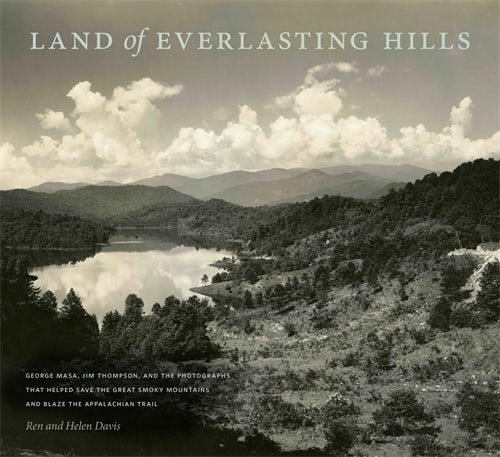
Join us at the East Tennessee History Center on Sunday, November 16 at 2:00 p.m. for a book release event, hosted by the East Tennessee Historical Society, for Land of Everlasting Hills: George Masa, Jim Thompson, and the Photographs that Helped Save the Great Smoky Mountains and Blaze the Appalachian Trail by Ren and Helen Davis.
Learn more at: https://www.easttnhistory.org/programs-events/
Paul James’s biographical essay on Jim Thompson, that appeared in KHP’s Knoxville Lives II (2022), provided background information for this new book.
Read Paul’s book review:
Land of the Everlasting Hills (University of Georgia Press, 2025) by Ren and Helen Davis is a new, large-format book featuring stunning photographs from the 1920s and ‘30s, many used to assist the creation of a national park in the Great Smoky Mountains. At the heart of the book is the parallel and interconnected stories of two photographers, both very different men, who shared a passion for outdoor natural photography and a genuine love for the captivating mountains that straddle the state line between North Carolina and Tennessee. This book certainly covers new ground.
Born in Japan, George Masa came to the United States where he settled in Seattle around 1906, and a decade later drifted east to Asheville, N.C., where he took a menial job at the illustrious Grove Park Inn. The book shows us how the ever-restless Masa seized any opportunity he could to realize his dream of becoming a successful professional photographer. Although a well-liked Asian man, he faced widespread discrimination that punctuated his working years, thwarting his career at various turns. But it was his discovery of the Smoky Mountains that would light up his heart and where he would forge a life-long friendship with author and early conservationist Horace Kephart. Yet some aspects of Masa’s life still remain unknown.
Over the mountains in Knoxville, Tenn., another photographer, just as talented but from a stable, notable family, Jim Thompson was already well established as a versatile commercial artist, known for his quality portraits of buildings, street scenes, and poignant events. He was also exploring the Great Smoky Mountains, at a time when they were a remote and forbidding place to most, and began to photograph wildflowers and the landscapes of those rolling hills.
The lives of these photographers would begin to intertwine in the mid-1920s as they continued to help national park efforts, employing their photographic expertise and an ever-growing knowledge and understanding of the mountains, forming a friendship on naming committees as well as the location of a new, rugged pathway that would become known as the iconic Appalachian Trail.
What’s also a boon for the reader is the recognition of sometimes lesser-known heroes, particularly Paul Fink, an early authority on the Smokies, who would forge an enduring link between Masa, Kephart and Thompson, all the while deftly moving the park movement ever forward.
Parts of Masa’s and Thompson’s stories may have been told before, but never really like this. The Davis’s new volume, part biography and part coffee table book, tells their stories with both economy and style then presents us with page after page of stunning photographs, each one reminding us, whether a seasoned hiker or a weekend traveler, how these mountains were decimated during the dollar-driven days of the lumber boom; onward during the fragile national park movement era that could have crumbled many times when faced by any number of political, legal, and financial roadblocks; and finally the tourism era when Masa and Thompson’s photographs became hand-colored penny postcards designed to attract visitors to a new outdoor destination—the Great Smoky Mountains National Park—the most visited national park in the country. Their stories are well told and beautifully illustrated.
Paul James, Knoxville History Project, Oct. 10, 2025